Reference coverage. Enfamil isn't sold by Organic's Best. We cover it because it's the US brand most often compared against European organic options (alongside Similac) and the manufacturer of the most prescribed US specialty medical formulas (Nutramigen, Puramino). Honest reference, no commercial funnel.
Enfamil is the #2 US infant formula by volume, produced by Mead Johnson Nutrition (now a Reckitt subsidiary after the 2017 acquisition) since 1959. Like Similac, Enfamil isn't one product, it's a product line spanning standard formulas (NeuroPro, Enspire), sensitivity variants (Gentlease, A.R.), soy (ProSobee), and specialty medical formulas (Nutramigen, Puramino, Pregestimil). Each has different composition, different indications, and different trade-offs.
The Enfamil product family
The main retail lines:
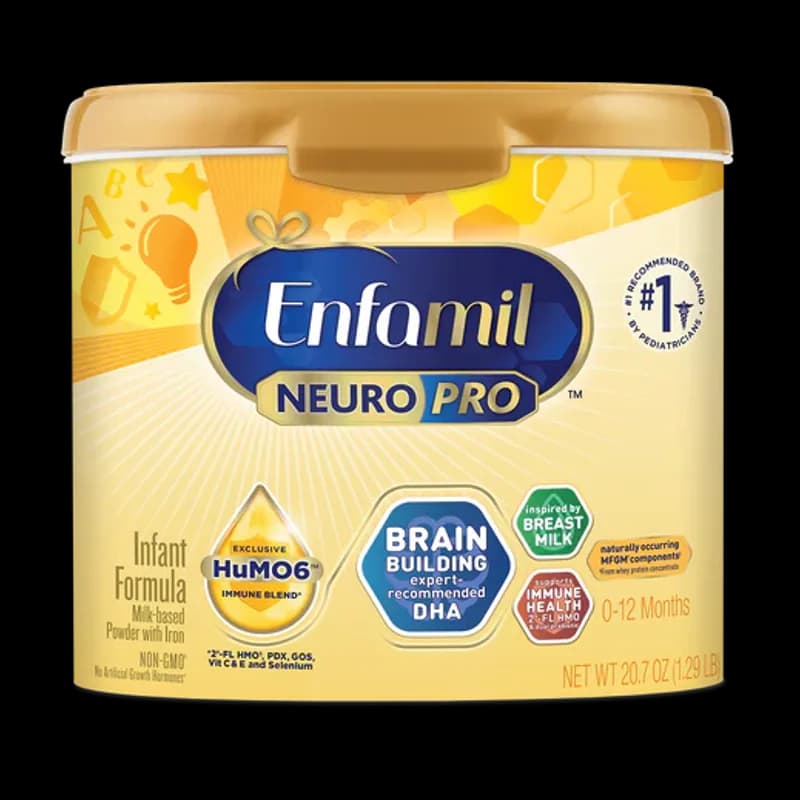
- NeuroPro: Enfamil's flagship standard formula. Lactose first; includes DHA, ARA, and MFGM (milk fat globule membrane), one of the few US brands with MFGM across standard lines. See our MFGM explainer, and Kendamil Classic vs Enfamil NeuroPro for how added MFGM compares with the membrane that arrives with whole milk fat.
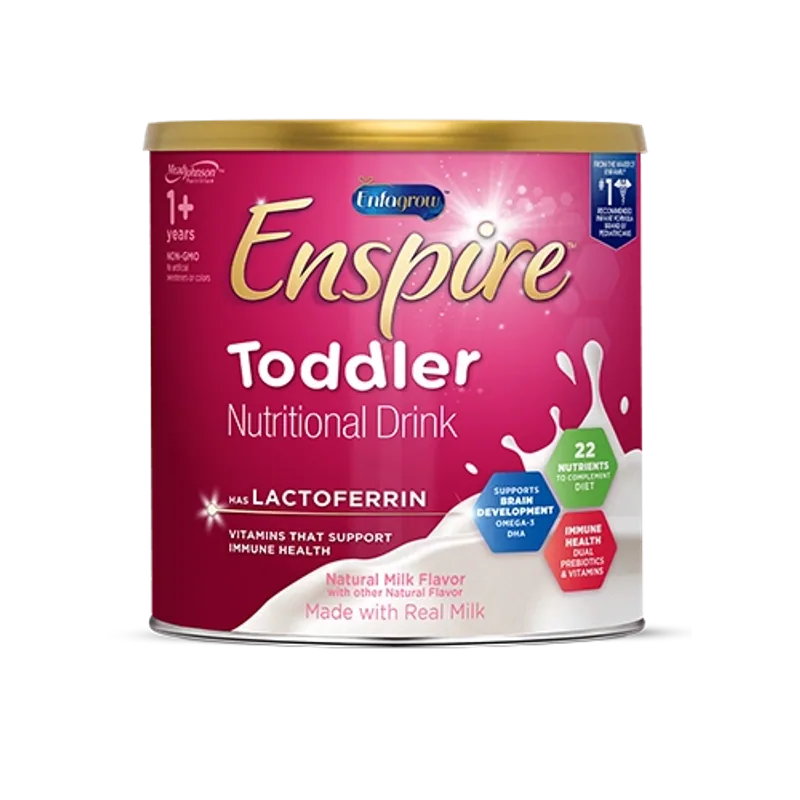
- Enspire, premium-plus Enfamil variant. Adds lactoferrin to NeuroPro's MFGM and DHA/ARA base. See our lactoferrin explainer.
- Gentlease, reduced-lactose, partially hydrolyzed. Uses corn syrup solids as the primary carbohydrate. Marketed for "gas and fussiness in 24 hours." A template example of the US formulation pattern that EU regulation does not permit in Stage 1 infant formula.
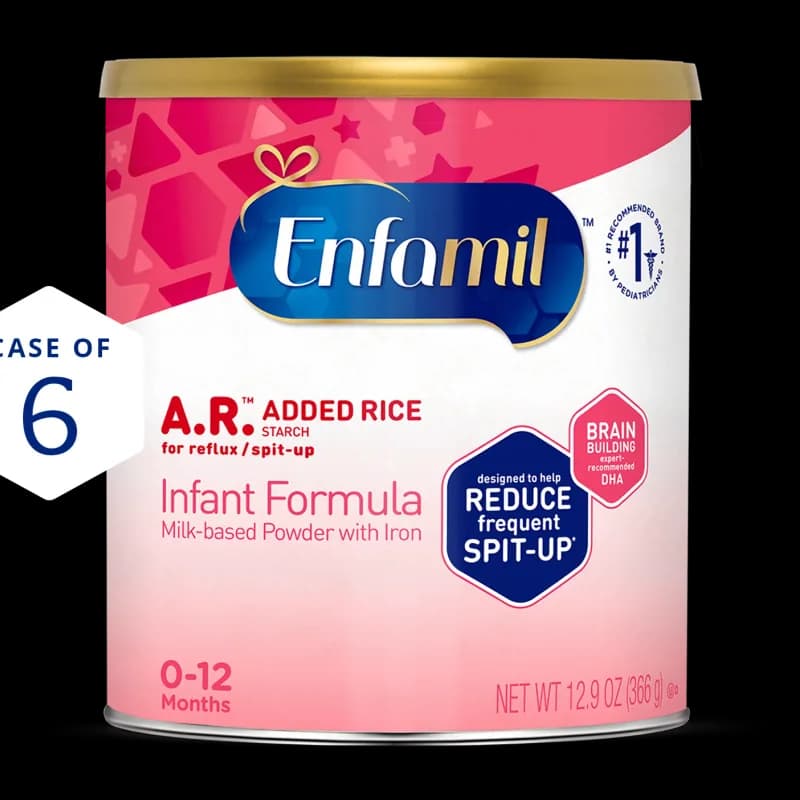
- A.R. (Anti-Reflux), thickened with rice starch to reduce spit-up frequency. See the best formula for reflux guide, or HiPP AR vs Enfamil AR for the EU locust-bean-gum vs US rice-starch head-to-head.
- ProSobee, soy-based for galactosemia or medically indicated soy-preference use.
- Nutramigen, extensively hydrolyzed (eHF) for diagnosed CMPA. Often marketed as standalone brand alongside Enfamil.
- Puramino, amino acid-based formula for severe CMPA or eHF failure.
- Pregestimil, specialized eHF for fat malabsorption.
Which Enfamil for a newborn
Like Similac, Enfamil does not sell a separate "newborn" formula: all ten retail products are labelled 0-12 months, so the choice is which of the ten fits a healthy newborn rather than which stage to buy. The answer is narrower than the shelf suggests.
The default is Enfamil NeuroPro (~$1.88/oz). Lactose first, 2'-FL HMO, a GOS prebiotic, and MFGM carried in via intact whey protein concentrate — the milk fat globule membrane that most US standard lines leave out. See the MFGM explainer.
Two alternatives worth the money in specific cases:
- Enfamil Enspire (~$2.02/oz) adds lactoferrin on top of NeuroPro's MFGM and HMO. Lactoferrin is the iron-binding glycoprotein breast milk carries in quantity and standard formula historically does not. See Enfamil Enspire vs Similac 360 Total Care.
- Enfamil NeuroPro Ready-to-Feed for the first days, or for a preterm or immunocompromised baby. Powder is not sterile and ready-to-feed is, which is why the FDA advises the liquid form for higher-risk infants. Its price per fluid ounce is not comparable to a powder tin's price per ounce of powder.
- Enfamil Simply Organic (~$1.72/oz) if USDA Organic is the requirement.
What not to start a newborn on without a pediatric reason: Gentlease, Sensitive and ProSobee all lead on corn syrup solids instead of lactose, and A.R. is thickened with rice starch for diagnosed reflux. Gentlease in particular is bought for ordinary newborn fussiness far more often than its composition warrants — see Enfamil NeuroPro vs Enfamil Gentlease for what the swap actually changes.
One line-wide fact: every Enfamil formula in this Atlas uses palm olein, which is the opposite of Similac and the reverse of what most parents assume about the two brands.
For quantities, see how much formula should I feed my newborn, and for Enfamil against the rest of the field at this age, best formula for newborns.
How Enfamil compares to Similac and European organic
For a parent weighing Enfamil against alternatives:
- vs Similac. The two US giants are comparable on most axes. Enfamil NeuroPro has MFGM that Similac Pro-Advance does not. Similac 360 Total Care has 5 HMOs vs Enfamil NeuroPro's single HMO source. Pricing is similar. For a parent without a specific medical indication, either is a reasonable choice.
- vs Bobbie. Bobbie is USDA Organic (Enfamil is not), uses lactose-first composition across all lines (Enfamil Gentlease does not), and positions itself as EU-style. Enfamil has wider retail availability, lower price, and a full specialty-medical line that Bobbie does not offer.
- vs European organic (HiPP, Holle, Kendamil). Enfamil NeuroPro is similar in composition intent to European organics (lactose first, added DHA) but: lacks organic certification, uses higher iron (US standard), uses folic acid rather than Metafolin, and has more synthetic-source nutrients overall. For parents specifically wanting organic and European-style formulation, Europeans remain stronger.
- For specialty medical indications, Enfamil's Nutramigen and Puramino are widely prescribed by US pediatricians for diagnosed CMPA. This is a legitimate strength: European hypoallergenic options are available but Enfamil's US-market penetration and physician familiarity make Nutramigen the default recommendation in many US clinical settings.
Our Infant Formula Atlas documents each Enfamil SKU with full nutrition panels alongside the European options for direct comparison.
The corn-syrup-solids issue (Gentlease specifically)
Enfamil Gentlease is the US formula most frequently criticized in European- formula parent communities, and it deserves its own paragraph for clarity.
Gentlease is marketed for "gas and fussiness in 24 hours" through two specific formulation choices:
- Partially hydrolyzed whey protein (easier to digest).
- Corn syrup solids as the primary carbohydrate, replacing most of the lactose.
The second point is legal under US FDA 21 CFR 107 but would fail EU Regulation 2016/127 compliance for standard Stage 1 infant formula, where lactose must be the predominant carbohydrate unless medically justified. The "fussiness reduction" that parents observe on Gentlease is partly from the protein hydrolysis and partly just from lower lactose exposure. For babies with genuine CMPA, an extensively hydrolyzed formula (Nutramigen) is the correct medical option; for most "gassy baby" complaints, the underlying cause isn't lactose intolerance (see our infant lactose intolerance explainer: Phase II).
Gentlease isn't unsafe. It's legal, effective for its marketed use, and widely covered by WIC. But a parent buying it because "it's gentler" often doesn't realize the tradeoff involves swapping lactose for corn syrup solids, and if that matters to you, it's worth knowing. Similar applies to Enfamil A.R., Similac Pro-Sensitive, and Similac Pro-Total Comfort.
Recall history
Enfamil has had several lot-level recalls over the years. Notably:
- Historical routine lot recalls for packaging defects, minor fortification deviations, ongoing across decades, generally handled without infant illness.
- The 2022 Abbott Cronobacter event (see the Similac hub) was NOT at an Enfamil/Reckitt facility. Enfamil production continued through the 2022 shortage and helped fill the market gap.
- 2011 Cronobacter investigation tied to an Enfamil Newborn product resulted in a temporary retail removal, though Enfamil was not ultimately confirmed as the transmission source.
As of April 2026, no broad Enfamil recall is active. Our Atlas changelog tracks ongoing events.
For the premium end of the US market, see Enfamil Enspire vs Similac 360 Total Care.
My take on Enfamil for parents
Enfamil is safe, FDA-registered, widely available, and covered by WIC in most US states. For families without specific dietary or composition priorities, Enfamil NeuroPro is a legitimate choice, particularly for parents who value the MFGM inclusion that most competitor standard lines lack.
For specialty medical needs (CMPA, severe allergy, fat malabsorption), Enfamil's Nutramigen and Puramino lines are the most widely- prescribed US options, and pediatrician familiarity alone makes them a reasonable default when an eHF or amino-acid formula is medically indicated.
Where Enfamil is weaker: the Gentlease and A.R. lines use corn syrup solids primary, which is a genuine composition departure from what most parents would choose informed. Enfamil lacks organic certification. European organics remain stronger on carbohydrate composition cleanliness and on organic sourcing, and Bobbie is the US alternative for parents specifically wanting EU-style composition at US retail.
All Enfamil formulas
Every Enfamil SKU currently documented in the Atlas appears below. Each entry links to the individual product record with verified nutrition per 100 ml, resolved ingredients, certification status, and retail availability. For a side-by-side comparison against other brands, add any of these SKUs to the compare tool; for one-dimension filters (origin, protein, certifications, red flags) start from the Atlas root.
FAQ
Is Enfamil or Similac better?
Which Enfamil formula is the healthiest for my baby?
Is Enfamil safe?
What's the difference between Enfamil NeuroPro and Gentlease?
Why does Enfamil Gentlease use corn syrup solids?
Is Enfamil covered by WIC?
Is Enfamil NeuroPro organic?
When should a baby need Nutramigen?
Sources
- Enfamil corporate: https://www.enfamil.com/
- Reckitt (parent company): https://www.reckitt.com/
- FDA infant formula registration: https://www.fda.gov/food/infant-formula-guidance-documents-regulatory-information
- FDA 21 CFR 107 infant formula regulation: https://www.ecfr.gov/current/title-21/chapter-I/subchapter-B/part-107
- WIC formula rebate contracts: https://www.fns.usda.gov/wic/infant-formula-cost-containment-provisions
Related reading
-
Enfamil Gentlease vs Similac Sensitive - two different answers to the same complaint
-
Head-to-head comparisons, Best baby formulas, Best European baby formulas, Best European baby formulas, Best European baby formulas, and Best baby formulas (clean-label vs big-brand USDA Organic: Enfamil edition)
This site provides research and comparisons, not medical advice. Consult your pediatrician before changing your baby's formula.