
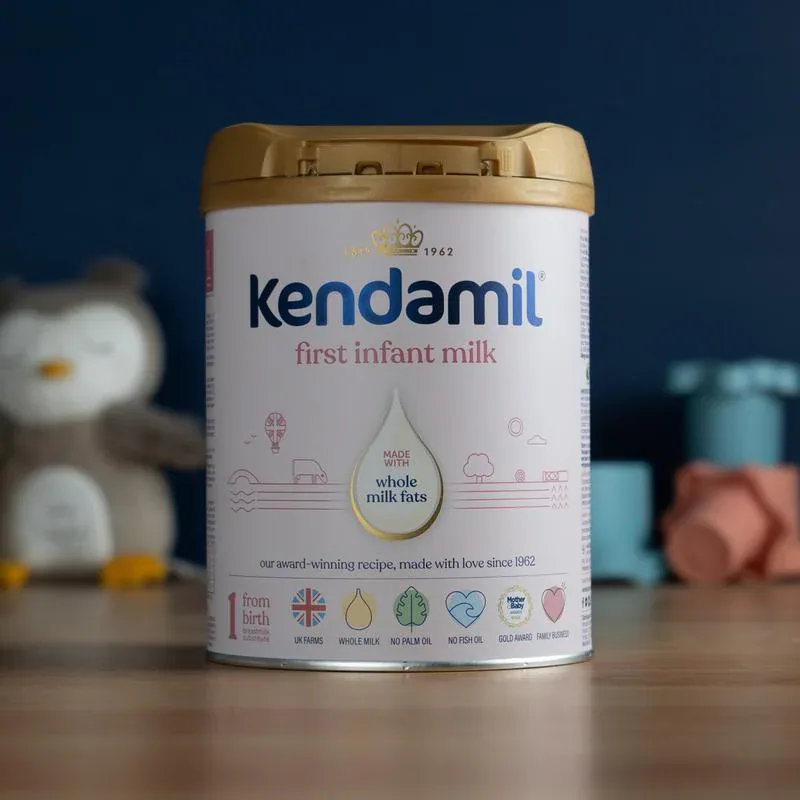
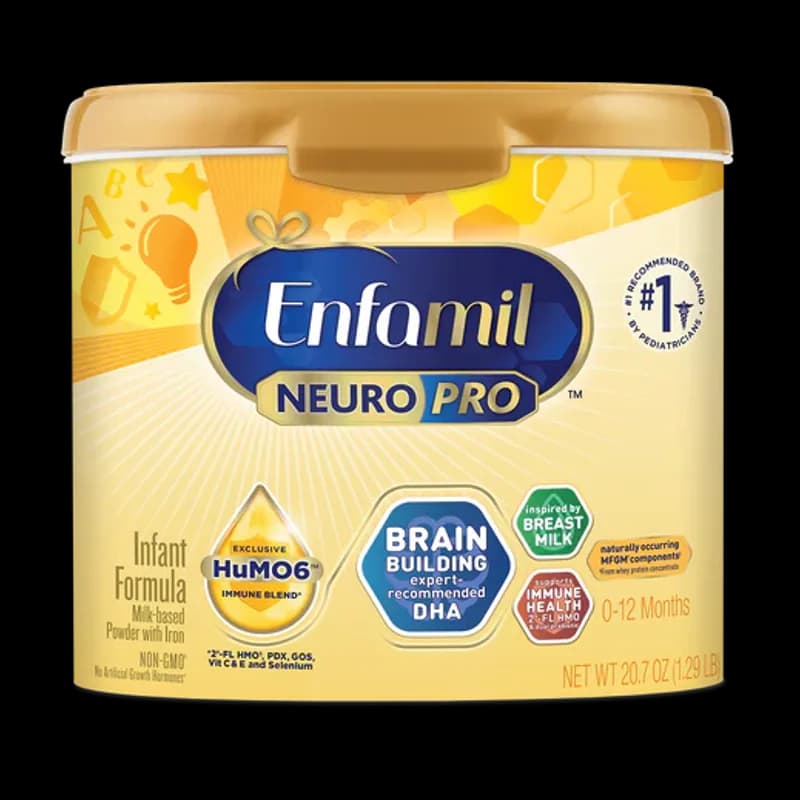
This is the comparison most families actually run: the European whole-milk-fat formula everybody talks about, against the US mainstream one their pediatrician's office has a sample of. They are both lactose-primary Stage 1 formulas for healthy term infants, and that is roughly where the similarity ends.
Kendamil Classic uses whole milk fat with no palm oil, carries 16.1 mg DHA per 100 ml and costs $1.30 an ounce, imported. Enfamil NeuroPro adds 2'-FL HMO and 22.6 mg ARA on a palm-and-soy blend, holds FDA registration and sits on US shelves, at $1.88 an ounce. Fat structure against bioactive breadth.
At a glance
| Kendamil Classic Stage 1 | Enfamil NeuroPro | |
|---|---|---|
| Made in | United Kingdom | United States |
| Regulation | EU 2016/127 compliant, imported under FDA enforcement discretion | FDA 21 CFR 107 registered |
| Protein | Whole cow milk | Skimmed cow milk |
| Primary carbohydrate | Lactose | Lactose |
| Fat | Whole milk fat, no palm oil | Vegetable oil blend with palm oil and soy |
| DHA per 100 ml | 16.1 mg | 11.3 mg |
| ARA per 100 ml | 8 mg | 22.6 mg |
| Protein per 100 ml | 1.3 g | 1.41 g |
| Iron per 100 ml | 0.66 mg | 1.2 mg |
| Prebiotic | GOS and FOS | GOS |
| HMO | – | 2'-FL |
| Certifications | UK Red Tractor, Vegetarian Society | FDA registration |
| Typical price | ~$36.79 per tin, $1.30/oz | ~$38.99 per tin, $1.88/oz |
Typical US retail price, normalised to USD per ounce of powder. Imported European formulas carry shipping and importer margin; US retail brands are typically cheapest per ounce. Subscribe-and-save and private-label pricing can shift the ranking.
Data table
| Formula | Price per ounce |
|---|---|
| Kendamil Classic Stage 1 | $1.30 |
| Enfamil NeuroPro | $1.88 |
The price surprise, first
The imported formula is the cheaper one per ounce. Kendamil Classic runs about $1.30 an ounce against Enfamil NeuroPro's $1.88, and the reason the shelf feels otherwise is tin size: Kendamil sells an 800 g tin at around $36.79 while Enfamil sells a smaller tub at around $38.99. The bigger number on the price tag buys more formula.
This inverts the usual assumption that European import means paying a premium, and it is worth checking before the decision gets made on the sticker alone. What the import does cost is time: 5 to 10 days of shipping and a buffer at home, covered in the import pillar.
Compositional differences that actually matter
1. The fat, which is the real difference
Kendamil builds its fat from whole cow milk rather than removing the milk fat and replacing it with a vegetable oil blend. That keeps the milk fat globule membrane and a fat structure closer to breast milk, and it is why the formula contains no palm oil at all: the palmitic acid the blend would otherwise need is already in the milk.
Enfamil NeuroPro takes the conventional route, a vegetable oil blend including palm oil and soy. That is not a red flag for a healthy term infant, and it is what most of the world's formula does. It is a different construction, and it is the axis on which these two products genuinely diverge. See whole milk fat for what the membrane carries.
2. DHA and ARA, in opposite directions
Kendamil carries 16.1 mg DHA per 100 ml against NeuroPro's 11.3 — a consequence of EU 2016/127 making DHA mandatory at 20 to 50 mg per 100 kcal, which the FDA does not.
ARA runs the other way, and by more: NeuroPro has 22.6 mg per 100 ml against Kendamil's 8. EU rules require ARA at a level no lower than the DHA content, which Kendamil meets by a margin of roughly half; US brands set their own ratio and Enfamil has historically run ARA high. Neither is out of range, and the pair matters more than either alone. See ARA.
3. Iron, where the regulators disagree
NeuroPro carries 1.2 mg iron per 100 ml, Kendamil 0.66. This is the single most-misread difference between EU and US formulas, and it is not a quality gap: the FDA sets a higher floor on the reasoning that US infant iron deficiency has historically been more common, while EFSA argues that the US level exceeds what a breastfed infant receives. Both are adequate for a healthy term infant. The iron explainer covers why formula is fortified above breast milk at all.
4. The bioactive layer
NeuroPro adds 2'-FL HMO, a direct copy of the most abundant human milk oligosaccharide, on top of a GOS prebiotic. Kendamil pairs GOS with FOS instead and carries no HMO.
Neither approach is clearly superior. 2'-FL selectively feeds HMO specialists such as B. infantis; GOS with FOS feeds a broader set of Bifidobacterium species across more of the colon. See 2'-FL HMO.
5. Protein source and amount
Both are cow milk and both are intact, so neither suits a diagnosed cow milk protein allergy. NeuroPro uses skimmed cow milk at 1.41 g protein per 100 ml; Kendamil uses whole cow milk at 1.3 g. The gap is small and both sit inside their respective regulatory bands.
Regulatory framework
NeuroPro is FDA-registered under 21 CFR Part 107, which means a pre-market notification, composition review and facility inspection under FSMA. Kendamil Classic is made to EU 2016/127 and reaches US families under FDA enforcement discretion: legal to buy for your own child, not the same thing as FDA registration.
The practical consequences are supply and recourse rather than safety. An FDA-registered formula is on the shelf today and covered by the FDA's recall machinery directly. An imported one depends on a reseller and a shipping window. See FDA vs EFSA standards for what each framework is stricter about.
Verdict: when to pick each
Pick Kendamil Classic if:
- Whole milk fat and a palm-free blend are the priority
- You want the higher DHA figure that EU rules guarantee
- You can absorb a 5 to 10 day shipping window and keep a buffer
- Lower cost per ounce matters more than lower cost per tin
Pick Enfamil NeuroPro if:
- 2'-FL HMO is on your list
- You want an FDA-registered formula you can replace the same afternoon
- Supply resilience outweighs fat structure
- Your pediatrician has recommended it specifically
Either is reasonable if you have a healthy term infant, no diagnosed allergy, and no strong preference on fat construction. Both are lactose-primary, which already puts them ahead of the reduced-lactose tier on the axis that matters most for a healthy baby.
What you can't infer from this comparison
Neither formula is appropriate for a diagnosed cow milk protein allergy: both use intact cow milk protein, and CMPA needs an extensively hydrolysed or amino acid formula under pediatric direction. Neither is an anti-reflux formula. Neither is organic — Kendamil Classic carries Red Tractor, which covers welfare and traceability but is not an organic certification, and if organic matters the comparison you want is Kendamil Classic vs Kendamil Organic.
Prices move. The figures here carry the verification date on each linked SKU record.
Frequently asked questions
Is Kendamil better than Enfamil?
Why is Kendamil cheaper per ounce than Enfamil?
Does Enfamil NeuroPro have more iron than Kendamil?
Can I switch between Kendamil and Enfamil?
Is Kendamil FDA approved?
Which one has HMO?
Related reading
- FDA vs EFSA standards
- Buying European formula in the US
- Whole milk fat
- 2'-FL HMO
- Iron in infant formula
- Kendamil brand hub
- Enfamil brand hub
Primary sources
- EU Commission Delegated Regulation 2016/127, the composition rules Kendamil Classic is made to, including the mandatory DHA range and the iron band. eur-lex.europa.eu
- FDA 21 CFR Part 107, the registration Enfamil NeuroPro holds and the nutrient minimums it is built against. ecfr.gov
- FDA infant formula guidance, including the enforcement discretion pathway that makes personal import lawful. fda.gov
This site provides research and comparisons, not medical advice. Consult your pediatrician before changing your baby's formula.