
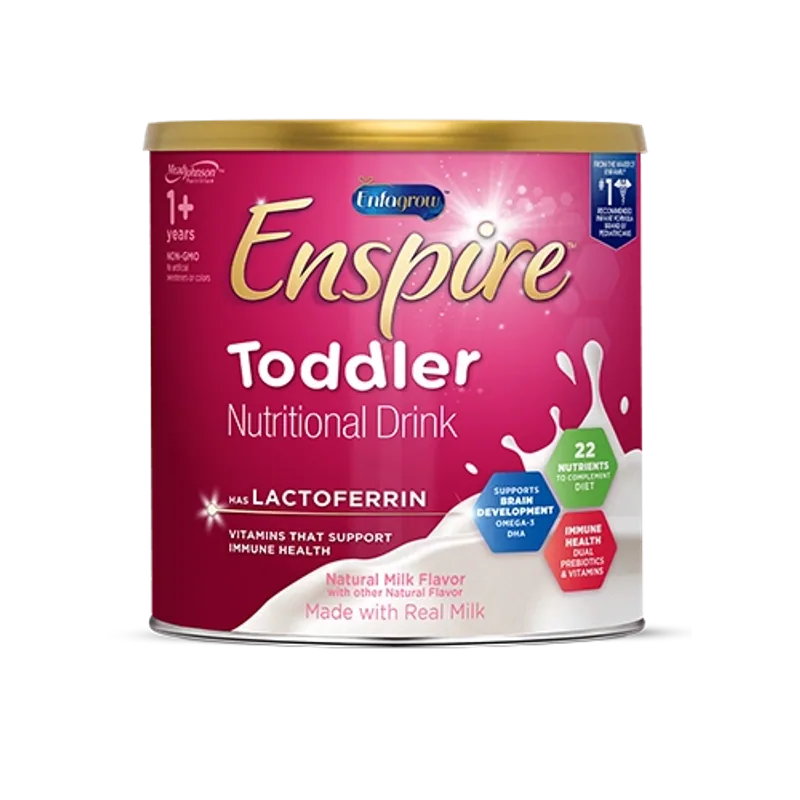
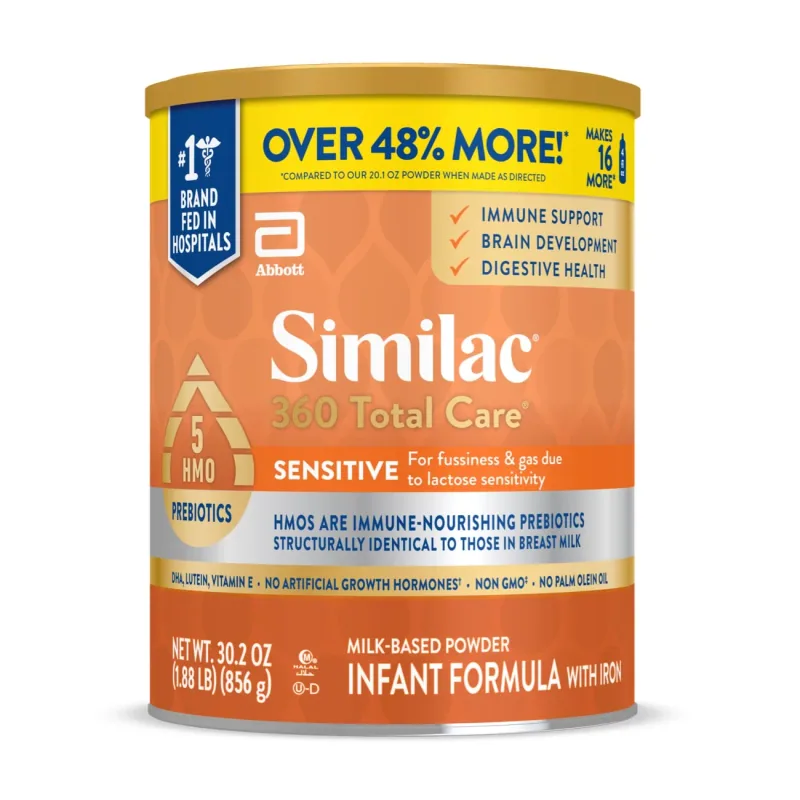
Same carbohydrate, same protein ratio, same fat archetype: the bioactive layer is where these separate. Enspire stacks MFGM, bovine lactoferrin, 2'-FL HMO and around 17 mg DHA per 100 ml, the highest in US mainstream, at ~$2.02/oz. Similac 360 Total Care stacks five HMOs with around 11 mg DHA at ~$1.91/oz. Depth against breadth.
Enfamil Enspire and Similac 360 Total Care are the top-tier bioactive flagships of the US mainstream two biggest companies, the SKUs each brand holds up as "this is the best we make." Both include 2'-FL HMO, both are lactose-first, both 60:40 whey:casein, both soy-inclusive, and they sit within ~$0.11/oz of each other. They diverge on which bioactive thesis Reckitt vs Abbott is betting on: Enspire goes deep on a single-SKU stack (MFGM, lactoferrin, and highest US DHA); 360 Total Care goes wide on HMO diversity (5 different human milk oligosaccharides).
At a glance
| Dimension | Enfamil Enspire | Similac 360 Total Care |
|---|---|---|
| Manufacturer | Reckitt / Mead Johnson Nutrition | Abbott Nutrition |
| Regulation | FDA 21 CFR 107 | FDA 21 CFR 107 |
| Protein | Skimmed cow milk and whey | Skimmed cow milk and whey |
| Whey:casein | 60:40 | 60:40 |
| Primary carbohydrate | Lactose (primary) | Lactose (primary) |
| Prebiotic | None | None |
| HMO | 2'-FL HMO (single) | 5-HMO blend (2'-FL, 3-FL, LNT, 3'-SL, 6'-SL) |
| Lactoferrin | Yes (bovine) | None |
| MFGM | Yes | None |
| DHA source | Fish oil, ~17 mg/100 ml (highest US) | Fish oil, ~11 mg/100 ml |
| ARA | Yes | Yes |
| Fat blend | Palm olein, soy, coconut, and high-oleic sunflower | High-oleic safflower, soy, coconut (no palm) |
| Fat-blend notes | Palm oil, soy | Soy |
| Format | 20 oz tin | 30.8 oz can |
| Typical price | ||
| US availability | Broad US retail | Broad US retail |
Typical US retail price, normalised to USD per ounce of powder. Imported European formulas carry shipping and importer margin; US retail brands are typically cheapest per ounce. Subscribe-and-save and private-label pricing can shift the ranking.
Data table
| Formula | Price per ounce |
|---|---|
| Enfamil Enspire | $2.02 |
| Similac 360 Total Care | $1.91 |
Why this comparison matters
For a US parent shopping the absolute top end of mainstream retail, not interested in organic, not importing from Europe, choosing within the Enfamil vs Similac two biggest companies: Enspire vs 360 Total Care is the real decision. NeuroPro and Pro-Advance are the "mid-premium" tier; Enspire and 360 Total Care are the "bring-everything" tier. Within that tier, the question is: do you want maximum bioactive depth in one SKU (Reckitt's thesis), or maximum HMO diversity (Abbott's thesis)? This comparison answers that directly.
Compositional differences that actually matter
1. HMO strategy: one deep vs five wide
Enfamil Enspire includes 2'-FL HMO, a single human milk oligosaccharide, and the most-studied of any commercially available HMO. 2'-FL is the most abundant HMO in breast milk of "secretor" mothers (~80% of women globally) and has the strongest published evidence base of any single HMO ingredient.
Similac 360 Total Care includes five HMOs in blend: 2'-FL, 3-FL, LNT (lacto-N-tetraose), 3'-SL (3'-sialyllactose), and 6'-SL (6'-sialyllactose). This was the first 5-HMO blend on the US market (launched 2022). The thesis: breast milk contains 150 and HMOs with different structural roles, a blend of 5 structurally diverse HMOs approximates breast-milk HMO diversity better than a single HMO.
Trade-off: Enspire has more 2'-FL by weight (single-HMO concentration typically higher than per-HMO in a blend); 360 Total Care has more HMO diversity. Neither approach is definitively "correct", the clinical evidence for multi-HMO blends over single 2'-FL at equivalent total HMO mass is still emerging. See our 2'-FL HMO explainer.
2. MFGM and lactoferrin: Enspire only
Enspire is one of very few US formulas combining MFGM and bovine lactoferrin in a single SKU. MFGM is the milk fat globule membrane (a lipid-protein complex with ~150 proteins and phospholipids); lactoferrin is the iron-binding protein native to breast milk. Both have research support for specific infant-outcome markers.
Similac 360 Total Care includes neither MFGM nor lactoferrin. Abbott's 360 line has not incorporated these bioactives in current formulation. For MFGM and lactoferrin combined in a Similac product: not available in the mainstream premium line currently.
This is the single largest compositional gap between the two. Parents weighting MFGM and lactoferrin as research-backed additions at US mainstream retail should lean Enspire. See the MFGM explainer and lactoferrin explainer.
3. DHA level: Enspire's ~50% higher
Enspire supplies ~17 mg DHA / 100 ml, the highest among US mainstream premium formulas. 360 Total Care supplies ~11 mg DHA / 100 ml, which is the standard US mainstream level shared by NeuroPro, Pro-Advance, Sensitive, and most other mainstream SKUs.
Enspire's ~50% higher DHA is a deliberate Reckitt design choice and sits in the upper range of breast-milk DHA concentration (breast-milk DHA varies widely by maternal diet: 0.1, 1.0% of total fat). For parents valuing DHA density: Enspire leads the US mainstream tier. Note: FDA permits but does not require DHA; all formulas adding DHA meet adequate levels for infant development.
4. Same carbohydrate and protein, different fat
Both use lactose as primary carbohydrate, no corn syrup solids, no maltodextrin. Both use 60:40 whey:casein (unlike Pro-Advance's atypical 48:52).
The fat is where they part. Enspire uses palm olein; 360 Total Care does not, building its blend from high oleic safflower, soy and coconut oil. The only palm-derived entry on the Similac label is vitamin A palmitate, a vitamin ester rather than a fat.
That is not a small footnote. Every Similac formula in this Atlas is palm-free, and every Enfamil formula here uses palm olein, so the brand-level shortcut runs the opposite way to the one most parents assume. Both still use soy oil, and neither replaces the palm with milk fat, so 360 Total Care carries little palmitic acid in any form. See palm oil.
5. Price per ounce: modest gap, meaningful over time
Enspire ~$2.02/oz. 360 Total Care ~$1.91/oz. ~6% price difference, much smaller than Enspire vs Pro-Advance's ~34% gap. On 100-oz/week feeding, the Enspire premium is ~$11/week or ~$48/month, a noticeable but not decisive cost difference.
The Enspire premium reflects MFGM, lactoferrin, and higher DHA. The 360 Total Care price reflects the multi-HMO ingredient cost (five HMOs is expensive sourcing). Both are priced at the upper end of US mainstream.
6. Format: 20 oz tin vs 30.8 oz can
Enspire ships in a smaller 20 oz tin; 360 Total Care in a larger 30.8 oz can. For steady-state monthly purchasing, 360 Total Care's larger can reduces package-handling frequency and (for families buying in bulk) often yields a slightly better unit price.
7. Recall history
Enspire (Reckitt): no active recall specific to Enspire. Reckitt had historical lot-level recalls across the Enfamil family but no broad facility-level event comparable to Abbott's 2022.
360 Total Care (Abbott): the 2022 Cronobacter recall affected non-organic Similac lines at Sturgis, Michigan. Similac 360 Total Care (then very recently launched) was among the affected SKUs at that time. Abbott has since remediated Sturgis and resumed production. No active recall on current 360 Total Care stock. Many families recall the 2022 event when choosing between Reckitt and Abbott flagships; that's legitimate context but shouldn't dominate, both manufacturers are FDA-inspected and FSMA-compliant today. See our US formula recall history.
Regulatory framework
Both are FDA-registered under 21 CFR Part 107, both US-domestic manufacturing, both benefit from FSMA recall authority. Neither is USDA Organic. Nutritional adequacy sits well above FDA minimums for both.
Real-world parent experience
Following site methodology, the observations below come from my personal use across both kids plus a stable pool of parent-feedback notes from families. They carry the parent-experience label rather than being claimed as regulatory or clinical facts, because individual infant variation on stool, smell, and mixability is large enough that any specific point can reverse for a specific baby.
Smell and taste. Enspire has a noticeably richer, creamier profile, the higher DHA and MFGM lipid contribution is palpable. 360 Total Care is cleaner and slightly sweeter (the 5-HMO blend adds sweetness). Most infants accept either; the minority who reject one typically accept the other.
Mixability. Both dissolve cleanly at 70°C. Enspire's smaller 20 oz tin is easier to handle one-handed; 360 Total Care's 30.8 oz can is better for families buying fewer units per month.
Stool consistency. Enspire families often report moderately firm, well-formed stools (palm-inclusive fat firms stool, though lactoferrin can occasionally soften it). 360 Total Care families report softer-leaning stools (the multi-HMO blend, particularly 3'-SL and 6'-SL, has prebiotic effects that soften stool, a common first-week adjustment). Neither is concerning without other symptoms.
Switching between them. Both are lactose-primary with 60:40 whey, so the protein and carbohydrate base is interchangeable; the fat is not, since Enspire uses palm olein and 360 Total Care does not. Multiple simultaneous changes in the bioactive layer: HMO profile (single 2'-FL ↔ 5-HMO blend), MFGM and lactoferrin add/remove, DHA level shift (~17 → ~11 mg or vice versa). Use a 4-6 day gradual transition. Going from Enspire → 360 Total Care: expect softer stool for 1-2 weeks as the multi-HMO blend settles in. Going 360 → Enspire: expect slight stool firming and richer smell; some babies take a feed or two to accept the creamier profile.
Verdict: when to pick each
Pick Enfamil Enspire if:
- MFGM and lactoferrin matter (unique US single-SKU combination at mainstream premium tier)
- Highest US DHA level (~17 mg/100 ml) matters for your family
- You weight single-HMO depth (2'-FL, most-studied) over multi-HMO breadth
- ~6% price premium vs 360 Total Care is acceptable
- Smaller 20 oz tin format is preferred
Pick Similac 360 Total Care if:
- 5-HMO breadth (2'-FL and 3-FL and LNT and 3'-SL and 6'-SL) matters, only US mainstream SKU with this diversity
- 2'-FL alone feels insufficient bioactive depth
- MFGM and lactoferrin absence is acceptable (standard for most US mainstream SKUs)
- Standard US DHA level (~11 mg/100 ml) is sufficient
- Larger 30.8 oz can format is preferred (fewer purchase cycles)
- Slightly lower per-oz price is appealing
Pick neither if:
- You want USDA Organic, consider Bobbie Original (USDA Organic, palm-free, no soy, lactose-only — but no bioactives at all)
- You want EU Organic and whole-milk fat, consider Kendamil Organic Stage 1 (whole-milk fat, palm-free, Red Tractor)
- You want EU Combiotik (GOS and probiotics), consider HiPP Dutch Stage 1
What you can't infer from this comparison
Both are safe, FDA-registered US mainstream premium formulas with substantial bioactive presence. The "more HMOs" vs "deeper bioactive stack" framing is genuinely undecided in the published evidence, no head-to-head clinical trial has compared Enspire and 360 Total Care directly on infant outcomes, and the magnitude of any difference benefit from single-2'-FL vs 5-HMO blend at equivalent use is not established. Neither formula is indicated for diagnosed CMPA. Enspire's higher DHA level is a real compositional difference but clinical outcome differences between 11 mg and 17 mg DHA at US doses are not definitively established either.
Frequently asked questions
Is Enfamil Enspire or Similac 360 Total Care better?
Does Similac 360 Total Care have MFGM or lactoferrin?
Is a 5-HMO blend better than a single 2'-FL HMO?
Which has more DHA: Enspire or 360 Total Care?
Are either of these palm-free?
Was Similac 360 Total Care affected by the 2022 Abbott recall?
Can I switch between Enspire and 360 Total Care?
Why is Enspire more expensive than 360 Total Care?
Related reading
- Enfamil brand hub
- Similac brand hub
- Best baby formulas, the mid-premium mainstream-flagship comparison
- MFGM explainer
- Lactoferrin explainer
- 2'-FL HMO explainer
Primary sources
- Enfamil / Reckitt (Mead Johnson), manufacturer product information. enfamil.com
- Similac / Abbott Nutrition, manufacturer product information. similac.com
- FDA 21 CFR Part 107. US infant formula regulation. ecfr.gov
- EFSA Scientific Opinion on compositional requirements for infant formula. efsa.europa.eu
This site provides research and comparisons, not medical advice. Consult your pediatrician before changing your baby's formula.