
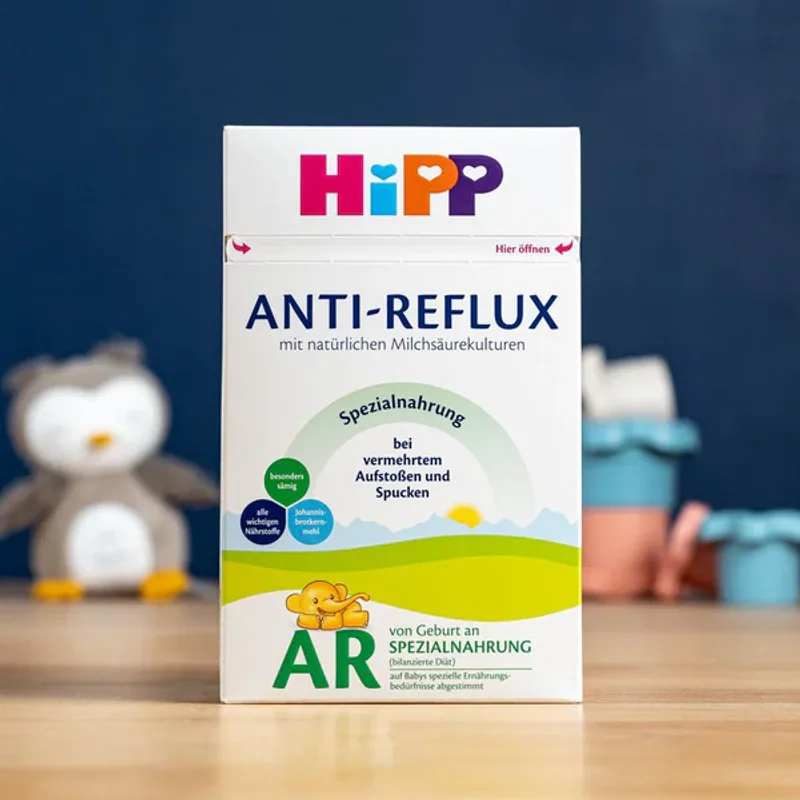
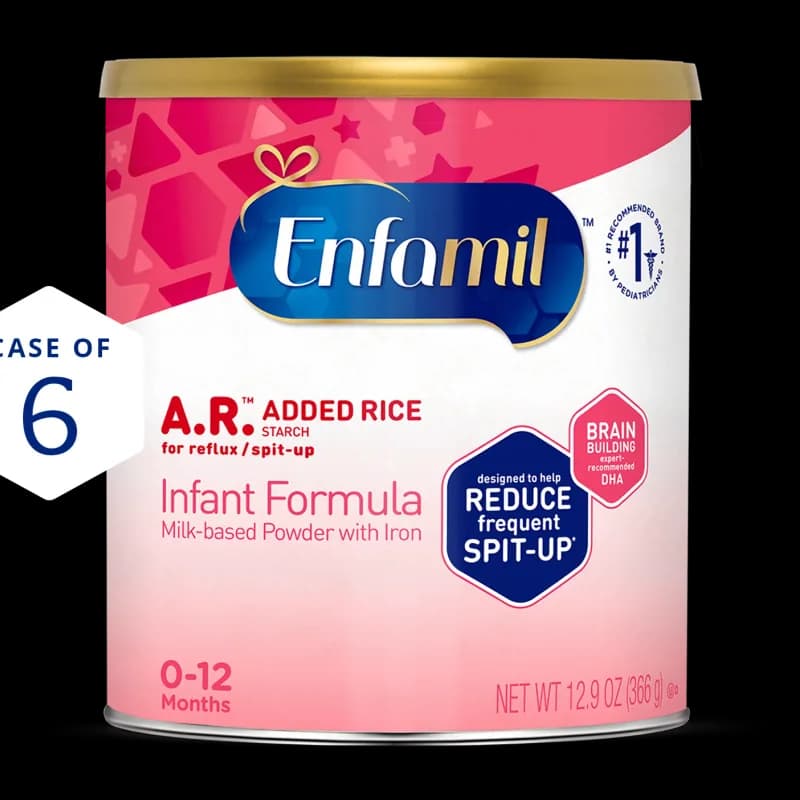
HiPP AR: locust-bean-gum thickener, lactose-primary, no soy, DHA 14 mg, iron 0.6 mg, EU composition, personal import at ~$2.03/oz. Enfamil A.R.: rice-starch thickener, lactose-primary, palm and soy, DHA 11 mg, iron 1.2 mg, FDA-registered US retail at ~$1.86/oz. Same non-hydrolyzed protein, neither is a CMPA formula. Pediatrician consultation comes before any anti-reflux switch.
HiPP AR Stage 1 and Enfamil A.R. are the two anti-reflux (AR) formulas a US parent is most likely to weigh against each other, the leading European import and the leading FDA-registered US-retail option. Both target the same mechanical problem (visible spit-up from gastroesophageal reflux) with the same strategy: a thickener that stays thin enough to drink from the bottle and firms up once it reaches the stomach. Where they differ is the thickener itself, locust bean gum in HiPP AR versus rice starch in Enfamil A.R., and everything that follows from being an EU product bought by personal import versus a US product on the shelf at Target.
Neither is a hydrolyzed or hypoallergenic formula. Both use standard, non-hydrolyzed cow-milk protein, so neither is appropriate for diagnosed cow milk protein allergy (CMPA), a distinction that matters because reflux and CMPA symptoms overlap.
At a glance
| Dimension | HiPP AR Stage 1 | Enfamil A.R. |
|---|---|---|
| Manufacturer | HiPP (Germany) | Reckitt / Mead Johnson (US) |
| Regulation | EU 2016/127 (special medical purpose); personal import to US | FDA 21 CFR 107 (US-registered) |
| Thickener | Locust bean gum (carob) | Rice starch |
| Protein | Standard cow-milk, not hydrolyzed | Standard cow-milk, not hydrolyzed |
| Whey:casein | 60:40 | 60:40 |
| Primary carbohydrate | Lactose | Lactose |
| Secondary carbohydrate | Glucose syrup | Rice starch |
| Corn syrup solids | No | No |
| Prebiotic (GOS/FOS) | None | None |
| Probiotic | None | None |
| Iron | 0.6 mg/100 ml (EU standard) | 1.2 mg/100 ml (US standard) |
| DHA | 14 mg/100 ml (fish oil) + ARA | 11 mg/100 ml (fish oil) + ARA |
| Fat blend | Palm (RSPO), rapeseed, sunflower, coconut, no soy | Palm, soy, coconut, safflower |
| Organic | No (German Bio for some components only) | No |
| Format | 600 g carton | ~595 g (21 oz) can |
| Typical price | ||
| US availability | Personal import (Organic's Best), 5, 10 day ship | Broad US retail (Walmart, Target, CVS, Amazon) |
| Insurance / WIC | Not applicable (import) | Possible with pediatric documentation; WIC varies by state |
Typical US retail price, normalised to USD per ounce of powder. Imported European formulas carry shipping and importer margin; US retail brands are typically cheapest per ounce. Subscribe-and-save and private-label pricing can shift the ranking.
Data table
| Formula | Price per ounce |
|---|---|
| HiPP AR Stage 1 | $2.03 |
| Enfamil A.R. | $1.86 |
Why this comparison matters
"Anti-reflux formula" is a high-intent search because a spitting-up baby is one of the most common reasons a parent goes looking for a specific formula. The trap is that most infant spit-up is physiologic reflux, normal, self-resolving, and better managed first with positioning and smaller, more-frequent feeds than with any formula switch (see our best formula for reflux guide and the reflux formula pillar). When an AR formula genuinely is warranted, the practical choice usually comes down to these two: the EU locust-bean-gum approach or the US rice-starch approach. Understanding how the two thickeners behave, and the availability, price, and composition trade-offs attached to each, is the point of this comparison.
Compositional differences that actually matter
1. The thickener: locust bean gum vs rice starch
This is the defining difference. HiPP AR uses locust bean gum (carob bean gum, E410), a plant polysaccharide that stays only mildly viscous at the neutral pH of the prepared bottle, then aggregates into a soft gel when it hits stomach acid (pH below ~4). The thickening happens mostly in the stomach, which is why locust bean gum is often described as gentler on nipple flow. See our locust bean gum explainer for the mechanism.
Enfamil A.R. uses rice starch. Rice starch thickens partly in the bottle as well as in the stomach, so Enfamil A.R. tends to feel thicker at the nipple and often needs a faster-flow nipple. Rice starch is the long-standing FDA-registered US approach and has a broad clinical track record for reducing visible regurgitation. See our rice starch explainer for the mechanism.
Both reduce visible spit-up meaningfully (clinical trials typically show 30, 50% fewer regurgitation episodes) rather than eliminating it, and neither treats the underlying reflux, infant reflux is developmental and largely resolves on its own between 6 and 12 months.
2. Carbohydrate base: both lactose-primary
A point in both formulas' favor: unlike the US "gentle / sensitive" category (Enfamil Gentlease, Similac Pro-Total Comfort), neither AR formula replaces lactose with corn syrup solids. Both keep lactose as the primary carbohydrate. HiPP AR's secondary carbohydrate is glucose syrup; Enfamil A.R.'s is the rice starch that also does the thickening. For parents who specifically want to avoid corn-syrup-primary composition, both AR options are cleaner than the mainstream "gentle" SKUs they are often cross-shopped against.
3. Protein: identical archetype, and neither is for CMPA
Both use standard, non-hydrolyzed cow-milk protein at a 60:40 whey:casein ratio. The anti-reflux effect comes entirely from the thickener, not from protein modification. This matters clinically: neither HiPP AR nor Enfamil A.R. is appropriate for diagnosed CMPA. Reflux is a common symptom of CMPA, so a baby whose "reflux" is actually a cow-milk-protein reaction will not improve on a thickened standard-protein formula. If CMPA is suspected, the pathway is an extensively hydrolyzed (eHF) or amino-acid formula, see our best formula for CMPA guide, not either of these.
4. Fat blend, iron, and DHA
Fat blend. HiPP AR uses RSPO-certified palm oil with rapeseed, sunflower, and coconut, and contains no soy oil. Enfamil A.R. uses palm, soy, coconut, and safflower. For families avoiding soy oil, HiPP AR is the cleaner blend; neither is palm-free.
Iron. Enfamil A.R. carries the higher US-standard iron level (1.2 mg/100 ml) versus HiPP AR's EU-standard 0.6 mg/100 ml. Both meet their respective regulatory requirements; the US fortifies iron more aggressively than the EU.
DHA. HiPP AR provides slightly more DHA (14 vs 11 mg/100 ml), both from fish oil, both with fungal ARA. Neither includes a GOS/FOS prebiotic or a probiotic, the AR variants strip back the bioactive extras that the standard Combiotik and NeuroPro lines carry, to keep the focus on the thickener.
5. Price and availability
Enfamil A.R. is both cheaper and far more accessible: ~$1.86/oz on the shelf at essentially every US retailer, same-day. HiPP AR is ~$2.03/oz and arrives by personal import through Organic's Best, typically 5, 10 days from EU warehouses. For a formula you may only need for a few months, the import lead time and premium are the main practical cost of the EU option.
Regulatory framework: FDA-registered vs personal import
Enfamil A.R. is fully FDA-registered under 21 CFR Part 107, which means US retail distribution, the possibility of insurance reimbursement with pediatric documentation of reflux/GERD, and variable WIC coverage.
HiPP AR is not FDA-registered. It is imported for personal use under FDA enforcement discretion, legal for a parent to buy and import, but not stocked by US retailers, not WIC-eligible, and not insurance-billable. It also is not an organic product: HiPP applies German Bio standards only to some components of the AR variant, unlike the fully EU-Organic standard HiPP Combiotik line. If "EU Organic" is the reason you are looking at HiPP, the AR variant is not it.
Practical considerations for AR feeding
Anti-reflux formulas behave differently in the bottle than standard formula, and the two thickeners behave differently from each other:
- Nipple flow. Rice-starch Enfamil A.R. is more viscous at the nipple and usually needs a medium- or fast-flow (or AR-specific) nipple; a slow-flow nipple frustrates the baby and increases air swallowing. Locust-bean-gum HiPP AR stays thinner in the bottle, so nipple-flow issues are milder, but still check the manufacturer's nipple guidance.
- Preparation window. Both thicken over time once mixed; prepare and use within about 30 minutes rather than batch-preparing for the day, or store cold-prepared bottles and use within the day.
- Constipation. Thickeners can slow gut transit; new or worsening constipation is a reason to check back with the pediatrician rather than push on.
- Expect improvement, not elimination. Continued small-volume spit-up on either formula is normal and not a sign of failure.
Verdict: when to pick each
Pick HiPP AR Stage 1 if:
- You prefer the locust-bean-gum approach (pH-activated thickening, gentler on nipple flow)
- You want lactose-primary, soy-free EU composition and slightly higher DHA
- Import lead time (5, 10 days) and the ~$2.03/oz price are acceptable
- You are already importing EU formula and want to stay in that supply chain
Pick Enfamil A.R. if:
- You want an FDA-registered formula available today at US retail
- Insurance or WIC pathways matter (with pediatric documentation)
- Lower price (~$1.86/oz) and higher iron fortification are priorities
- Rice-starch thickening and a faster-flow nipple are acceptable
Pick neither if:
- Your baby is a "happy spitter", thriving and gaining weight despite spit-up. Lifestyle measures come first; see the best formula for reflux guide.
- CMPA is suspected (reflux plus blood/mucus stool, eczema, poor weight gain), you need an eHF, not a thickened standard formula. See best formula for CMPA.
What you can't infer from this comparison
Both are safe, compositionally sound anti-reflux formulas that do what they are designed to do: reduce visible regurgitation via a thickener. Head-to-head clinical evidence showing that locust bean gum outperforms rice starch (or vice versa) on hard outcomes is not established, the choice is driven by availability, price, composition preference, and nipple-flow tolerance, not by a proven clinical superiority of one thickener. And neither addresses GERD complications or CMPA, both of which warrant pediatric evaluation rather than a self-directed formula switch.
Frequently asked questions
Is HiPP AR or Enfamil A.R. better for reflux?
What is the difference between locust bean gum and rice starch in anti-reflux formula?
Is either HiPP AR or Enfamil A.R. safe for a baby with CMPA?
Is HiPP AR organic?
Why is Enfamil A.R. cheaper and easier to get than HiPP AR?
Do I need a special nipple for these anti-reflux formulas?
How long should my baby stay on an anti-reflux formula?
Related reading
- Best baby formula for reflux
- Locust bean gum ingredient explainer
- Reflux formula babies pillar
- Colic and formula choice
- Best baby formula for CMPA
- HiPP brand hub
- Enfamil brand hub
Primary sources
- Enfamil / Reckitt (Mead Johnson), manufacturer product information for Enfamil A.R. enfamil.com
- HiPP GmbH, manufacturer information for the HiPP AR line. hipp.de
- FDA 21 CFR Part 107. US infant formula regulation. ecfr.gov
- EU Regulation 2016/127. EU compositional requirements for infant formula (permits locust bean gum in specialty AR formulas). eur-lex.europa.eu
- AAP Clinical Report on Pediatric Gastroesophageal Reflux. publications.aap.org
This site provides research and comparisons, not medical advice. Consult your pediatrician before changing your baby's formula.
This site provides research and comparisons, not medical advice. Consult your pediatrician before changing your baby's formula.