

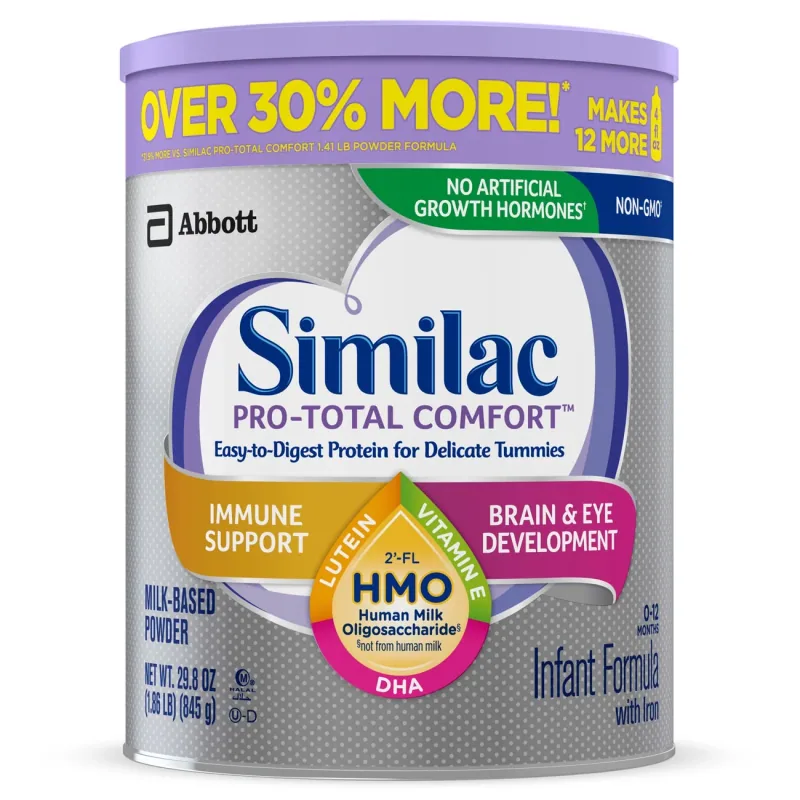
Gentlease: 60:40 whey:casein partially hydrolyzed, corn-syrup-solids primary, no HMO, palm and soy, DHA ~11.3 mg, ~$1.50/oz. Pro-Total Comfort: 100% whey partially hydrolyzed, corn-syrup-solids primary, 2'-FL HMO included, palm-free but soy-inclusive, DHA ~11 mg, ~$1.86/oz. Same "gentle" positioning, same reduced-lactose strategy, Pro-Total Comfort adds HMO and drops casein; Gentlease is cheaper and more WIC-accessible.
Enfamil Gentlease and Similac Pro-Total Comfort are the two US two biggest companies-brand entries in the "gentle / sensitive" partially hydrolyzed category, products marketed for "fussiness, gas, and crying" through the same two-part formulation template: (1) partially hydrolyzed whey protein, (2) corn-syrup-solids as primary carbohydrate (lactose-reduced). They share the same commercial positioning and the same overall formulation strategy, but they differ on the details that matter most, protein ratio, HMO inclusion, and price.
At a glance
| Dimension | Enfamil Gentlease | Similac Pro-Total Comfort |
|---|---|---|
| Manufacturer | Reckitt / Mead Johnson Nutrition | Abbott Nutrition |
| Regulation | FDA 21 CFR 107 | FDA 21 CFR 107 |
| Protein | Partially hydrolyzed nonfat milk and whey | Partially hydrolyzed 100% whey |
| Whey:casein | 60:40 | 100:0 (whey only) |
| Hydrolysis | Partial | Partial |
| Primary carbohydrate | Corn syrup solids (lactose reduced) | Corn syrup solids (lactose reduced) |
| Prebiotic | None | None |
| HMO | None | 2'-FL HMO |
| Lactoferrin | None | None |
| MFGM | None | None |
| DHA source | Algal (Crypthecodinium), ~11.3 mg/100 ml | Fish oil, ~11 mg/100 ml |
| Fat blend | Palm olein, soy, coconut, and safflower | High-oleic safflower, soy, coconut (no palm) |
| Red flags | Corn syrup solids | Corn syrup solids |
| Fat-blend notes | Palm oil, soy | Soy |
| Format | ~19.9 oz can | ~21 oz tin |
| Typical price | ||
| WIC coverage | Very broad US state coverage | Variable US state coverage |
| US availability | Broad US retail | Broad US retail |
Typical US retail price, normalised to USD per ounce of powder. Imported European formulas carry shipping and importer margin; US retail brands are typically cheapest per ounce. Subscribe-and-save and private-label pricing can shift the ranking.
Data table
| Formula | Price per ounce |
|---|---|
| Enfamil Gentlease | $1.50 |
| Similac Pro-Total Comfort | $1.86 |
Why this comparison matters
The "fussiness, gas, and crying" marketing category is one of the most-searched US formula buying motivations, parents whose baby seems uncomfortable after feeding are heavily targeted by both Reckitt and Abbott with partially hydrolyzed and reduced-lactose SKUs. Gentlease and Pro-Total Comfort are the category leaders. Understanding the differences (and the shared regulatory context) is important because: (a) both use corn-syrup-solids as primary carb, a composition choice worth understanding before committing, and (b) neither is indicated for diagnosed CMPA despite being marketed into that adjacent emotional space.
Compositional differences that actually matter
1. Primary carbohydrate: corn-syrup-solids in both
Both use corn syrup solids as the primary carbohydrate, replacing most of the lactose that a standard formula would contain. This is the defining feature of the US "gentle / sensitive" category and worth understanding up front. US FDA 21 CFR 107 permits this composition. EU Regulation 2016/127 would not permit it for standard Stage 1 infant formula, where lactose must be the predominant carbohydrate unless medically justified.
Why corn syrup solids? When you remove lactose from formula, you need a replacement carbohydrate. Corn syrup solids (dextrose and glucose polymers from corn) are inexpensive, well-tolerated by infant gut, and widely used in US "sensitive" and partially-hydrolyzed SKUs. The sweetness and glycemic response differ from lactose but the digestive tolerability is why parents observe the "less gas" effect. See our corn syrup solids explainer.
Neither Gentlease nor Pro-Total Comfort is unsafe or nutritionally inadequate. Both meet FDA nutrition requirements. The corn-syrup-primary formulation is legal, effective for its marketed use, and covered by WIC. But for a parent comparing against European-style lactose-primary options, this is the single most important shared feature to understand.
2. Protein hydrolysis: both partial, different protein source
Gentlease: partially hydrolyzed nonfat milk and whey protein concentrate (both cow-milk proteins, hydrolyzed partially). 60:40 whey:casein ratio, the standard whey-majority ratio. Some casein fraction remains intact at intermediate fragment size.
Pro-Total Comfort: partially hydrolyzed 100% whey protein. No casein. All protein comes from whey, all partially hydrolyzed. This is a meaningful difference: casein digests slower than whey and forms larger curds in the stomach; eliminating casein entirely (as Pro-Total Comfort does) produces a more uniformly fast-digesting protein profile.
Both are "partial hydrolysates" (pHF), NOT "extensively hydrolyzed" (eHF). Neither is indicated for diagnosed cow milk protein allergy, for CMPA, Nutramigen (Reckitt) or Alimentum (Abbott) are the eHF options. Pro-Total Comfort's 100% whey may feel marginally lighter to digest than Gentlease's 60:40 blend for some infants, but for routine "fussiness" the clinical difference is small.
3. HMO presence: Pro-Total Comfort only
Pro-Total Comfort includes 2'-FL HMO, making it one of few partially hydrolyzed / reduced-lactose formulas with HMO fortification. Gentlease has no HMO.
For parents who want the "gentle" feature set plus bioactive HMO fortification at US retail, Pro-Total Comfort is the differentiated option. Gentlease positions on hydrolysis and WIC pricing; Pro-Total Comfort positions on hydrolysis and 2'-FL HMO adding a step above mainstream "gentle". See our 2'-FL HMO explainer.
4. Fat blend: the one place they genuinely differ
Both use soy, coconut and high-oleic safflower. The palm is the exception: Gentlease uses palm olein and Pro-Total Comfort does not, leaving vitamin A palmitate as the only palm-derived entry on the Similac label. That runs brand-wide — every Similac formula in this Atlas is palm-free and every Enfamil formula uses palm olein — and it is easy to miss on two tins that otherwise read as the same product. Neither carries whole-milk fat, so Pro-Total Comfort removes the palm without putting milk fat in its place. See palm oil.
5. Price per ounce: Gentlease ~24% cheaper
Gentlease ~$1.50/oz. Pro-Total Comfort ~$1.86/oz. ~24% price difference favoring Gentlease. On 100-oz/week feeding, that's ~$36/week or ~$155/month, a meaningful gap for families buying at retail. WIC coverage further favors Gentlease: many state WIC programs contract with Reckitt/Enfamil as the primary supplier, making Gentlease effectively free for qualifying families, whereas Pro-Total Comfort coverage varies more by state.
6. Recall history
Gentlease (Reckitt): no active recall specific to Gentlease. Reckitt had historical lot-level recalls across the Enfamil family (packaging defects, minor fortification deviations). No broad facility-level event comparable to Abbott's 2022.
Pro-Total Comfort (Abbott): the 2022 Cronobacter recall at Sturgis, Michigan affected non-organic Similac lines including Pro-Total Comfort SKUs at that time. Abbott has remediated Sturgis and resumed production. No active recall on current stock. Both manufacturers are FDA-inspected and FSMA-compliant today. See our US formula recall history.
Regulatory framework
Both comply with FDA 21 CFR Part 107 for US infant formula. Both are partially hydrolyzed (pHF) formulas, which under US regulation can be marketed for "fussiness, gas, and crying" but not for allergy prevention or CMPA treatment. Both contain cow milk protein fragments and are not safe for infants with diagnosed CMPA.
Important regulatory note: the US FDA has issued warnings about marketing claims that suggest pHF formulas prevent allergies, evidence does not support that claim. Gentlease and Pro-Total Comfort both avoid making allergy-prevention claims in current labeling.
For parents whose baby has documented CMPA: the eHF options (Nutramigen, Alimentum) or amino acid formulas (Puramino, EleCare) are the medically-appropriate products, not these pHFs. See our hypoallergenic formula explainer, pHF formulas fit a separate commercial niche from true CMPA medical nutrition.
Real-world parent experience
Following site methodology, the observations below come from my own feeding experience and a stable pool of US parent feedback. They carry the parent-experience label rather than being claimed as regulatory or clinical facts.
The "less gas" observation. Both Gentlease and Pro-Total Comfort reliably produce what parents describe as "less fussy, less gassy" babies within 24-72 hours of switching. The honest mechanism: you're feeding the baby less lactose. For babies whose "fussiness" was actually just normal newborn digestive adjustment (not lactose intolerance, which is rare in infants), the reduced-lactose formula calms the symptom because there's less lactose to ferment. The baby hasn't become less fussy because the formula is "gentler" in an abstract sense; the baby is getting a different carbohydrate profile. See our infant lactose intolerance explainer.
Taste and smell. Both are sweeter than lactose-primary formulas (corn-syrup-solids and glucose polymers register as sweeter than lactose to the infant palate). Smell is slightly different from standard formulas, less "milky", more "sugary" to adult noses. Infants typically accept both readily; some switch-from-lactose babies show preference for the sweeter profile.
Stool consistency. Both produce softer, more frequent stools compared to standard lactose-primary formulas. Pro-Total Comfort's 100% whey tends toward slightly softer/looser than Gentlease's 60:40. Green-tinged stool is common on both (normal for reduced-lactose formulas, not a concern absent other symptoms).
Switching between them. Straightforward, both reduced-lactose, both pHF, very similar digestibility profile. Use a 4-6 day gradual transition. Going to either from a standard lactose-primary formula is the bigger compositional change (watch for transient stool changes in the first 1-2 weeks).
Verdict: when to pick each
Both are partial hydrolysates with the lactose reduced, so this decision is not about which one is gentler. It comes down to price and WIC access on one side, and 2'-FL HMO fortification with 100% whey protein on the other.
Pick Enfamil Gentlease if:
- Price matters, ~24% cheaper per-oz than Pro-Total Comfort
- WIC coverage is relevant: Gentlease has broader state WIC access
- Standard 60:40 whey:casein is acceptable
- HMO fortification is not a priority (neither has MFGM or lactoferrin anyway)
- Pediatrician familiarity matters: Gentlease is the most recognized "gentle" US SKU by pediatricians
Pick Similac Pro-Total Comfort if:
- 2'-FL HMO fortification matters in the partial-hydrolysate category (Pro-Total Comfort is the only major US pHF with HMO)
- You want 100% whey protein (no casein), faster digesting profile
- ~24% higher per-oz price is acceptable
- Abbott manufacturer preference (or local WIC coverage)
Pick neither if:
- You want to keep lactose-primary composition, consider Enfamil NeuroPro (lactose and MFGM and 2'-FL HMO) or Similac 360 Total Care (lactose and 5-HMO blend)
- You need CMPA management, consider Nutramigen (eHF) or EleCare (amino acid)
- You want EU-style lactose-primary and partial hydrolysate, consider HiPP HA Combiotik (imported, Metafolin and EU Organic)
What you can't infer from this comparison
Both are safe, FDA-registered US infant formulas appropriate for the "fussiness, gas, and crying" marketing category. Neither is indicated for diagnosed CMPA. The corn-syrup-solids primary carbohydrate is a legal, compliant choice under US regulation but diverges from EU standards for standard Stage 1 infant formula, that's a composition-transparency matter, not a safety matter. Clinical evidence showing meaningful outcome differences between Gentlease and Pro-Total Comfort at equivalent use is not established, both perform as marketed for their shared category.
Frequently asked questions
Is Enfamil Gentlease or Similac Pro-Total Comfort better?
Do both use corn syrup solids?
Can I use these for a baby with CMPA?
Does Similac Pro-Total Comfort have HMO?
Why is Enfamil Gentlease cheaper?
My baby is gassy, which should I try first?
Can I switch between Gentlease and Pro-Total Comfort?
Are these formulas organic?
Related reading
- Enfamil brand hub
- Similac brand hub
- Best baby formulas, mid-premium mainstream two biggest companies
- Corn syrup solids explainer
- Hydrolyzed whey explainer
- 2'-FL HMO explainer
- Infant lactose intolerance explainer
- Colic and formula choice
- Enfamil NeuroPro vs Enfamil Gentlease - Lactose-Primary Premium vs Corn-Syrup-Primary 'Gentle'
- HiPP HA Combiotik vs Nutramigen - EU Partial Hydrolysate vs US Extensively Hydrolyzed (Not the Same Category)
- HiPP HA Stage 1 vs Enfamil Gentlease - EU pHF Combiotik vs US pHF (Apples-to-Apples)
- Best baby formula for reflux
- HiPP AR vs Enfamil AR
Primary sources
- Enfamil / Reckitt (Mead Johnson), manufacturer product information. enfamil.com
- Similac / Abbott Nutrition, manufacturer product information. similac.com
- FDA 21 CFR Part 107. US infant formula regulation. ecfr.gov
- EU Regulation 2016/127. EU compositional requirements for infant formula (reference for lactose-primary requirement). eur-lex.europa.eu
- EFSA Scientific Opinion on compositional requirements for infant formula. efsa.europa.eu
This site provides research and comparisons, not medical advice. Consult your pediatrician before changing your baby's formula.