
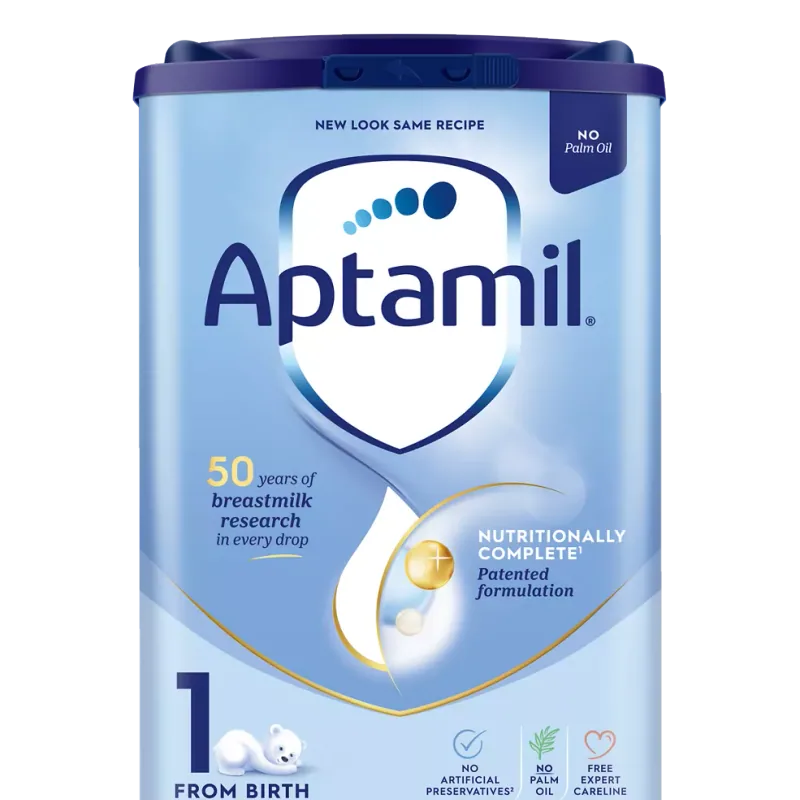
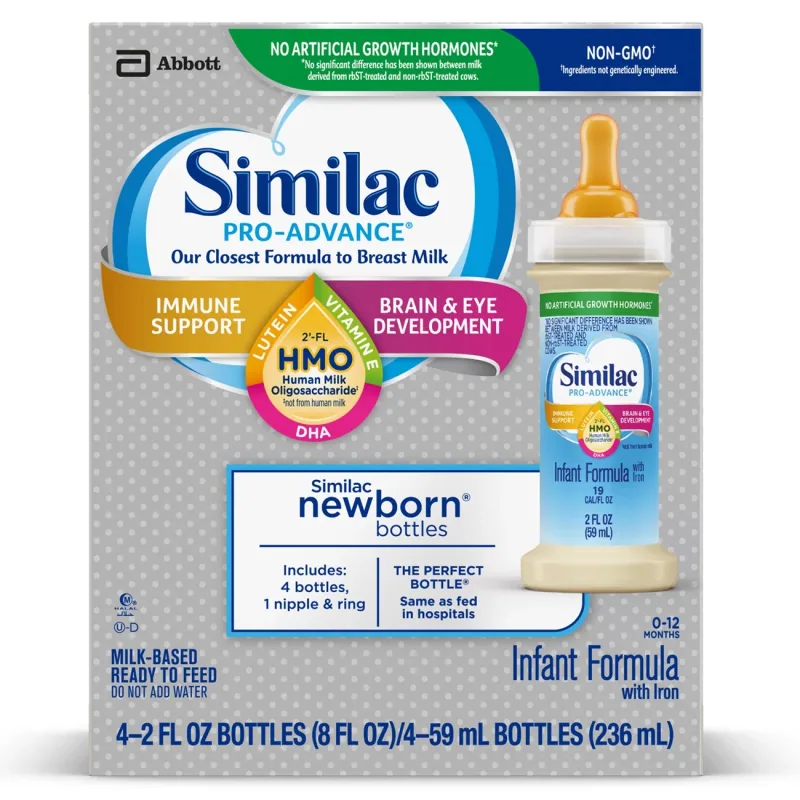
Aptamil UK Stage 1 and Similac Pro-Advance are an unusually close matchup on price. Both are cow-milk Stage 1 formulas at ~$1.42-1.51/oz delivered. Both exclude palm olein. Both contain soy in their fat construction. Both are lactose-primary. The differentiation is bioactive strategy (GOS+FOS 9:1 prebiotic plus 29% fermented dairy from Aptamil's Pronutra heritage versus Similac's GOS plus 2'-FL HMO) and regulatory pathway (EU 2016/127 personal import via Organic's Best vs FDA 21 CFR 107 next-day retail). Aptamil is the cheapest EU-tier formula families can import; Similac is the cheapest US-retail HMO formula.
Aptamil UK Stage 1 is a Danone formula with skimmed cow milk, lactose- primary carbohydrate, GOS+FOS 9:1 prebiotic blend, 29% fermented dairy (Pronutra heritage), palm-free fat blend that includes soy and rapeseed and sunflower, ~$1.42/oz delivered via personal import. Similac Pro-Advance is an Abbott formula with skimmed cow milk, lactose-primary carbohydrate, GOS and 2'-FL HMO, palm-olein-free vegetable oil blend that includes soybean oil, FDA-registered, WIC-eligible, ~$1.51/oz at standard retail. Pricing is essentially tied; bioactive strategy and regulatory pathway diverge.
Why this comparison matters
For families exploring European formula because they want palm-free construction, Aptamil UK is one of the few candidates that doesn't require paying the EU-organic premium. Aptamil UK is not organic — that distinction belongs to Holle, Kendamil Organic, Lebenswert, and similar. What Aptamil offers is the EU regulatory backbone, the Danone research heritage (Pronutra fermented-dairy approach), and a price per ounce competitive with US retail. Similac Pro-Advance is the closest US-retail counterpart on price and on the palm-free axis.
This is the rare US-vs-EU comparison where cost per ounce is not the decisive driver — both are within ~$0.10/oz. The decision is bioactive strategy plus regulatory pathway plus retail availability.
At a glance
| Dimension | Aptamil UK Stage 1 | Similac Pro-Advance |
|---|---|---|
| Manufacturer | Danone Nutricia (UK manufacturing) | Abbott Nutrition |
| Origin | United Kingdom | USA (Sturgis MI and Columbus OH) |
| Age range | 0-6 months (Stage 1) | 0-12 months |
| Regulation | EU 2016/127 and UK FSA (FDA enforcement discretion for US import) | FDA 21 CFR 107 |
| Organic certification | None | None |
| Protein source | Skimmed cow milk and whey | Skimmed cow milk and whey |
| Whey:casein ratio | 60:40 | 60:40 |
| Primary carbohydrate | Lactose | Lactose |
| Prebiotic | GOS and FOS (9:1 blend) | GOS and 2'-FL HMO |
| Probiotic | None | None |
| Fermented dairy | 29% (Pronutra) | None |
| Folate form | Folic acid | Folic acid |
| Fat blend | Palm-free, vegetable oil blend with soy | No palm olein, soybean and coconut and safflower/sunflower |
| DHA source | Algal oil, ~14 mg/100 ml | Algal oil, ~11.3 mg/100 ml |
| Iron | 0.53 mg/100 ml | 1.2 mg/100 ml |
| Fat-blend notes | Soy oil and soy lecithin | Soy oil, soy lecithin, synthetic beta-carotene |
| Format | 800 g tin | ~23.2 oz container |
| Typical US price | ||
| US availability | Personal import via Organic's Best Shop, 5-10 day shipping | Target, Walmart, Amazon, CVS, WIC, next-day |
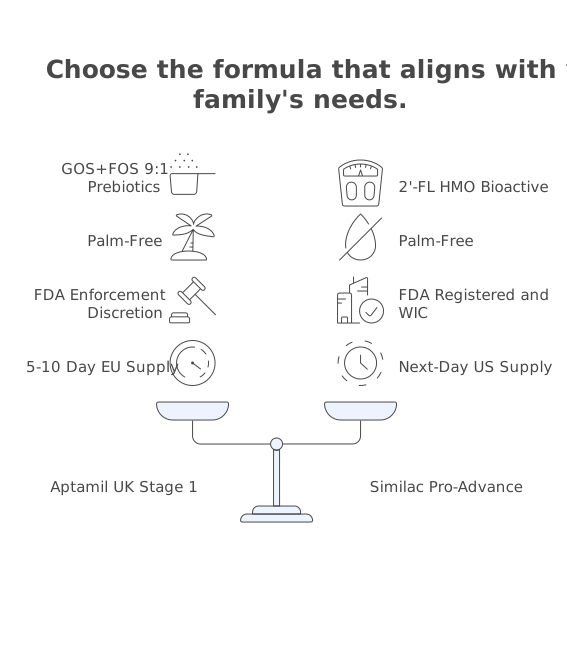
Visual generated with Napkin AI, editorial review by María López Botín. See methodology for our use policy.
Compositional differences that actually matter
Five dimensions where Aptamil UK and Similac Pro-Advance diverge.
1. Bioactive strategy: GOS+FOS plus fermented dairy vs GOS plus 2'-FL HMO
Aptamil's bioactive approach is the Danone Pronutra philosophy: a GOS and FOS 9:1 prebiotic blend (the original European prebiotic formulation, with decades of clinical evidence) plus 29% fermented dairy ingredients in the protein base. The fermented component is intended to deliver postbiotic effects, metabolites of bacterial fermentation that interact with the infant gut without requiring live bacterial strains.
Similac's bioactive approach is GOS plus 2'-FL HMO. The 2'-FL HMO has direct structural analogy to breast milk oligosaccharides and is the most-studied human milk oligosaccharide added to formula. See 2'-FL HMO, GOS, and FOS explainers.
Neither bioactive strategy is clinically superior; they target similar gut-microbiome shifts via different mechanisms. Families with a preference for human-milk-analog bioactives pick Similac. Families weighting the longer European clinical history of GOS+FOS 9:1 plus fermented dairy pick Aptamil.
2. Both palm-free, both contain soy
Both formulas exclude palm olein, which is the headline fat-blend match. Both formulas use soybean oil and soy lecithin in their vegetable oil construction. For families avoiding soy entirely, neither is a fit; look at Bobbie Original (US, USDA Organic, palm-free and soy-free) or Kendamil Classic Stage 1 (UK, palm-free and soy-free, whole-milk-fat base).
3. DHA and iron: Aptamil higher DHA, Similac higher iron
Aptamil provides ~14 mg DHA per 100 ml (EU 2016/127 mandatory level), Similac ~11.3 mg (above FDA baseline). Iron differs: Aptamil ~0.53 mg/100 ml (EU 2016/127 minimum), Similac ~1.2 mg/100 ml (US convention). Both are nutritionally adequate for term infants without iron-deficiency risk. The EU lower-iron range reflects different population-level iron-stores assumptions; pediatric guidance trumps formula iron for at-risk infants.
4. Cost and supply: tied per ounce, different logistics
Aptamil UK ~$1.42/oz delivered through Organic's Best Shop. Similac Pro-Advance ~$1.51/oz at standard US retail, $0 in WIC contract states. The ~$0.10/oz gap is not decisive for non-WIC families. WIC contract collapses the comparison toward Similac.
The supply logistics differ. Aptamil arrives 5-10 days from EU warehouses; maintain a 2-4 week stock buffer. Similac is next-day from multiple US retailers; supply is essentially instantaneous post-2022.
5. Stage range and transition planning
Similac Pro-Advance is labeled 0-12 months as a single stage (US convention). Aptamil UK Stage 1 is 0-6 months per EU 2016/127; at 6 months families transition to Aptamil UK Stage 2. The EU staging provides finer-grained nutrient adjustment as the infant grows but adds a transition decision at 6 months.
Regulatory framework
Aptamil UK Stage 1 complies with EU Regulation 2016/127 (EU infant formula composition) and UK Food Standards Agency requirements. Its US presence operates under FDA enforcement discretion for personally-imported infant formula via authorized resellers like Organic's Best Shop. Aptamil is not FDA-registered and not WIC-eligible in the US.
Similac Pro-Advance complies with FDA 21 CFR Part 107 under Abbott Nutrition's pre-market notification, Part 106 quality control, and the FSMA mandatory recall framework. Pro-Advance was not directly affected by the 2022 Sturgis Cronobacter recall — see Abbott 2022 recall aftermath.
For the broader regulatory comparison, see FDA vs EFSA standards compared.
Real-world parent experience
Following site methodology, the observations below come from my personal testing across both formulas plus a stable pool of parent-feedback notes from families. Read these as context, not prediction.
Smell and taste. Aptamil UK has a mildly tangy character from the fermented-dairy component, more subtle than a yogurt note but distinguishable from Similac's clean sweetness. Most infants accept either; some develop a preference when switching.
Mixability. Both dissolve cleanly at 70°C preparation temperature. Similac produces more foam on vigorous shaking from soy oil; swirling reduces it. Aptamil dissolves with slightly higher viscosity from the fermented-dairy fraction.
Stool consistency. Both families typically report soft stools. Aptamil's GOS+FOS 9:1 prebiotic load can produce slightly looser patterns in the first 5-7 days as gut bacteria adapt to the prebiotic mix, then normalizes. Similac's GOS plus 2'-FL HMO load is generally well-tolerated from the start.
Switching between them. Use a 4-6 day gradual transition. Both are cow-milk lactose-primary palm-free formulas, so the structural shift is smaller than goat-vs-cow or palm-inclusive-vs-palm-free transitions. Most infants tolerate the change without issue.
Verdict: when to pick each
Pick Aptamil UK Stage 1 if:
- Danone Pronutra heritage and fermented-dairy approach matters
- GOS+FOS 9:1 prebiotic blend is your priority over HMO
- You can absorb 5-10 day import shipping and maintain stock buffer
- Higher DHA at EU mandatory level matters
- You want the cheapest EU-import Stage 1 per ounce
Pick Similac Pro-Advance if:
- 2'-FL HMO bioactive is your priority
- WIC eligibility makes Similac effectively free in your state
- FDA pre-market registration is a baseline assurance
- US retail next-day availability is required
- 0-12 month single-stage range fits your planning
Pick neither if:
- USDA Organic or EU Organic is required (look at Bobbie Original, Kendamil Organic Stage 1, or Holle Cow Stage 1)
- Soy-free is required (look at Bobbie Original or Kendamil Classic Stage 1)
- Diagnosed CMPA (neither is hypoallergenic)
What you can't infer from this comparison
Neither is organic. Aptamil UK is the cheapest EU-import Stage 1 because it is non-organic; the EU-organic Stage 1 brands (Holle, Kendamil Organic, HiPP Dutch) all retail above ~$1.65/oz. Aptamil German Profutura is a separate Aptamil line with German manufacturing and slightly different composition; the UK variant is what most US families import for the palm-free attribute. Neither formula is indicated for diagnosed CMPA, reflux, or constipation as a clinical condition.
Frequently asked questions
Is Aptamil UK Stage 1 organic?
Why is Aptamil UK cheaper than other EU imports?
Does Aptamil UK have HMOs?
Is Aptamil UK or Similac Pro-Advance better for a sensitive baby?
Can I switch from Similac Pro-Advance to Aptamil UK Stage 1?
Is Aptamil UK FDA-registered?
Does Aptamil UK have soy?
Related reading
- Aptamil brand hub
- Similac brand hub
- Aptamil UK Stage 1, full SKU record
- Similac Pro-Advance, full SKU record
- Aptamil UK Stage 1 vs Stage 2, the intra-Aptamil progression
- HiPP Dutch Stage 1 vs Aptamil UK Stage 1 for the EU-Combiotik alternative
- Buying European formula in the USA for the import logistics
- GOS explainer
- FOS explainer
- 2'-FL HMO explainer
- Aptamil UK Stage 1 vs Enfamil NeuroPro - Palm-Free EU Import vs US Bioactive Stack with Palm
Primary sources
- Aptamil UK Stage 1, official Danone product information. aptaclub.co.uk
- Similac Pro-Advance, official product information. similac.com
- FDA 21 CFR Part 107: US infant formula regulation. ecfr.gov
- EU Regulation 2016/127: Infant formula compositional requirements. eur-lex.europa.eu
This site provides research and comparisons, not medical advice. Consult your pediatrician before changing your baby's formula.