
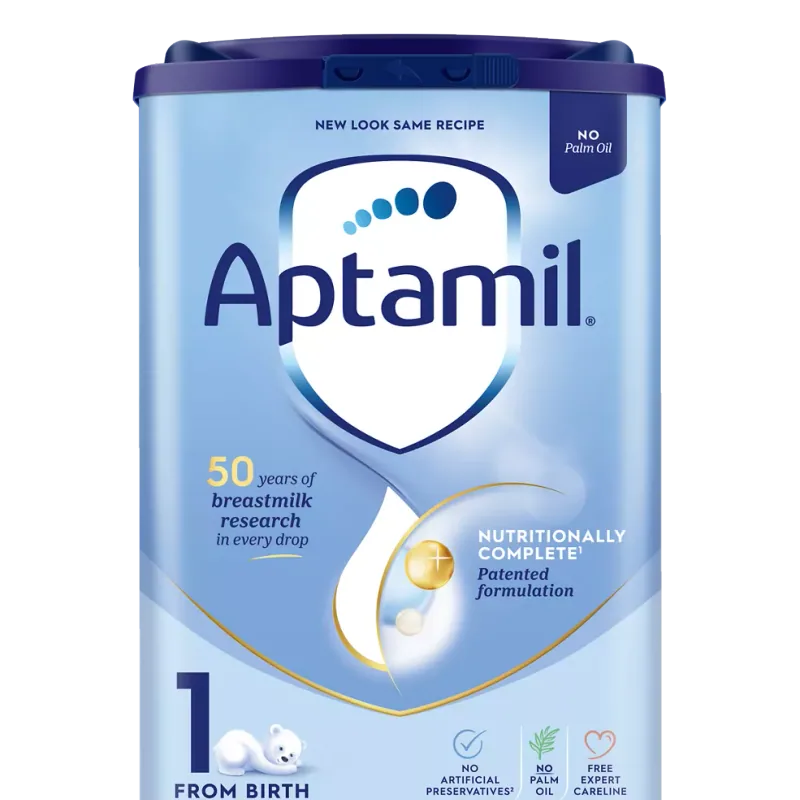
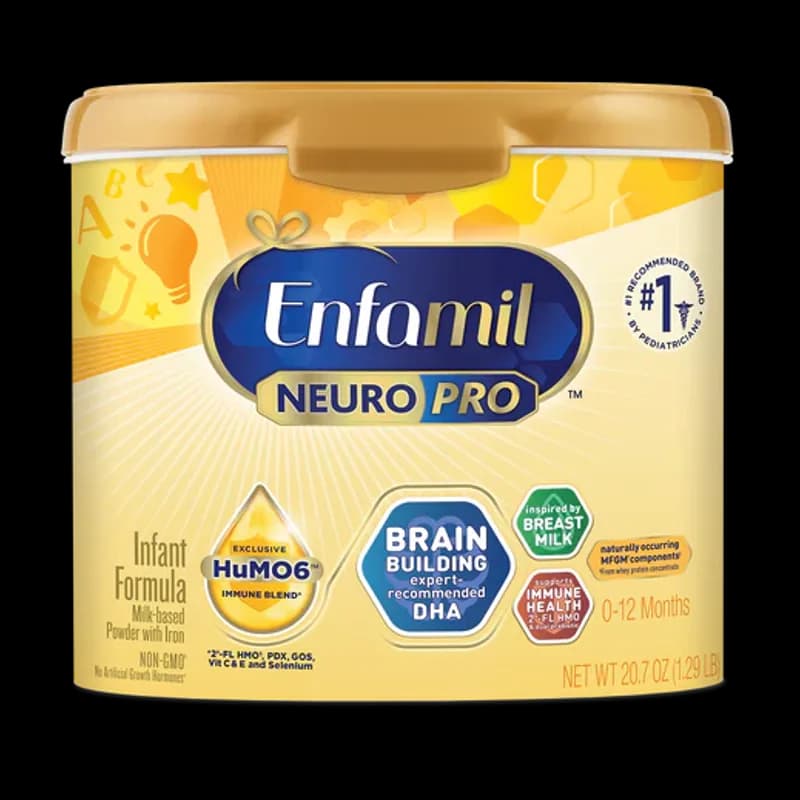
Aptamil UK Stage 1 and Enfamil NeuroPro represent two opposite philosophies on Stage 1 cow-milk formula. Aptamil UK is the EU-import palm-free option with a Danone GOS+FOS 9:1 plus 29% fermented dairy bioactive approach, no 2'-FL HMO, no MFGM. Enfamil NeuroPro is the US flagship with the deepest US bioactive stack on the shelf — 2'-FL HMO, MFGM via intact whey protein concentrate, GOS, and polydextrose — but with palm oil and soy in the fat blend. Both contain soy.
Aptamil UK Stage 1 is a palm-free Danone formula with GOS+FOS 9:1 prebiotic, 29% fermented dairy, no 2'-FL HMO, no MFGM, soy in the fat blend, ~$1.42/oz delivered via personal import. Enfamil NeuroPro is a palm and soy inclusive Reckitt/Mead Johnson formula with 2'-FL HMO, MFGM via intact whey, GOS, polydextrose, FDA-registered, ~$1.88/oz at US retail. Same protein species (skimmed cow milk), same lactose-primary carbohydrate. Diverging on palm avoidance vs bioactive depth.
Why this comparison matters
Parents arriving at this matchup are typically optimizing on two opposite axes. One group prioritizes palm-oil avoidance (avoid the calcium-soap and stool-hardening issues; prefer the Danone fat-blend philosophy) and accepts the EU-import logistics plus the GOS+FOS plus fermented-dairy bioactive approach without HMO. The other group prioritizes maximum bioactive stack inclusion (2'-FL HMO and MFGM are the marquee US-formula bioactive additions; polydextrose is the secondary prebiotic fiber Reckitt added to NeuroPro) and accepts palm oil in the fat blend. The two priorities rarely align in a single formula; this comparison surfaces the trade-off cleanly.
At a glance
| Dimension | Aptamil UK Stage 1 | Enfamil NeuroPro |
|---|---|---|
| Manufacturer | Danone Nutricia (UK manufacturing) | Reckitt / Mead Johnson Nutrition (US) |
| Origin | United Kingdom | United States |
| Age range | 0-6 months (Stage 1) | 0-12 months |
| Regulation | EU 2016/127 and UK FSA (FDA enforcement discretion for US import) | FDA 21 CFR 107 |
| Organic certification | None | None |
| Protein source | Skimmed cow milk and whey | Skimmed cow milk and whey concentrate (intact, MFGM-bearing) |
| Whey:casein ratio | 60:40 | 60:40 (unusual for US) |
| Primary carbohydrate | Lactose | Lactose |
| Prebiotic | GOS and FOS (9:1 blend) | GOS, 2'-FL HMO, polydextrose |
| Probiotic | None | None |
| Fermented dairy | 29% (Pronutra) | None |
| HMO | None | 2'-FL HMO |
| MFGM | None | Yes (via intact whey) |
| Folate form | Folic acid | Folic acid |
| Fat blend | Palm-free, vegetable oil blend with soy | Palm oil, soy oil, coconut, safflower/sunflower |
| DHA source | Algal oil, ~14 mg/100 ml | Fish oil, ~11.3 mg/100 ml |
| Iron | 0.53 mg/100 ml | 1.2 mg/100 ml |
| Red flags | None | None |
| Fat-blend notes | Soy oil and soy lecithin | Palm oil, soy oil and lecithin |
| Format | 800 g tin | ~20.7 oz container |
| Typical US price | ||
| US availability | Personal import via Organic's Best Shop, 5-10 day shipping | Target, Walmart, Amazon, CVS, next-day |
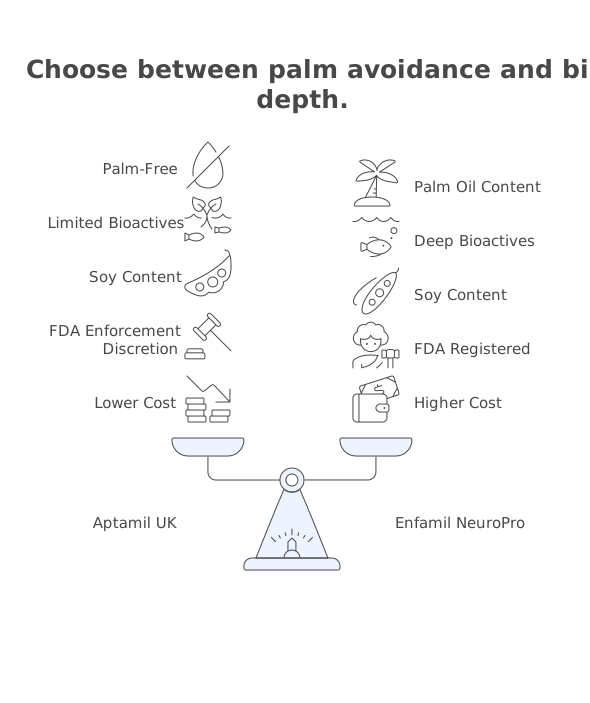
Visual generated with Napkin AI, editorial review by María López Botín. See methodology for our use policy.
Compositional differences that actually matter
Five dimensions where Aptamil UK and Enfamil NeuroPro diverge in ways parents care about.
1. Bioactive depth: minimal-but-fermented vs maximum-stack
Enfamil NeuroPro carries the deepest bioactive stack of any US-retail non-specialty cow-milk Stage 1: 2'-FL HMO, MFGM via intact whey protein concentrate, GOS, and polydextrose. The MFGM is preserved through processing rather than added as an ingredient, which Reckitt highlights as a key bioactive selector. See MFGM explainer and 2'-FL HMO.
Aptamil UK carries no HMO and no MFGM. Its bioactive profile is GOS+FOS 9:1 prebiotic plus 29% fermented dairy — the Danone Pronutra approach emphasizing postbiotic effects via fermented-dairy metabolites rather than HMO or MFGM additions.
Families weighting maximum bioactive inclusion pick Enfamil. Families weighting Danone heritage and fermented-dairy philosophy pick Aptamil.
2. Palm oil: avoided in Aptamil, present in NeuroPro
The structural fat-blend difference. Aptamil UK Stage 1 is palm-free (specifically the UK variant; Aptamil German variants do contain palm). NeuroPro contains palm oil alongside soy oil, coconut, and safflower or sunflower. For families avoiding palm because of constipation history, calcium-soap concerns, or the broader palm-oil-avoidance position, Aptamil clears the line and NeuroPro doesn't. See the palm oil explainer for the mechanism.
Both contain soy. Soy-avoiding families need a different formula on either side.
3. DHA, ARA, and iron levels
Aptamil provides ~14 mg DHA per 100 ml (EU mandatory minimum, algal oil source), NeuroPro ~11.3 mg DHA (fish oil source). Both deliver functional DHA for term infant brain and retinal development. Iron differs sharply: Aptamil ~0.53 mg/100 ml (EU minimum), NeuroPro ~1.2 mg/100 ml (US convention). Both are nutritionally adequate; the EU range reflects different population-level iron-stores assumptions.
4. Cost and supply
Aptamil ~$1.42/oz delivered via Organic's Best Shop, 5-10 day import shipping. NeuroPro ~$1.88/oz at US retail, next-day from major chains. The ~$0.46/oz gap is meaningful — at ~120 oz/month consumption for a 2-3 month-old, that's ~$55/month difference. WIC contracts vary by state; NeuroPro is the contracted brand in some states.
5. Stage range and transition planning
NeuroPro is labeled 0-12 months as a single stage. Aptamil UK Stage 1 is 0-6 months per EU 2016/127, transitioning to Aptamil UK Stage 2 at 6 months. The EU staging adds a transition decision but allows finer-grained nutrient adjustment as the infant grows.
Regulatory framework
Aptamil UK Stage 1 complies with EU Regulation 2016/127 and UK Food Standards Agency requirements. Its US presence operates under FDA enforcement discretion via authorized resellers. Not FDA-registered, not WIC-eligible.
Enfamil NeuroPro complies with FDA 21 CFR Part 107 under Reckitt / Mead Johnson's pre-market notification, Part 106 quality control, and the FSMA mandatory recall framework. NeuroPro was not affected by the 2022 Sturgis Cronobacter recall (that was an Abbott facility, not a Reckitt one). For the broader regulatory comparison, see FDA vs EFSA standards compared.
Real-world parent experience
Following site methodology, the observations below come from my personal testing across both formulas plus a stable pool of parent-feedback notes from families. Read these as context, not prediction.
Smell and taste. Aptamil UK has a mildly tangy character from the fermented-dairy fraction. NeuroPro has a slightly creamier profile from the intact whey protein concentrate, denser-smelling than Similac. Most infants accept either; some develop a flavor preference when switching.
Mixability. Both dissolve cleanly at 70°C. NeuroPro produces more foam on vigorous shaking from soy and palm; swirling reduces it. Aptamil dissolves with slightly higher viscosity from the fermented fraction.
Stool consistency. Aptamil's GOS+FOS prebiotic load can produce slightly looser patterns the first 5-7 days, then normalizes. NeuroPro families often report softer-then-harder pattern for the first 7-10 days as the gut microbiome adapts to the bioactive stack; the palm oil component is sometimes associated with firmer stools longer-term in a subset of infants. Both within normal range for healthy term infants.
Switching between them. Use a 4-6 day gradual transition. The fat-blend shift (palm-free to palm-inclusive or reverse) plus the bioactive shift (GOS+FOS plus fermented dairy to 2'-FL HMO plus MFGM plus polydextrose or reverse) can produce 7-14 days of stool adjustment. Most infants tolerate the change without issue.
Verdict: when to pick each
Pick Aptamil UK Stage 1 if:
- Palm-oil avoidance is decisive
- Danone Pronutra heritage and fermented-dairy approach matters
- GOS+FOS 9:1 prebiotic blend fits your preference
- You can absorb 5-10 day import shipping
- The cheapest EU-import per-oz price matters
Pick Enfamil NeuroPro if:
- Maximum bioactive stack (2'-FL HMO and MFGM and GOS and polydextrose) is the priority
- US retail next-day availability is required
- FDA pre-market registration matters as a baseline
- 0-12 month single-stage range fits your planning
- WIC contract makes NeuroPro effectively free in your state
Pick neither if:
- Soy-free is required (look at Bobbie Original or Kendamil Classic Stage 1)
- USDA Organic or EU Organic is required (look at Holle Cow Stage 1, Kendamil Organic Stage 1, or HiPP Dutch Stage 1)
- Diagnosed CMPA (neither is hypoallergenic)
What you can't infer from this comparison
Neither is organic. Aptamil UK is the cheapest EU-import Stage 1 because it is non-organic; Enfamil NeuroPro is more expensive than Aptamil despite being domestic because of the bioactive stack (2'-FL HMO and MFGM-via-intact-whey both add cost). Neither is indicated for diagnosed CMPA, reflux, or constipation as a clinical condition. Aptamil's palm-free claim applies specifically to the UK variant; the German Aptamil Profutura line does contain palm.
Frequently asked questions
Does Aptamil UK have HMOs or MFGM?
Does Enfamil NeuroPro have palm oil?
What is MFGM and does it actually matter?
Is Aptamil UK or Enfamil NeuroPro cheaper?
Can I switch from Enfamil NeuroPro to Aptamil UK Stage 1?
Is Enfamil NeuroPro the same as Enfamil Enspire?
Are both Aptamil UK Stage 1 and Enfamil NeuroPro lactose-primary?
Related reading
- Aptamil brand hub
- Enfamil brand hub
- Aptamil UK Stage 1, full SKU record
- Enfamil NeuroPro, full SKU record
- Aptamil UK Stage 1 vs Similac Pro-Advance, the other US comparison
- Enfamil Enspire vs Enfamil NeuroPro, the in-family premium comparison
- Buying European formula in the USA
- MFGM explainer
- 2'-FL HMO explainer
- Palm oil explainer
Primary sources
- Aptamil UK Stage 1, official Danone product information. aptaclub.co.uk
- Enfamil NeuroPro, official product information. enfamil.com
- FDA 21 CFR Part 107: US infant formula regulation. ecfr.gov
- EU Regulation 2016/127: Infant formula compositional requirements. eur-lex.europa.eu
This site provides research and comparisons, not medical advice. Consult your pediatrician before changing your baby's formula.