
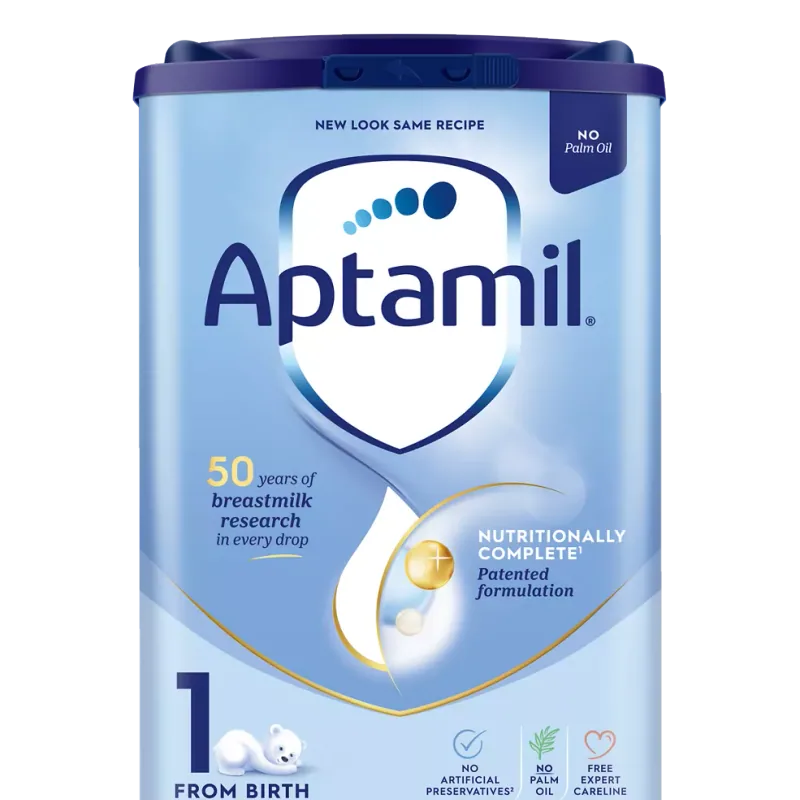
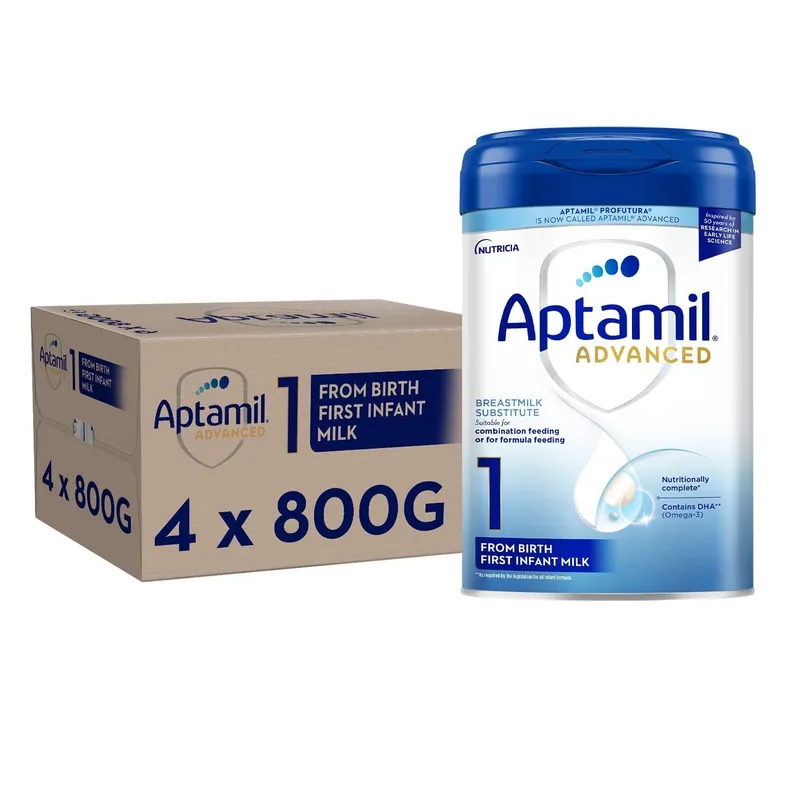
Aptamil UK Stage 1 and Stage 2 are Danone's UK-market infant formula progression, the most budget-friendly EU-tier option available via US personal import. Both stages share palm-free composition, GOS, FOS synbiotic, and no probiotic and preserve the Danone Aptamil signature across the 0-6 → 6-12 month window. The Stage 1 → Stage 2 transition is the standard EU iron jump, modest protein increase, and a pricing drop (Stage 2 is cheaper per-oz).
Stage 1 (0-6m): Danone Aptamil UK, palm-free, and GOS, FOS, and protein
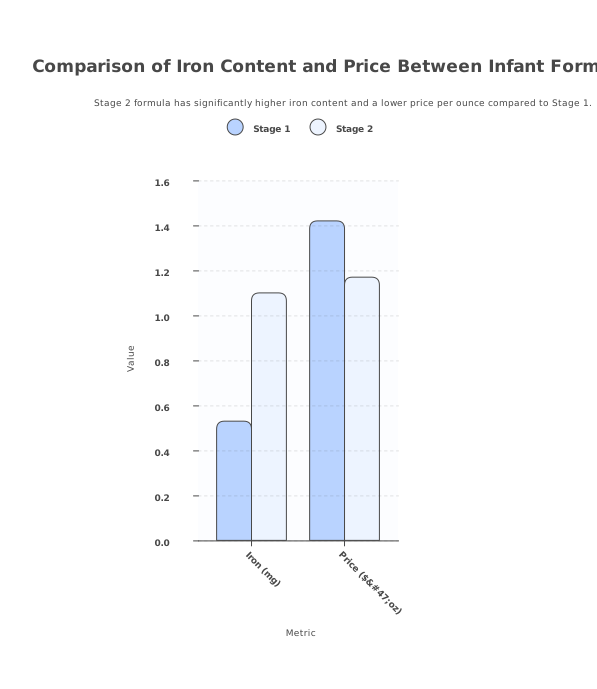
1.3 g/100 ml and iron 0.53 mg and DHA 14 mg and $1.42/oz. Stage 2
(6-12m): same Danone base, same GOS, FOS, and protein 1.4 g and iron
1.1 mg (+108%) and DHA 14 mg and **$1.17/oz (cheaper per-oz)**. Same
palm-free and synbiotic philosophy preserved.
Why this comparison matters
For families importing EU formulas on a budget, Aptamil UK is
often the cheapest per-oz option, significantly cheaper than HiPP
Dutch ($1.77/oz), Holle ($1.65/oz Stage 2), or Kendamil Organic
(~$1.77-1.95/oz). The Stage 1 → Stage 2 transition preserves the
Danone composition (GOS and FOS synbiotic, palm-free, lactose primary)
and further reduces per-oz cost. Understanding this matters for
families choosing the most cost-effective EU-tier progression.
At a glance
| Dimension | Aptamil UK Stage 1 | Aptamil UK Stage 2 |
|---|---|---|
| Age range | 0-6 months | 6-12 months |
| Manufacturer | Danone UK (Nutricia parent) | Danone UK |
| EU regulation | EU 2016/127 | EU 2016/128 |
| Energy | 66 kcal / 100 ml | 68 kcal / 100 ml |
| Protein | 1.3 g / 100 ml | 1.4 g / 100 ml |
| Primary carbohydrate | Lactose | Lactose |
| Fat | 3.4 g / 100 ml | 3.1 g / 100 ml |
| Iron | 0.53 mg / 100 ml | 1.1 mg / 100 ml (+108%) |
| DHA | 14 mg / 100 ml | 14 mg / 100 ml |
| Prebiotic | GOS and FOS (9:1 ratio) | GOS and FOS (9:1 ratio) |
| Probiotic | None | None |
| HMO | None | None |
| Palm-free | Yes | Yes |
| Folate | Folic acid | Folic acid |
| Format | 800 g tin | 800 g tin |
| Typical price (US) |
Visual generated with Napkin AI, editorial review by María López Botín. See methodology for our use policy.
What changes from Stage 1 to Stage 2
1. Iron more than doubles
Stage 1: 0.53 mg → Stage 2: 1.1 mg / 100 ml. +108%, largest proportional jump among EU stage progressions. Aptamil Stage 2 iron (1.1 mg) is slightly higher than HiPP / Holle / Kendamil Stage 2 (~1.0 mg): Danone's approach fortifies at the upper end of the EU follow-on range.
2. Protein and macronutrient adjustments
Protein 1.3 → 1.4 g. Fat 3.4 → 3.1 g (-9%). Carbs 7.3 → 8.5 g (+16%). Same carb-up / fat-down pattern as Kendamil. Energy 66 → 68 kcal.
3. DHA constant at 14 mg
Same as HiPP. Lower than Kendamil (16.1 mg) and Holle (15 mg).
4. Pricing drops at Stage 2
Stage 1 ~$1.42/oz → Stage 2 ~$1.17/oz (-18%). Unusual among EU progressions, most brands hold pricing constant or raise slightly. Aptamil UK's Stage 2 is the cheapest EU-tier per-oz option in the US personal import market.
5. Everything else preserved
- GOS and FOS synbiotic (9:1 ratio, same as Kendamil Classic)
- Palm-free fat blend
- Lactose primary, 60:40 whey:casein
- Folic acid folate
- No probiotic, no HMO, no whole milk fat
- 800 g tin format
Aptamil UK vs other EU brands: positioning
| Brand | Stage 1 price/oz | Signature |
|---|---|---|
| Aptamil UK | ~$1.42/oz | GOS, FOS, and palm-free, no probiotic, cheapest |
| Kendamil Classic | ~$1.63/oz | Whole-milk-fat, palm-free, GOS, FOS, and high DHA |
| Holle Cow | ~$1.95/oz | Demeter biodynamic and minimalist (no GOS/probiotic) |
| HiPP Dutch | ~$1.77/oz | Combiotik (GOS and probiotics) and Metafolin and RSPO palm |
Aptamil UK is positioned as budget EU-tier with synbiotic support, for families prioritizing cost efficiency without dropping key EU features (palm-free, GOS and FOS, Metafolin alternative with folic acid).
Transition approach
Typical 10-day gradual transition:
- Day 1-3: 25% Stage 2 and 75% Stage 1 across feeds
- Day 4-6: 50% Stage 2 and 50% Stage 1
- Day 7-9: 75% Stage 2 and 25% Stage 1
- Day 10+: 100% Stage 2
Most infants don't notice the transition. Minor stool pattern shift (slightly darker or firmer for 5-10 days) related to iron increase is normal and temporary. The GOS and FOS synbiotic continuity across both stages means the microbiome fermentation pattern stays the same, one reason Aptamil UK transitions tend to be smooth.
Real-world parent experience
Following site methodology, observations come from US parent feedback on Aptamil UK use. Not clinical recommendations. Where my own feeding observations are referenced, they are clearly labeled as parent-experience notes; manufacturer claims and regulatory data are cited separately so the source weight stays explicit.
Smell and taste. Aptamil UK has a neutral, slightly sweet profile — typical of EU standard formulas without probiotic fermentation character. Stage 1 and Stage 2 are very similar in smell/taste. Most infants don't notice the transition.
Stool consistency. Aptamil UK's GOS and FOS synbiotic supports regular soft stool formation. Stage 2 transition produces typical iron-related darkening for 7-10 days. GOS and FOS effect persists across stages.
Supply considerations. Aptamil UK is less commonly imported to US than HiPP Dutch or Holle, but trusted EU resellers (Organic's Best and similar) maintain Aptamil UK in their inventory. Allow standard EU import timing of 5-7 business days.
Why budget-sensitive families choose Aptamil UK. At $1.17-$1.42/
oz, Aptamil UK is meaningfully cheaper than HiPP Dutch ($1.77/oz) or
Holle ($1.65-$1.95/oz) or Kendamil Classic ($1.63/oz). For a
formula used 6 and months, the per-oz savings accumulate substantially
— a family consuming 25 oz/day saves ~$250+ over 12 months vs HiPP
Dutch. For families who value GOS, FOS synbiotic, palm-free EU
composition, and don't specifically need Combiotik probiotic or
whole-milk-fat, Aptamil UK delivers the core EU features at budget
pricing.
What you can't infer from this comparison
Both are safe UK-compliant EU formulas for their respective age ranges. The "cheapest per-oz" positioning reflects Danone's cost structure, not lower quality: Aptamil UK delivers core EU standards (palm-free, GOS and FOS, Metafolin alternative, lactose primary) equivalent to premium-priced EU brands. Families who choose Aptamil UK for budget reasons aren't making a quality trade-off in core EU composition; they're declining the premium features (live probiotic, whole-milk-fat, Demeter biodynamic) that premium brands add on top.
Verdict
Pick Aptamil UK Stage 1 if: baby is 0-6 months, budget matters, you value GOS, FOS synbiotic, and palm-free without probiotic.
Transition to Aptamil UK Stage 2 if: baby is 6 and months, you want Danone composition continuity with age-appropriate iron.
Pick neither if:
- You want Combiotik (GOS and live probiotic), consider HiPP Dutch
- You want whole-milk-fat, consider Kendamil Classic or Organic
- You want Demeter biodynamic, consider Holle Cow
Frequently asked questions
When should I switch Aptamil UK from Stage 1 to Stage 2?
Why is Aptamil UK cheaper than other EU formulas?
Does Aptamil UK have probiotic like HiPP Dutch?
Is Aptamil UK palm-free in both stages?
Why does the price drop at Aptamil UK Stage 2?
Can I switch between Aptamil UK and Kendamil Classic at the stage transition?
Does Aptamil UK have a Stage 3?
Is Aptamil UK the same as German Aptamil Pre Profutura?
Related reading
- Aptamil brand hub
- Aptamil UK Stage 1 vs HiPP Dutch Stage 1
- Kendamil Classic Stage 1 vs Stage 2, sibling GOS and FOS brand progression
- HiPP Dutch Stage 1 vs Stage 2
- GOS explainer
- FOS explainer
- Aptamil UK Stage 1 vs Similac Pro-Advance - Cheapest EU Import vs US Retail HMO
Primary sources
- Aptamil / Danone UK, manufacturer product information. aptaclub.co.uk
- EU Regulation 2016/127. EU compositional requirements for infant formula. eur-lex.europa.eu
- EU Regulation 2016/128. EU compositional requirements for follow-on formula. eur-lex.europa.eu
- EFSA Scientific Opinion on compositional requirements for infant formula. efsa.europa.eu
This site provides research and comparisons, not medical advice. Consult your pediatrician before changing your baby's formula.