
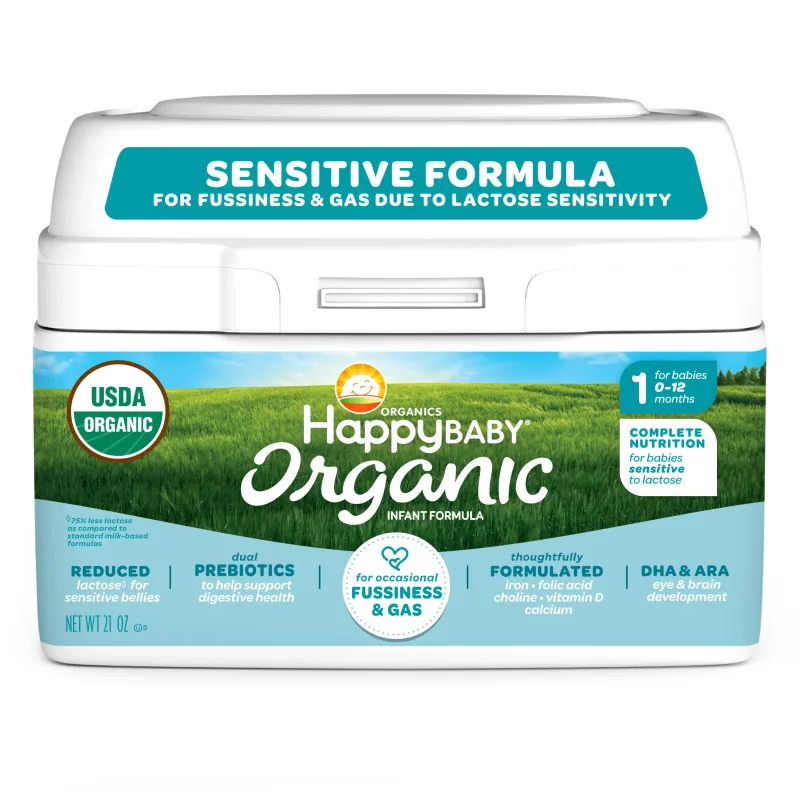
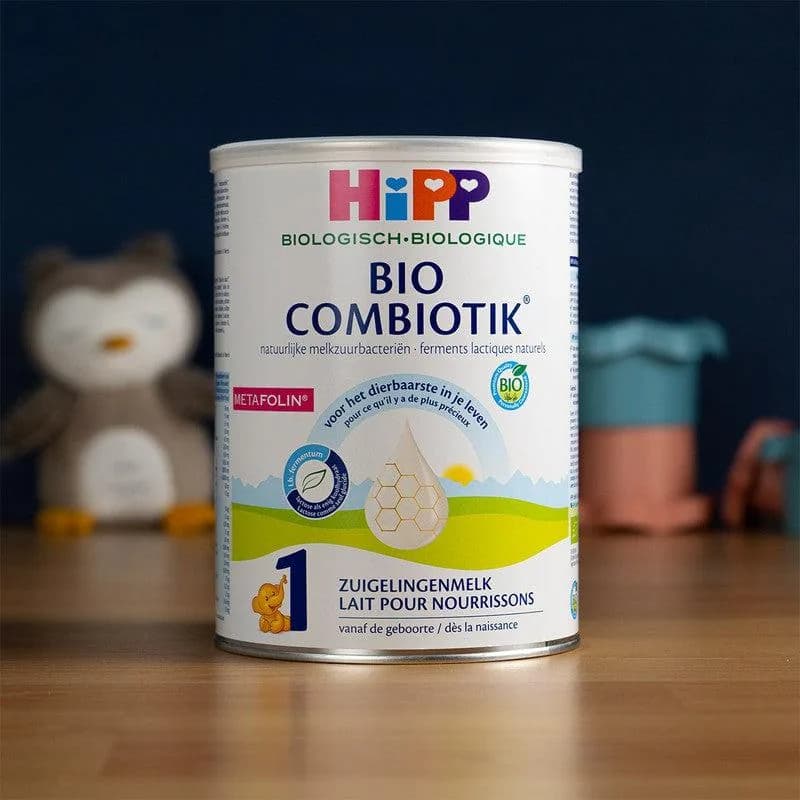
Both are organic Stage 1 formulas with a GOS prebiotic, but they diverge on carbohydrate. HiPP Dutch uses lactose as its only added carbohydrate, as EU 2016/127 requires. Happy Baby lists organic maltodextrin and glucose syrup solids ahead of the whey and the GOS, so those are its primary added carbohydrates by weight.
Happy Baby Organic Infant Formula is a widely-retailed USDA Organic US formula from Happy Family Organics (a Danone-owned US brand). HiPP Dutch Stage 1 is the most bioactive-rich EU organic Stage 1, lactose-only added carbohydrate, Combiotik (GOS and live probiotic), Metafolin folate. On paper, both are "organic premium formulas." On the ingredient list, they diverge sharply, and the divergence matters more than parents often realize when choosing.
At a glance
| Dimension | Happy Baby Organic Infant | HiPP Dutch Stage 1 |
|---|---|---|
| Manufacturer | Happy Family Organics (Danone US) | HiPP (Germany) |
| Origin | USA | Germany (Dutch-market SKU) |
| Age range | 0-12 months | 0-6 months (Stage 1) |
| Regulation | FDA 21 CFR 107 | EU 2016/127 and 2018/848 organic |
| Organic certification | USDA Organic and Non-GMO Project Verified | EU Organic |
| Protein | Skimmed cow milk and whey | Skimmed cow milk and whey |
| Whey:casein | 60:40 | 60:40 |
| Primary added carbohydrate | Organic maltodextrin and organic glucose syrup solids (listed before whey) | Lactose only (EU 2016/127) |
| Prebiotic | GOS and FOS (9:1 ratio) | GOS |
| Probiotic | None | L. fermentum hereditum (Combiotik) |
| Folate form | Folic acid | Metafolin (L-methylfolate) |
| DHA source | Algal oil (Schizochytrium), ~11.3 mg/100 ml | Fish oil, ~13.2 mg/100 ml |
| Fat blend | Palm olein, soy, coconut, safflower | Palm, rapeseed, sunflower |
| Red flags | Maltodextrin | None |
| Fat-blend notes | palm oil, soy | Palm oil |
| Typical US price | ||
| US availability | Whole Foods, Target, Amazon, specialty baby stores | Organic's Best, 5-10 day import shipping |
Typical US retail price, normalised to USD per ounce of powder. Imported European formulas carry shipping and importer margin; US retail brands are typically cheapest per ounce. Subscribe-and-save and private-label pricing can shift the ranking.
Data table
| Formula | Price per ounce |
|---|---|
| Happy Baby Organic Stage 1 | $1.90 |
| HiPP Dutch Stage 1 | $1.77 |
Why this comparison matters
Happy Baby Organic is a common US retail choice for parents who want "organic formula without importing from Europe." It's USDA Organic, FDA- registered, broadly retailed. On the organic-certification axis it's a defensible pick. On the composition axis, specifically carbohydrate composition, it makes choices that EU Regulation 2016/127 would not permit for a Stage 1 infant formula. This comparison unpacks that specifically, because parents reading marketing copy ("organic lactose!") often don't realize what the ingredient list order means.
Compositional differences that actually matter
1. Carbohydrate composition: the headline issue
This is the single most consequential differentiator and the one Happy Baby's marketing downplays. Read the ingredient list in order:
Happy Baby Organic Infant: Organic Nonfat Milk, Organic Maltodextrin, Organic Glucose Syrup Solids, Organic Palm Olein or Palm Oil, Organic Soy Oil, Organic Coconut Oil, Organic High Oleic Safflower Oil, Organic Galactooligosaccharides (GOS), Organic Whey Protein Concentrate…
HiPP Dutch Stage 1: Skimmed milk*, whey product*, vegetable oils* (palm oil*, rapeseed oil*, sunflower oil*), lactose*, galacto-oligosaccharides* from lactose*, fish oil…
The ingredient list reads in descending order by weight. Happy Baby's second and third ingredients are maltodextrin and glucose syrup solids, they appear before the vegetable oils, before the GOS, and before the whey protein. The naturally-occurring lactose from the "organic nonfat milk" component contributes some lactose to the finished formula, but the primary added carbohydrates by weight are maltodextrin and glucose syrup solids, not lactose.
HiPP Dutch lists lactose as a standalone ingredient after the milk components, and adds no maltodextrin, no glucose syrup, no corn syrup solids. EU Regulation 2016/127 Article 5.1 requires lactose predominance for standard Stage 1 infant formula unless a medical indication justifies deviation. Happy Baby's carbohydrate composition would not clear EU 2016/127 compliance for standard Stage 1.
This does not mean Happy Baby is unsafe, it's FDA-compliant and FDA-registered under 21 CFR 107, which permits maltodextrin and glucose syrup in standard infant formula. But it means a parent picking "Happy Baby because it's the organic lactose option" is reading the label wrong. For parents who want organic and lactose-primary, HiPP Dutch is structurally the better fit, as is Bobbie Original, Kendamil Organic, or Earth's Best Dairy (which actually does list organic lactose first).
2. Bioactive stack: Combiotik vs GOS and FOS only
HiPP Dutch Stage 1 adds GOS prebiotic and Limosilactobacillus fermentum hereditum® live probiotic strain (the Combiotik pairing). Happy Baby adds GOS and FOS (9:1 prebiotic ratio), both are prebiotic fibers, but Happy Baby does not include any probiotic bacterial strain.
Both brands have a legitimate prebiotic strategy. Happy Baby's GOS and FOS 9:1 ratio is the well-studied European-research ratio (same as used in some Aptamil / Nutrilon research formulations). HiPP's GOS and L. fermentum pairing adds a live bacterial strain with its own clinical trial evidence. Neither replicates breast-milk HMO complexity. See the GOS and FOS explainers.
3. Folate form: Metafolin vs folic acid
HiPP uses Metafolin (calcium L-methylfolate), the bioactive form usable without MTHFR conversion. Happy Baby uses folic acid, the synthetic oxidized form that requires MTHFR-dependent conversion. For families with MTHFR considerations, or for general metabolic optimization, Metafolin is preferred. See the Metafolin vs folic acid explainer.
4. Soy ingredients
Happy Baby includes organic soybean oil (vegetable oil blend) and organic soy lecithin (emulsifier). HiPP Dutch contains no soy, its fat blend is palm, rapeseed, and sunflower. For families specifically avoiding soy, HiPP is the cleaner choice.
5. Palm oil: both include it
Both formulas include organic palm oil in the vegetable oil blend. For palm-free premium options, consider Kendamil Organic Stage 1 (UK whole-milk fat) or Bobbie Original (US, palm-free blend). See palm oil explainer.
6. Price per ounce: the counter-intuitive part
Happy Baby is ~$1.90/oz at US retail. HiPP Dutch is ~$1.77/oz via Organic's Best subscription, cheaper, despite being imported from Europe. The ~7% price advantage for HiPP runs against the typical expectation that US-domestic formulas should be cheaper than EU imports. Happy Baby's price point appears to reflect its Danone-owned premium retail positioning rather than ingredient cost. For parents on a strict per-ounce budget, HiPP Dutch Stage 1, OB subscribe-and-save, and lactose- only carbohydrate composition and Combiotik is the structurally better value proposition, once you tolerate the 5-10 day import shipping.
Regulatory framework
Happy Baby Organic Infant complies with FDA 21 CFR Part 107 (pre- market notification, Part 106 quality control, FSMA recall authority). USDA Organic (NOP) and Non-GMO Project Verified layer on top. Happy Family Organics is a Danone-owned US brand.
HiPP Dutch Stage 1 complies with EU Regulation 2016/127 (infant formula, mandatory lactose predominance, mandatory DHA, mandatory vitamin/mineral ranges per Annex I) plus EU Regulation 2018/848 (organic). Not FDA-registered; families import under FDA enforcement discretion, see the buying European formula pillar.
The lactose-predominance requirement is a meaningful EU-vs-US regulatory divergence, documented in our FDA vs EFSA standards comparison.
Real-world parent experience
Following site methodology, the observations below come from my personal use across both kids plus a stable pool of parent-feedback notes from families on both formulas. They carry the parent-experience label rather than being claimed as regulatory or clinical facts, because individual infant variation on stool consistency, smell preference, and mixability is large enough that any specific point can reverse for a specific baby. Read these as context, not prediction.
Smell and taste. HiPP Dutch has traditional European dairy character (richer, milkier notes). Happy Baby is sweeter and starchier, the maltodextrin and glucose syrup contributions are noticeable in the taste profile and match the sweeter end of the US market. Most infants accept either, though some transitioning from breast milk adjust faster to HiPP's more neutral profile.
Mixability. Both dissolve cleanly at 70°C. Happy Baby's 21 oz container is US-standard. HiPP's 800 g metal tin is larger-format European packaging.
Stool consistency. HiPP families often report softer, more yogurt- like stools (L. fermentum probiotic contribution). Happy Baby families report moderate firmness with some reports of firmer-than-expected stools (palm oil and glucose syrup contributions). Neither is concerning for term infants without other symptoms.
Switching between them. Use a 4-6 day gradual transition. The maltodextrin → lactose transition (Happy Baby → HiPP) can temporarily shift stool character as infant gut bacteria re-adapt.
Verdict: when to pick each
Pick HiPP Dutch Stage 1 (most cases):
- You want organic Stage 1 with lactose as the only added carbohydrate (EU 2016/127 standard, not present in Happy Baby)
- Combiotik probiotic (L. fermentum) matters
- Metafolin folate matters (MTHFR or general optimization)
- No soy is a must-have
- Lower per-ounce price matters
- 5-10 day import shipping is tolerable
Pick Happy Baby Organic Infant if:
- FDA registration is a binding requirement
- You need immediate US supermarket availability (not 5-10 day import)
- GOS and FOS 9:1 prebiotic ratio specifically resonates (rather than GOS and probiotic)
- Maltodextrin and glucose syrup solids as primary added carbs are acceptable, many parents would not pick Happy Baby if they read the ingredient list order carefully
Pick neither if:
- Palm oil avoidance is a must-have, both include it. Consider Kendamil Organic or Bobbie Original.
- You need FDA-registered, lactose-first, and organic, that's Bobbie Original or Earth's Best Dairy.
What you can't infer from this comparison
Neither is indicated for diagnosed cow milk protein allergy, see the CMPA pillar. Neither is reflux-specific. Neither is appropriate for preterm infants. "Maltodextrin in primary carb position" is a composition choice to flag, not a safety risk. FDA 21 CFR 107 permits it; no clinical harm is documented at the concentrations used.
Frequently asked questions
Does Happy Baby Organic Infant have lactose as primary carbohydrate?
Is maltodextrin in infant formula bad?
Why is HiPP Dutch cheaper than Happy Baby?
Does Happy Baby have a probiotic?
Does Happy Baby Organic Infant have 2'-FL HMO?
Is Happy Baby WIC-eligible?
Can I switch my baby from Happy Baby to HiPP Dutch?
Related reading
- Happy Baby brand hub
- HiPP brand hub
- Best baby formulas, the head-to-head US organic comparison (coming soon)
- FDA vs EFSA standards, the lactose-predominance regulatory divergence
- Metafolin vs folic acid explainer
- Buying European formula in the USA
- Happy Baby Organic Infant vs Similac Organic - Danone US vs Abbott USDA Organic
- Best Non-GMO Baby Formulas for US Families (2026 Buying Guide)
Primary sources
- Happy Family Organics, manufacturer product information. happyfamilyorganics.com
- HiPP, manufacturer product information. hipp.com
- USDA National Organic Program. ams.usda.gov
- EU Regulation 2016/127, infant formula compositional requirements including lactose predominance (Article 5.1). eur-lex.europa.eu
- FDA 21 CFR Part 107. US infant formula regulation. ecfr.gov
This site provides research and comparisons, not medical advice. Consult your pediatrician before changing your baby's formula.