
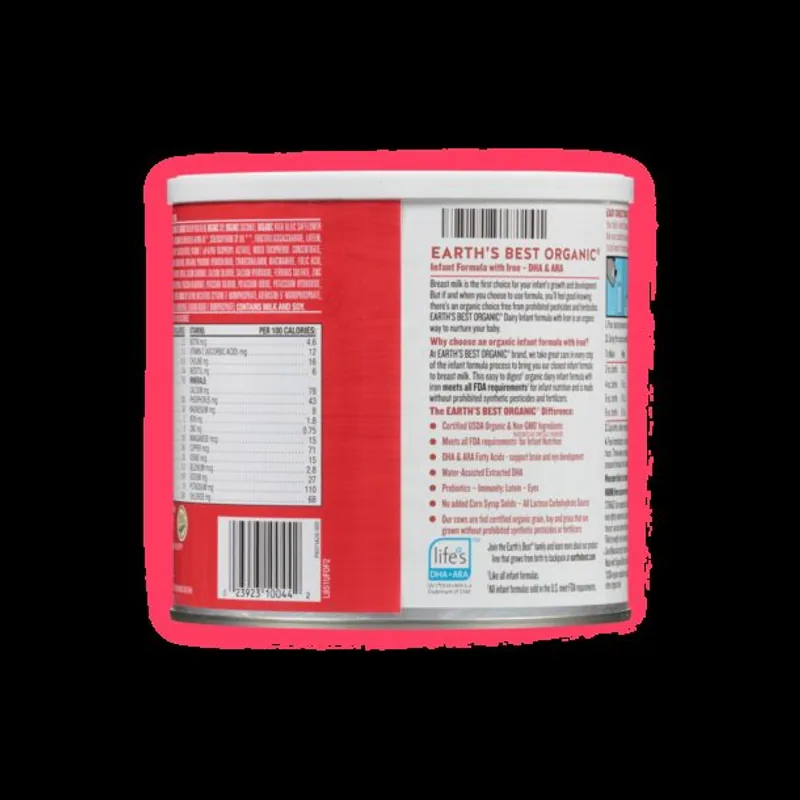
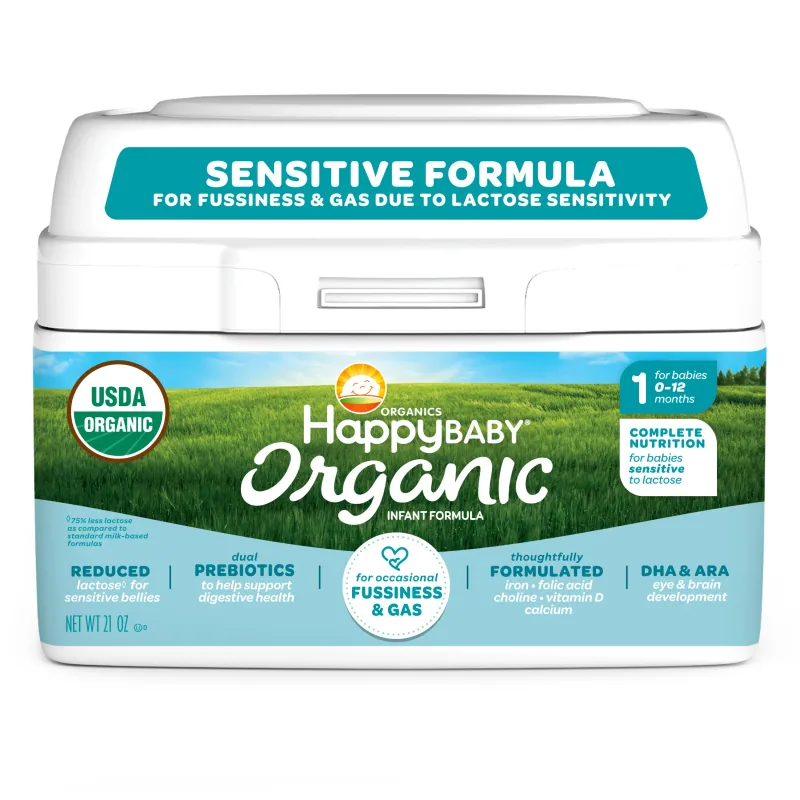
Earth's Best Organic Dairy and Happy Baby Organic Infant are both widely-retailed US supermarket USDA Organic infant formulas, same national organic label, same FDA registration, same broad grocery distribution (Whole Foods, Target, Walmart, Kroger, Amazon). Parents comparing them usually weigh: Earth's Best's long US-organic heritage, lactose-first composition, and WIC eligibility vs Happy Baby's Danone-scale manufacturing, GOS, and FOS 9:1 prebiotic and larger 21 oz format.
Earth's Best Organic Dairy and Happy Baby Organic Infant are both USDA Organic and FDA-registered Stage 1 cow-milk formulas retailed broadly across US supermarkets. Earth's Best uses lactose as primary added carbohydrate and FOS prebiotic, at ~$1.29/oz: WIC-eligible in several US states. Happy Baby uses organic maltodextrin and glucose syrup solids as primary added carbohydrates, GOS, and FOS 9:1 prebiotic, at ~$1.90/oz. Both include palm oil and soy in their vegetable oil blends. Both are 60:40 whey:casein.
Why this comparison matters
Both brands target the same shelf space, the Whole Foods / Target / Amazon organic formula aisle. Parents comparing them are usually not choosing between "organic vs non-organic" (both qualify) but between "long-heritage supermarket organic with FOS" and "Danone-owned organic with GOS and FOS plus maltodextrin-primary carbohydrate." Price, WIC, and carbohydrate composition typically decide.
At a glance
| Dimension | Earth's Best Organic Dairy | Happy Baby Organic Infant |
|---|---|---|
| Manufacturer | Hain Celestial Group (US) | Happy Family Organics (Danone US) |
| Age range | 0-12 months | 0-12 months |
| Regulation | FDA 21 CFR 107 | FDA 21 CFR 107 |
| Organic certification | USDA Organic and Non-GMO Project Verified | USDA Organic and Non-GMO Project Verified |
| Protein | Skimmed cow milk and whey | Skimmed cow milk and whey |
| Whey:casein | 60:40 | 60:40 |
| Primary added carbohydrate | Lactose (primary) | Maltodextrin and glucose syrup solids (listed before whey) |
| Prebiotic | FOS | GOS and FOS (9:1 ratio) |
| Probiotic | None | None |
| HMO | None | None |
| Folate form | Folic acid | Folic acid |
| DHA source | Algal oil, ~11 mg/100 ml | Algal oil, ~11.3 mg/100 ml |
| Fat blend | Palm olein, soybean oil, coconut, and safflower | Palm olein, soybean oil, coconut, and safflower |
| Red flags | None | Maltodextrin |
| Fat-blend notes | Palm oil, soy | palm oil, soy |
| Format | 23.2 oz container | 21 oz container |
| Typical price | ||
| WIC eligibility | Covered in several US states | Varies; less broadly covered |
| US availability | Broad supermarket (Whole Foods, Target, Walmart, Kroger, Amazon) | Broad supermarket (Whole Foods, Target, Kroger, Amazon, specialty baby stores) |
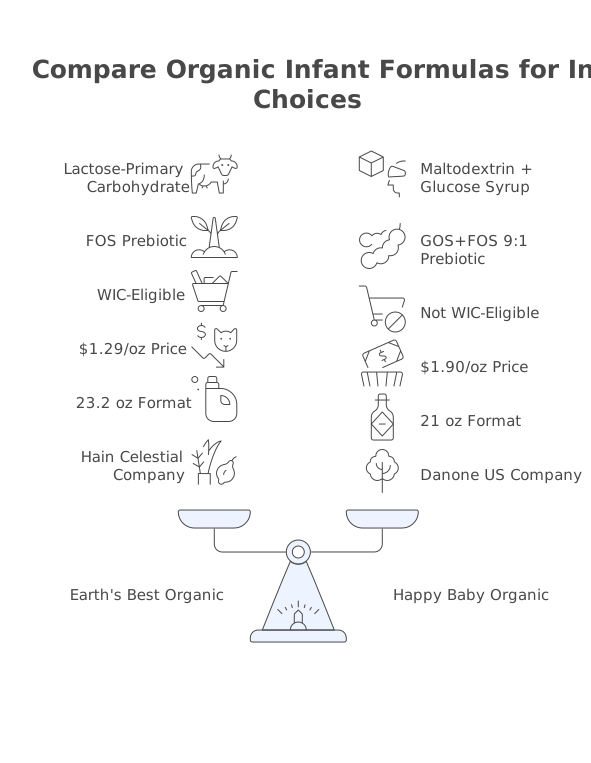
Visual generated with Napkin AI, editorial review by María López Botín. See methodology for our use policy.
Compositional differences that actually matter
1. Carbohydrate composition: the primary differentiator
This is the single most consequential point.
Earth's Best Organic Dairy: ingredient list starts Organic lactose, organic nonfat milk, organic oils..., lactose listed first. Primary added carbohydrate is lactose.
Happy Baby Organic Infant: ingredient list starts Organic Nonfat Milk, Organic Maltodextrin, Organic Glucose Syrup Solids, Organic Palm Olein or Palm Oil, Organic Soy Oil, Organic Coconut Oil, Organic High Oleic Safflower Oil, Organic Galactooligosaccharides (GOS), Organic Whey Protein Concentrate…
Happy Baby's second and third ingredients are organic maltodextrin and organic glucose syrup solids, listed before the whey protein and before the GOS. By ingredient-list weight ordering, those are the primary added carbohydrates.
This is the deepest compositional divergence. Earth's Best matches the EU Regulation 2016/127 lactose-predominance standard at the ingredient-order level. Happy Baby does not.
FDA 21 CFR 107 permits maltodextrin and glucose syrup in standard US infant formula, legal, documented-safe at the concentrations used. But the carbohydrate structure is noticeably different: lactose is the breast-milk carbohydrate; maltodextrin and glucose syrup are added carbohydrate sweeteners that ferment differently in the infant gut.
2. Prebiotic strategy: Happy Baby adds GOS, Earth's Best has FOS only
Earth's Best: FOS (fructo-oligosaccharides) as prebiotic fiber.
Happy Baby: GOS and FOS at 9:1 ratio, the well-studied European research ratio used across Aptamil and some Nutrilon lines. Adds GOS as the dominant prebiotic fiber, FOS as a minor secondary.
Both contribute prebiotic fiber to the infant gut; the clinical equivalence is close. GOS is the more dominant prebiotic in breast milk; Happy Baby's GOS-weighted ratio is slightly closer to breast milk's prebiotic profile. See GOS explainer and FOS explainer.
3. Fat blend: both palm and soy, both standard US-organic approach
Earth's Best: organic palm olein, organic soybean oil, and organic coconut oil and organic safflower oil.
Happy Baby: organic palm olein (or palm oil) and organic soybean oil, organic coconut oil, and organic high oleic safflower oil.
Effectively identical fat-blend composition. Both include palm and soy. For palm-free US organic: Bobbie Original. For palm-free, whole-milk fat, and organic: Kendamil Organic via EU import. See the palm oil explainer.
4. DHA level
Earth's Best ~11 mg DHA / 100 ml. Happy Baby ~11.3 mg. Effectively identical, both FDA-compliant, both algal source (vegetarian-friendly).
5. Price per ounce: Earth's Best substantially cheaper
Earth's Best ~$1.29/oz. Happy Baby ~$1.90/oz. ~47% price difference favoring Earth's Best. On 100-oz/week feeding, that's ~$53/week, ~$230/month savings.
6. WIC eligibility: Earth's Best's competitive advantage
Earth's Best Organic Dairy is on several state WIC approved-product lists. For WIC-eligible families in those states, Earth's Best is effectively free.
Happy Baby WIC coverage is less common, some states include it, many don't. Check your state's WIC list directly.
For WIC-eligible families, Earth's Best is typically the decisive winner on cost-to-family even before composition preferences are considered.
7. Corporate ownership: Hain Celestial vs Danone
Earth's Best is owned by Hain Celestial Group (US holding company, owns multiple natural/organic food brands including Celestial Seasonings, Spectrum, Imagine). Long US organic heritage: Earth's Best infant formula has been produced since 1985 (the oldest continuously-produced US organic infant formula).
Happy Baby is owned by Danone (French multinational, also owns Nutricia, Aptamil, Neocate). Global consumer-goods company with substantial manufacturing scale.
For parents who weight independent-heritage ownership vs global- conglomerate ownership, Earth's Best sits closer to independent positioning than Happy Baby.
8. Format: 23.2 oz vs 21 oz
Earth's Best: 23.2 oz container. Happy Baby: 21 oz container. ~10% larger format on Earth's Best, slightly better packaging economics.
Regulatory framework
Both comply with FDA 21 CFR Part 107 and USDA National Organic Program and Non-GMO Project Verified. Both are US-domestic manufacturing. Both benefit from FSMA recall authority.
Real-world parent experience
Following site methodology, the observations below come from my personal use across both kids plus a stable pool of parent-feedback notes from families on both formulas. They carry the parent-experience label rather than being claimed as regulatory or clinical facts, because individual infant variation on stool consistency, smell preference, and mixability is large enough that any specific point can reverse for a specific baby. Read these as context, not prediction.
Smell and taste. Earth's Best has a cleaner, slightly drier profile — typical US organic supermarket character. Happy Baby is noticeably sweeter and starchier, the maltodextrin and glucose syrup solids contribute sensorially. Most infants accept either; some families report easier transition from breast milk onto Earth's Best's less- sweet profile.
Mixability. Both dissolve cleanly with 70°C preparation water. Earth's Best's 23.2 oz container vs Happy Baby's 21 oz, comparable, Earth's Best slightly larger.
Stool consistency. Earth's Best families report moderate firmness typical of palm-inclusive FOS formulas. Happy Baby families report moderate consistency: GOS-dominant prebiotic sometimes produces slightly softer stools than FOS-only for the first week of use. Neither is concerning.
Switching between them. Use a 4-6 day gradual transition. Both USDA Organic and 60:40 whey:casein, palm-inclusive, and soy, the fat-blend and protein macro composition transitions smoothly. Main observable shift: lactose-primary ↔ maltodextrin and glucose syrup primary, this is a more pronounced gut-microbiome shift than the usual brand switch, as fermentation substrates change meaningfully. Expect 1-2 weeks of stool and gas-pattern adjustment. The FOS ↔ GOS and FOS prebiotic shift is secondary but contributes.
Verdict: when to pick each
Pick Earth's Best Organic Dairy if:
- Lowest USDA Organic per-oz price is the binding constraint
- WIC covers Earth's Best in your state (often decisive)
- Lactose-primary carbohydrate composition matters (Earth's Best matches the EU 2016/127 standard at the ingredient-order level)
- Long-heritage US organic brand recognition resonates (since 1985)
- FOS prebiotic is acceptable (no GOS)
Pick Happy Baby Organic Infant if:
- GOS and FOS 9:1 prebiotic specifically resonates (the European research ratio)
- Danone manufacturing scale matters (global pediatric nutrition R&D)
- Broad supermarket availability at a slightly higher price is acceptable
- Maltodextrin and glucose syrup solids as primary added carbohydrates are acceptable for your family
Pick neither if:
- Palm-free and no soy are must-haves, Bobbie Original
- Organic, whole-milk fat, and palm-free, Kendamil Organic Stage 1 (EU Organic via Organic's Best)
- Bioactive depth with HMO: Similac 360 Total Care (5 HMOs, non- organic) or Enfamil Enspire (2'-FL, MFGM, and lactoferrin, non-organic)
What you can't infer from this comparison
Both are safe, USDA Organic, FDA-registered, compliant. Neither is indicated for diagnosed cow milk protein allergy. Price and composition differences reflect formulation choices and brand positioning, not quality tier judgments.
Frequently asked questions
Is Earth's Best or Happy Baby cheaper?
Does Earth's Best have lactose as primary carbohydrate?
Does Happy Baby have maltodextrin in it?
Is Earth's Best WIC-eligible?
Are Earth's Best and Happy Baby both USDA Organic?
Can I switch from Earth's Best to Happy Baby or vice versa?
Which is better for a sensitive baby?
Related reading
- Earth's Best brand hub
- Happy Baby brand hub
- Bobbie Original vs Earth's Best Dairy, premium vs supermarket USDA Organic
- Bobbie Original vs Happy Baby Organic Infant, lactose-only premium vs maltodextrin-primary
- Earth's Best Dairy vs HiPP Dutch Stage 1, budget US organic vs EU Combiotik
- Happy Baby Organic Infant vs HiPP Dutch Stage 1, maltodextrin vs lactose-only EU Combiotik
- FDA vs EFSA standards, the lactose-predominance regulatory divergence
- Palm oil explainer
- Happy Baby Organic Infant vs Similac Organic - Danone US vs Abbott USDA Organic
Primary sources
- Earth's Best, manufacturer product information. earthsbest.com
- Happy Family Organics, manufacturer product information. happyfamilyorganics.com
- USDA National Organic Program. ams.usda.gov
- FDA 21 CFR Part 107. US infant formula regulation. ecfr.gov
- USDA WIC program, state-by-state eligibility varies. fns.usda.gov/wic
- EFSA Scientific Opinion on compositional requirements for infant formula. efsa.europa.eu
This site provides research and comparisons, not medical advice. Consult your pediatrician before changing your baby's formula.