
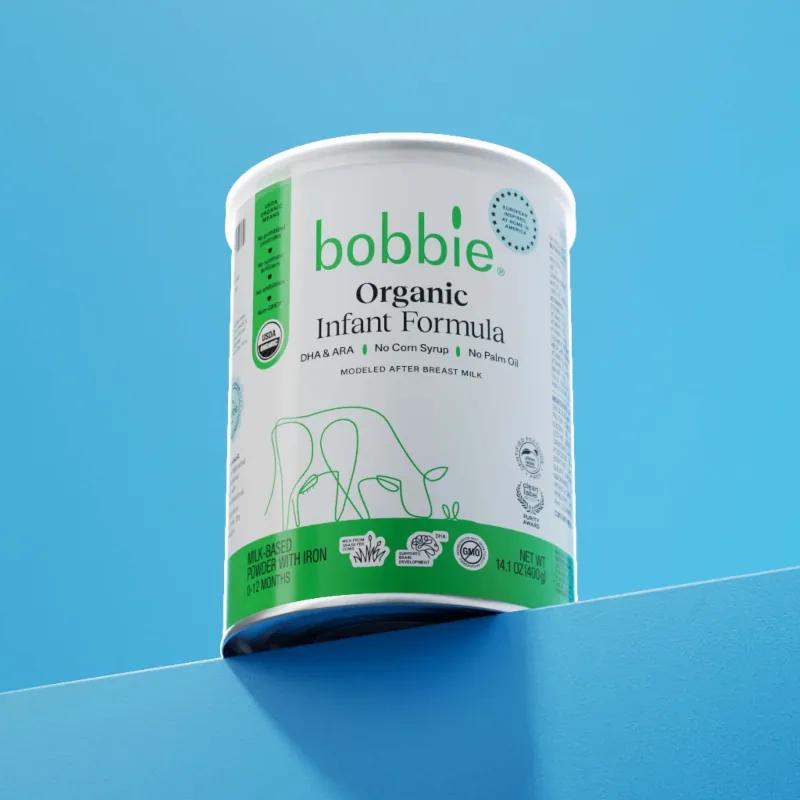
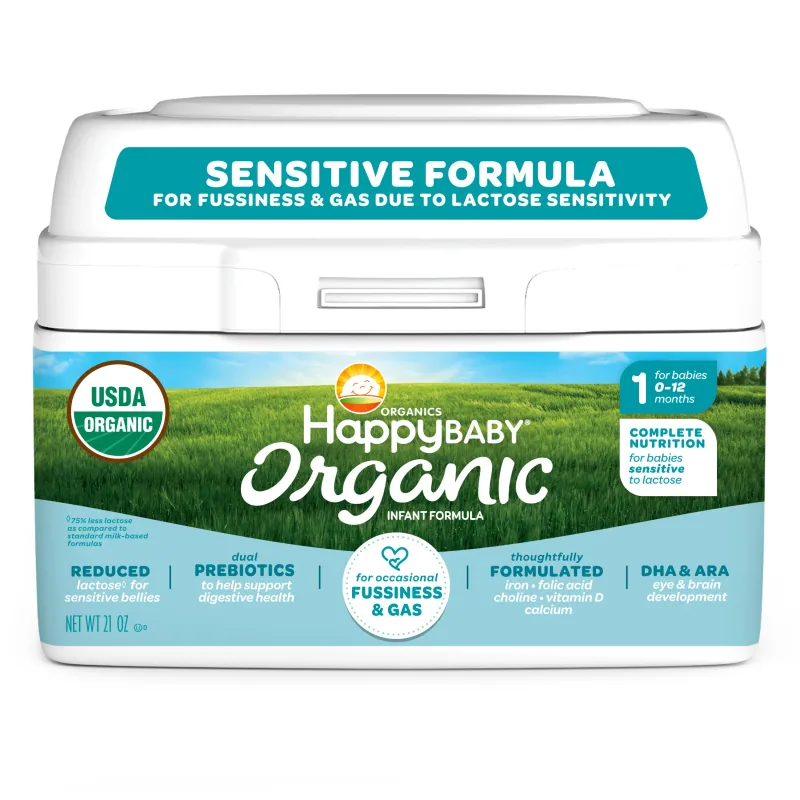
Bobbie Original and Happy Baby Organic Infant are both USDA Organic premium formulas parents compare frequently, both sold at Whole Foods, both certified by the same USDA National Organic Program, both FDA-registered. On the ingredient list they diverge sharply. Bobbie is palm-free, soy-free, and lactose-only as the added carbohydrate. Happy Baby uses palm oil, soybean oil, soy lecithin, and lists organic maltodextrin plus organic glucose syrup solids before the whey protein — meaning those are the primary added carbs by weight. Same organic label, noticeably different compositions.
Bobbie Original and Happy Baby Organic Infant are both USDA Organic and FDA-registered Stage 1 cow-milk formulas. Bobbie is palm-free, no soy, lactose-only added carbohydrate, and Clean Label Project Purity Award at ~$2.94/oz. Happy Baby is palm and soy and maltodextrin and glucose syrup solids as primary added carbohydrates and GOS and FOS 9:1 prebiotic at ~$1.90/oz. The USDA Organic label hides a deep composition divergence — especially on carbohydrate structure.
Why this comparison matters
Parents comparing Bobbie and Happy Baby often assume "both are USDA Organic" means "both are in their ingredients similar." The ingredient-list order reveals the opposite. Happy Baby's second and third ingredients are organic maltodextrin and organic glucose syrup solids, listed before the whey protein concentrate, so those are the primary added carbohydrates by weight. Bobbie adds only lactose as its carbohydrate. For parents who specifically want "organic Stage 1 with lactose as the primary carb" (the EU 2016/127 standard), Bobbie matches and Happy Baby does not.
At a glance
| Dimension | Bobbie Original | Happy Baby Organic Infant |
|---|---|---|
| Manufacturer | Bobbie (US-contract Perrigo and Dutch Heerlen) | Happy Family Organics (Danone US) |
| Origin | USA | USA |
| Age range | 0-12 months | 0-12 months |
| Regulation | FDA 21 CFR 107 | FDA 21 CFR 107 |
| Organic certification | USDA Organic and Non-GMO Project and Clean Label Project Purity Award | USDA Organic and Non-GMO Project Verified |
| Protein | Skimmed cow milk and whey | Skimmed cow milk and whey |
| Whey:casein | 60:40 | 60:40 |
| Primary added carbohydrate | Lactose (only added) | Organic maltodextrin and organic glucose syrup solids |
| Prebiotic | None | GOS and FOS (9:1 ratio) |
| Probiotic | None | None |
| Folate form | Folic acid | Folic acid |
| DHA source | Algal oil, ~13.4 mg/100 ml | Algal oil, ~11.3 mg/100 ml |
| Fat blend | Coconut, sunflower, rapeseed (no palm, no soy) | Palm olein, soybean oil, coconut, and safflower |
| Red flags | None | **Maltodextrin, ** |
| Fat-blend notes | None | palm oil, soy |
| Format | 14 oz tin | 21 oz container |
| Typical price | ||
| US availability | Target, Amazon, Bobbie direct, Whole Foods | Whole Foods, Target, Kroger, Amazon, specialty baby stores |
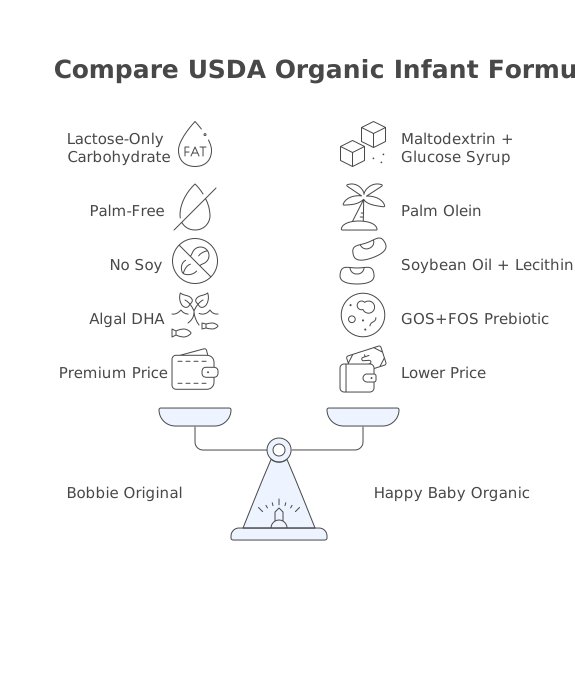
Visual generated with Napkin AI, editorial review by María López Botín. See methodology for our use policy.
Compositional differences that actually matter
1. The carbohydrate composition: Bobbie's biggest advantage
This is the single most consequential point of comparison.
Bobbie Original uses lactose as the only added carbohydrate. Ingredient list order: Organic nonfat milk, organic whey protein concentrate, organic lactose…
Happy Baby Organic Infant ingredient list: Organic Nonfat Milk, Organic Maltodextrin, Organic Glucose Syrup Solids, Organic Palm Olein or Palm Oil, Organic Soy Oil, Organic Coconut Oil, Organic High Oleic Safflower Oil, Organic Galactooligosaccharides (GOS), Organic Whey Protein Concentrate…
The second and third ingredients in Happy Baby are organic maltodextrin and organic glucose syrup solids, listed before the GOS and before the whey protein concentrate. By ingredient-list weight ordering, those are the primary added carbohydrates. The naturally-occurring lactose from the "organic nonfat milk" component contributes lactose too, but the added primary carbs are maltodextrin and glucose syrup.
EU Regulation 2016/127 Article 5.1 requires lactose predominance for standard Stage 1 infant formula unless medical indication justifies deviation. Happy Baby's carbohydrate composition would not clear EU 2016/127 for standard Stage 1. FDA 21 CFR 107 permits maltodextrin and glucose syrup in US infant formula, legal and documented-safe at the concentrations used, but a different composition standard than the EU lactose-primary baseline. See our FDA vs EFSA standards comparison.
For parents who specifically want "organic and lactose-primary" as their criterion, Bobbie matches. Happy Baby does not, regardless of the USDA Organic certification.
2. Palm oil and soy ingredients
Bobbie excludes both palm oil and soy. Fat blend: coconut, sunflower, and rapeseed only. No soy oil, no soy lecithin.
Happy Baby includes organic palm olein (or palm oil), organic soybean oil, and organic soy lecithin (as an emulsifier inside the vegetable oil blend). Both soy components are label-declared allergens.
For families avoiding palm oil, soy, or both: Bobbie wins cleanly. See the palm oil explainer.
3. Prebiotic: Happy Baby adds GOS and FOS 9:1, Bobbie adds none
Happy Baby includes GOS (galacto-oligosaccharides) and FOS (fructo- oligosaccharides) at a 9:1 ratio, the well-studied European research ratio used across Aptamil and some Nutrilon formulations. Two prebiotic fiber classes.
Bobbie Original adds no prebiotic or probiotic. Clean-label minimal-additive approach.
Neither has 2'-FL HMO. For parents valuing prebiotic fiber inclusion, Happy Baby wins on this narrow dimension. See the GOS explainer and FOS explainer.
4. DHA level and source
Bobbie ~13.4 mg DHA / 100 ml (algal oil). Happy Baby ~11.3 mg DHA / 100 ml (algal oil). Both vegetarian-friendly algal source. Bobbie ~19% higher. Both meet FDA requirements; Bobbie's higher level sits closer to upper-range breast-milk DHA.
5. Certification testing beyond USDA Organic
Bobbie adds Clean Label Project Purity Award, third-party testing for 400 and environmental contaminants (heavy metals, pesticides, industrial chemicals). A distinct certification beyond USDA Organic farming rules.
Happy Baby adds Non-GMO Project Verified (which Bobbie also has). Does not carry Clean Label Project Purity Award.
For parents specifically valuing contaminant-testing assurance, Bobbie has the formal certification that Happy Baby lacks. Not a quality signal per se, just a different certification scope.
6. Price per ounce: Happy Baby cheaper
Happy Baby ~$1.90/oz. Bobbie $2.94/oz at retail ($2.50/oz with
subscribe-and-save). ~35-55% price difference depending on
Bobbie price path. On a 100-oz/week feeding schedule, that's
~$50-$100/month.
7. Brand positioning: independent vs Danone
Bobbie is an independent US challenger brand (founded 2018). Happy Baby is part of Happy Family Organics, owned by Danone — the same French multinational that owns Nutricia, Aptamil, Neocate. For parents who weight "independent challenger" vs "subsidiary of global conglomerate," Bobbie sits on the independent side.
Regulatory framework
Both comply with FDA 21 CFR Part 107 and USDA National Organic Program. Both carry Non-GMO Project Verified. Both are US-domestic manufacturing. Both benefit from FSMA recall authority.
The USDA Organic label covers: organic feed, no synthetic pesticides on agricultural inputs, no GMO, no irradiation, no sewage sludge fertilizer. It does not regulate specific composition choices like maltodextrin inclusion, glucose syrup inclusion, palm/soy inclusion, or prebiotic addition. Those are product-level formulation decisions within USDA Organic rules.
Real-world parent experience
Following site methodology, the observations below come from my personal use across both kids plus a stable pool of parent-feedback notes from families on both formulas. They carry the parent-experience label rather than being claimed as regulatory or clinical facts, because individual infant variation on stool consistency, smell preference, and mixability is large enough that any specific point can reverse for a specific baby. Read these as context, not prediction.
Smell and taste. Bobbie has a clean neutral profile. Happy Baby has a sweeter, slightly starchier profile, the maltodextrin and glucose syrup solids contribute noticeably to sensory character, reading as sweet and closer to the US mainstream formula profile. Most infants accept either.
Mixability. Both dissolve cleanly with typical shake preparation at 70°C. Happy Baby's 21 oz container is larger than Bobbie's 14 oz tin — fewer repurchases.
Stool consistency. Bobbie families commonly report moderate-to- soft stools (palm-free and algal DHA). Happy Baby families report moderate consistency, the maltodextrin, glucose syrup carbohydrate structure, and palm-inclusive fat blend together produce typical US- formula stool patterns. Neither is concerning for term infants without other symptoms.
Switching between them. Use a 4-6 day gradual transition. Main observable changes: palm-free ↔ palm-inclusive fat blend shift (7-10 days stool adjustment), maltodextrin and glucose syrup ↔ lactose- only carbohydrate shift (more significant, gut bacteria re-adapt to different fermentation substrates, sometimes producing a 1-2 week transition), soy addition/removal (usually uneventful).
Verdict: when to pick each
Pick Bobbie Original if:
- Lactose-only carbohydrate is a must-have (the single most consequential Bobbie advantage)
- Palm-free and no soy are must-haves
- Clean Label Project contaminant-testing assurance resonates
- Higher DHA (~13.4 mg vs 11.3 mg) matters
- Independent challenger brand positioning resonates
Pick Happy Baby Organic Infant if:
- USDA Organic certification is sufficient without the composition specifics (maltodextrin / palm / soy are acceptable)
- GOS and FOS 9:1 prebiotic inclusion is desirable
- Broad supermarket availability matters (Whole Foods, Target, Kroger)
- ~35% lower per-ounce price matters
- You're comfortable with Danone (parent company) ownership
Pick neither if:
- You want EU Organic, whole-milk fat, and palm-free, consider Kendamil Organic Stage 1
- You want EU Organic, Combiotik probiotic, and Metafolin folate — consider HiPP Dutch Stage 1
What you can't infer from this comparison
Both are safe, USDA Organic, FDA-registered, compliant. Neither is indicated for diagnosed cow milk protein allergy. "Maltodextrin in the primary carb position" is a composition choice to understand, not a safety red flag. FDA 21 CFR 107 permits it and no clinical harm is documented at the concentrations used. The price difference reflects composition choices and brand positioning, not a quality tier judgment.
Frequently asked questions
Is Bobbie or Happy Baby cheaper?
Are Bobbie and Happy Baby both USDA Organic?
Does Happy Baby have maltodextrin in it?
Does Bobbie Original have palm oil?
Does Happy Baby have HMO?
Can I switch from Bobbie to Happy Baby or vice versa?
Is Happy Baby owned by a big corporation?
Related reading
- Bobbie brand hub
- Happy Baby brand hub
- Bobbie Original vs Earth's Best Dairy. USDA Organic premium vs supermarket tier
- Bobbie Original vs Kendamil Organic Stage 1. US vs EU palm-free organic
- Happy Baby Organic Infant vs HiPP Dutch Stage 1, maltodextrin vs lactose-only EU Combiotik
- FDA vs EFSA standards, the lactose-predominance regulatory divergence
- Palm oil explainer
- Happy Baby Organic Infant vs Similac Organic - Danone US vs Abbott USDA Organic
Primary sources
- Bobbie, official US-market product information. hibobbie.com
- Happy Family Organics, manufacturer product information. happyfamilyorganics.com
- USDA National Organic Program. ams.usda.gov
- FDA 21 CFR Part 107. US infant formula regulation. ecfr.gov
- EU Regulation 2016/127, infant formula compositional requirements (lactose-predominance reference). eur-lex.europa.eu
- EFSA Scientific Opinion on compositional requirements for infant formula. efsa.europa.eu
This site provides research and comparisons, not medical advice. Consult your pediatrician before changing your baby's formula.