
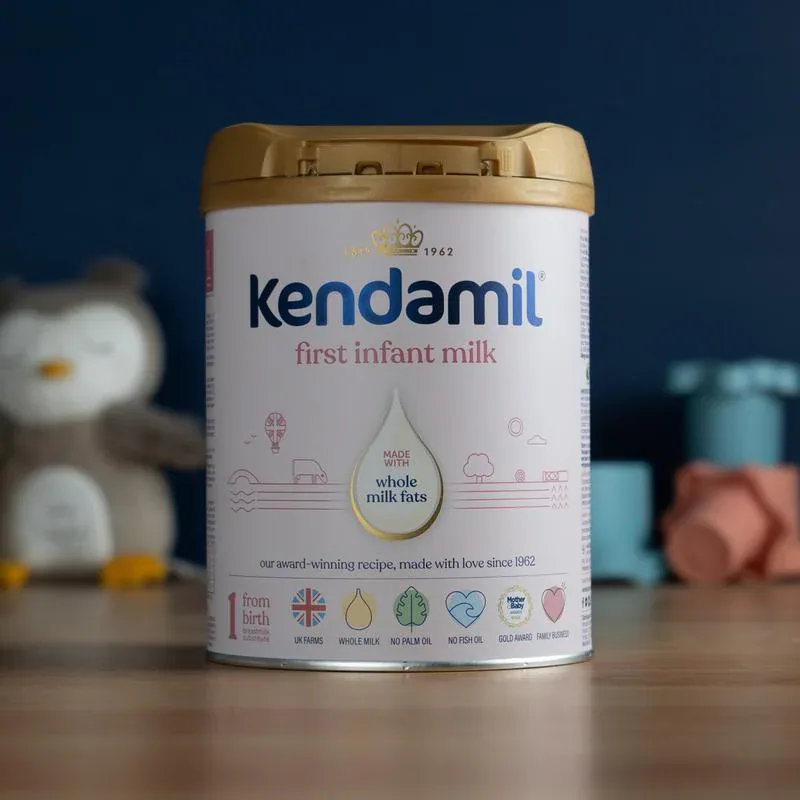
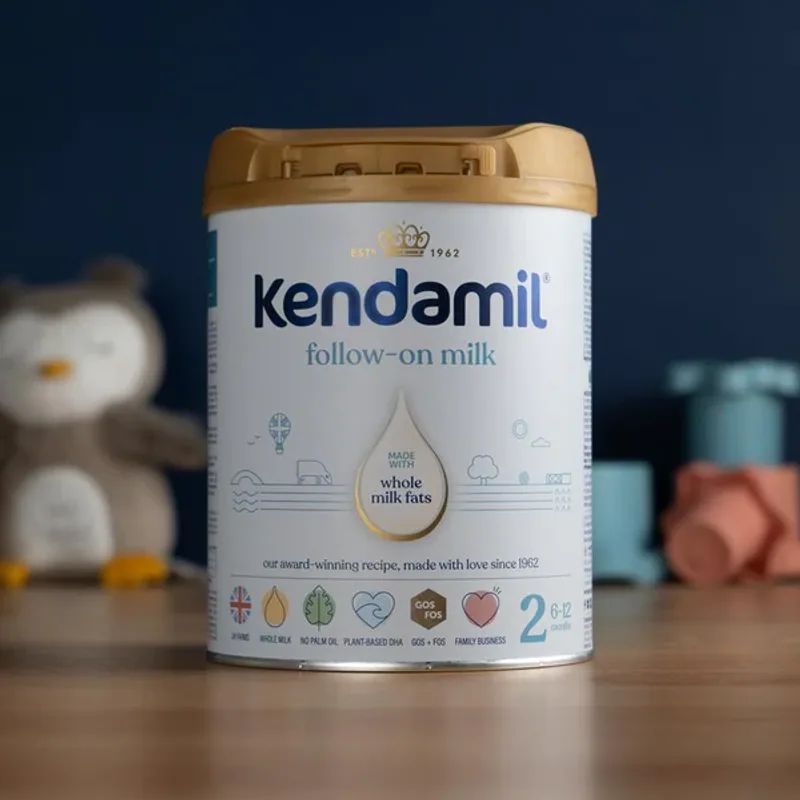
Stage 1 (0-6m): whole-milk-fat and palm-free and GOS, FOS, and protein 1.3 g/100 ml and iron 0.66 mg and DHA 16.1 mg and Red Tractor farm-certified. Stage 2 (6-12m): same whole-milk-fat, palm-free, and GOS, FOS base, and protein 1.4 g and iron 1.0 mg (~50% higher) + DHA 16.1 mg. Signature Kendamil philosophy preserved; age- appropriate fortification adjusted.
Kendamil Classic Stage 1 and Stage 2 are the two primary Kendamil SKUs for families choosing the UK whole-milk-fat, palm-free, and Red Tractor farm-certified approach to EU formula. The Stage 1 → Stage 2 transition at 6 months preserves every signature Kendamil feature, whole milk fat, palm-free blend, GOS and FOS (9:1 ratio), and the distinctive DHA 16.1 mg level, while adjusting iron and protein for the 6-12 month window. This is the most composition-consistent EU stage transition in the Kendamil line.
At a glance
| Dimension | Kendamil Classic Stage 1 | Kendamil Classic Stage 2 |
|---|---|---|
| Age range | 0-6 months | 6-12 months |
| EU regulation | EU 2016/127 (infant formula) | EU 2016/128 (follow-on) |
| UK certification | Red Tractor farm-certified | Red Tractor farm-certified |
| FDA status | Not FDA-registered (personal import enforcement discretion) | Not FDA-registered (personal import enforcement discretion) |
| Energy | 67 kcal / 100 ml | 67 kcal / 100 ml |
| Protein | 1.3 g / 100 ml | 1.4 g / 100 ml |
| Whey:casein | 60:40 | 60:40 |
| Primary carbohydrate | Lactose | Lactose |
| Carbohydrates | 7.2 g / 100 ml | 8.0 g / 100 ml |
| Fat | 3.6 g / 100 ml | 3.2 g / 100 ml (slight decrease) |
| Iron | 0.66 mg / 100 ml | 1.0 mg / 100 ml (+~50%) |
| DHA | 16.1 mg / 100 ml | 16.1 mg / 100 ml (same) |
| Whole milk fat | Yes (~50% of fat blend) | Yes (~50% of fat blend) |
| Palm-free | Yes | Yes |
| Prebiotic | GOS and FOS (9:1 ratio) | GOS and FOS (9:1 ratio) |
| Probiotic | None | None |
| HMO | None | None |
| Folate | Folic acid | Folic acid |
| Iron form | Iron pyrophosphate | Iron pyrophosphate |
| Format | 800 g tin | 800 g tin |
| Typical price (US) |
Typical US retail price, normalised to USD per ounce of powder. Imported European formulas carry shipping and importer margin; US retail brands are typically cheapest per ounce. Subscribe-and-save and private-label pricing can shift the ranking.
Data table
| Formula | Price per ounce |
|---|---|
| Kendamil Classic Stage 1 | $1.30 |
| Kendamil Classic Stage 2 | $1.30 |
Why this comparison matters
Kendamil Classic is one of the three dominant EU formulas for US families (alongside HiPP Dutch and Holle Cow). Its differentiators, whole milk fat, palm-free, UK Red Tractor certification, GOS and FOS synbiotic, matter most when those features are preserved across stages. Kendamil delivers on this: Stage 1 and Stage 2 use the same compositional philosophy, so families choosing Kendamil for the whole-milk-fat approach get that continuity through the 6-12 month window.
What changes from Stage 1 to Stage 2
1. Iron rises ~50%
Stage 1: 0.66 mg iron / 100 ml. Stage 2: 1.0 mg iron / 100 ml.
~50% increase, smaller relative increase than HiPP (+100%) or Holle (+85%). Kendamil Stage 1 starts with slightly higher iron than HiPP Dutch Stage 1 (0.5 mg) and Holle Cow Stage 1 (0.54 mg), so the Stage 2 increase is proportionally smaller. The final Stage 2 iron value (1.0 mg/100 ml) matches HiPP and Holle Stage 2, all three EU brands land at the same follow-on iron density.
2. Protein rises slightly
Stage 1: 1.3 g / 100 ml. Stage 2: 1.4 g / 100 ml (+8%).
Modest bump reflecting elevated 6-12 month protein needs.
3. Carbohydrates rise, fat decreases
Stage 1: carbs 7.2 g, fat 3.6 g. Stage 2: carbs 8.0 g (+11%), fat 3.2 g (-11%).
The carb-up / fat-down shift is distinctive to Kendamil's Stage 2, HiPP and Holle maintain more consistent carb/fat across stages. Kendamil's adjustment may reflect the whole-milk-fat composition: Stage 1 uses more total fat per 100 ml to deliver the whole-milk-fat advantage at the EU Stage 1 fortification range; Stage 2 reduces total fat slightly while maintaining the whole-milk-fat proportion, compensating with additional lactose for age-appropriate energy density.
4. DHA stays the same
Stage 1: 16.1 mg / 100 ml. Stage 2: 16.1 mg / 100 ml.
Kendamil holds DHA constant across the transition, the highest level among EU standard formulas (HiPP Stage 1 at 13.2 mg, Holle at 15 mg). DHA continuity across stages is a distinctive Kendamil feature.
5. Everything else: preserved across transition
Preserved from Stage 1 to Stage 2:
- Whole milk fat (~50% of total fat blend from whole milk, not just skim; distinctive vs HiPP and Holle which use skim-based composition)
- Palm-free fat blend (vs HiPP and Holle which use organic/RSPO palm)
- GOS and FOS in 9:1 ratio (galacto-oligosaccharides and fructo- oligosaccharides, breast-milk HMO-mimicking prebiotic system)
- 60:40 whey:casein ratio
- Lactose-primary carbohydrate
- Red Tractor farm certification (UK sustainable farming standard)
- No probiotic, no HMO
- No soy oil
- Folic acid (not Metafolin, same as Holle, different from HiPP)
- Iron pyrophosphate form (different from most EU formulas' iron sulfate, pyrophosphate has different absorption and taste profile)
The Kendamil signature, whole-milk-fat, palm-free, GOS, and FOS and high DHA, carries across both stages without alteration.
6. Format and price parity
Both come in 800 g tins at $47/tin via US personal import ($1.30/
oz). Your monthly Kendamil budget doesn't change at the stage
transition.
When to make the transition
Kendamil's guidance: Stage 2 from 6 months onward, same timing as HiPP and Holle. The decision is rarely binary, the recommendation below documents the typical pediatric-aligned threshold plus the family circumstances that justify staying on the current formula a little longer.
Practical transition timing for parents on Kendamil Classic:
- Not before 6 months: Stage 2's higher iron is unnecessary for the 0-6 month window.
- At 6 months, typical transition point, aligning with solids introduction.
- Not later than 8 months: Stage 1's iron (0.66 mg) is adequate for 0-6 but marginal for 6-8 months when iron demand increases.
Transitioning Stage 1 → Stage 2
Among the smoothest EU formula transitions because so much of the composition is preserved. Typical approach:
- Day 1-3: Mix 25% Stage 2 and 75% Stage 1
- Day 4-6: Mix 50% and 50%
- Day 7-9: Mix 75% Stage 2 and 25% Stage 1
- Day 10+: 100% Stage 2
Most infants experience no noticeable adjustment. The core taste profile (whole milk fat sweetness, Kendamil's signature GOS, and FOS fermentation notes) continues; only the iron increase and minor macronutrient ratio adjustment change. Minor stool pattern shift (7-10 days) is normal.
Kendamil's stage design philosophy
Different from HiPP and Holle in meaningful ways:. The specifics below follow the site's primary-source methodology and reflect the editorial judgement applied across every comparable record in the Atlas.
HiPP Dutch: keeps Combiotik (GOS and probiotics) across stages; adjusts iron significantly at Stage 2; preserves Metafolin and RSPO palm throughout.
Holle: keeps minimalist (no prebiotic / no probiotic) across stages; adjusts iron significantly at Stage 2; preserves Demeter biodynamic and folic acid throughout.
Kendamil: keeps whole-milk-fat, palm-free, GOS, and FOS synbiotic across stages; adjusts iron moderately at Stage 2; preserves UK Red Tractor, iron pyrophosphate, and high DHA throughout.
All three brands maintain their respective philosophies, families picking a brand for specific compositional reasons don't face a philosophy shift at the stage transition.
Real-world parent experience
Following site methodology, observations come from US parent feedback on Kendamil use. Not clinical recommendations. Where my own feeding observations are referenced, they are clearly labeled as parent-experience notes; manufacturer claims and regulatory data are cited separately so the source weight stays explicit.
Smell and taste. Kendamil has a distinctly "creamier" smell than HiPP or Holle, the whole-milk-fat component contributes this. The smell and taste are very consistent between Stage 1 and Stage 2. Infants typically accept the transition without issue.
Stool consistency. Kendamil's GOS and FOS combination tends to produce soft, regular, well-formed stools. Iron increase at Stage 2 may produce slight darkening for 7-10 days. Not concerning.
Mixability. Kendamil's whole-milk-fat composition can require slightly warmer preparation water (per package instructions, follow exact scoop-to-water ratios). This is consistent between stages; prep technique doesn't change at the transition.
Iron pyrophosphate note. Kendamil uses iron pyrophosphate as the iron form (vs iron sulfate used by HiPP, Holle, most US formulas). Iron pyrophosphate has slightly different absorption characteristics and a less pronounced metallic aftertaste than iron sulfate, some parents specifically report Kendamil's flavor as more pleasant than formulas with iron sulfate. This characteristic continues across both stages.
Verdict: which to pick when
Use Kendamil Classic Stage 1 if:
- Your baby is 0-6 months
- You value whole milk fat composition and palm-free fat blend
- You want UK Red Tractor farm certification
- You value high DHA density (16.1 mg)
- You prefer GOS and FOS (9:1) synbiotic over HiPP Combiotik's GOS and probiotics approach
Transition to Kendamil Classic Stage 2 if:
- Your baby is 6+ months (typically 6-12)
- Solids introduction has begun
- You want signature Kendamil composition preserved with age- appropriate iron and protein fortification
Pick neither if:
- You want EU Organic whole-milk-fat Kendamil, consider Kendamil Organic Stage 1 → Stage 2 progression (different composition: GOS only, no FOS)
- You want goat milk and whole-milk-fat approach, consider Kendamil Goat Stage 1 → Stage 2
- You want EU and Combiotik (GOS and probiotic), consider HiPP Dutch Stage 1 → Stage 2
- You want Demeter biodynamic, consider Holle Cow Stage 1 → Stage 2
What you can't infer from this comparison
Both are safe UK-compliant EU formulas for their respective age ranges. The Kendamil whole-milk-fat and palm-free philosophy is a real composition differentiator vs HiPP and Holle (both of which use skim-based and palm-inclusive composition), but whether whole milk fat produces measurably different infant outcomes vs skim-based formulas is not established clinically. The Stage 1 → Stage 2 transition is primarily about age-appropriate fortification adjustment, not philosophy change.
Frequently asked questions
When should I switch Kendamil Classic from Stage 1 to Stage 2?
Does Kendamil whole milk fat continue in Stage 2?
Does Kendamil Stage 2 still have GOS and FOS prebiotic?
Why is Kendamil Stage 1 iron higher than HiPP Stage 1 iron?
Does DHA really stay the same at 16.1 mg across both Kendamil stages?
Is the Kendamil Classic Stage 1 → Stage 2 transition easier than HiPP's or Holle's?
Does the price change at Stage 2?
Can I switch directly to whole cow milk at 12 months instead of staying on Stage 2?
Related reading
- Kendamil brand hub
- HiPP Dutch Stage 1 vs Stage 2, sibling EU stage transition
- Holle Cow Stage 1 vs Stage 2
- Kendamil Classic Stage 1 vs Kendamil Organic Stage 1, intra-brand definitive
- Kendamil Classic Stage 1 vs HiPP Dutch Stage 1
- EU infant formula regulation
- When to switch formula stages
- Whole milk fat explainer
- GOS explainer
- FOS explainer
- Kendamil Goat Stage 1 vs Stage 2 - UK Goat-Milk Whole-Fat Progression (0-6 to 6-12 Months)
Primary sources
- Kendamil (Kendal Nutricare), manufacturer product information. kendamil.com
- EU Regulation 2016/127. EU compositional requirements for infant formula. eur-lex.europa.eu
- EU Regulation 2016/128. EU compositional requirements for follow-on formula. eur-lex.europa.eu
- EFSA Scientific Opinion on compositional requirements for infant formula. efsa.europa.eu
- Red Tractor Assurance: UK farm certification standard. redtractor.org.uk
This site provides research and comparisons, not medical advice. Consult your pediatrician before changing your baby's formula.