
Best Hypoallergenic Baby Formulas for CMPA, 2026 Buying Guide
Last updated 2026-04-26 · facts verified · María López Botín · not a doctor, contains a paid link to Organic's Best Shop
Hypoallergenic infant formulas are pediatrician-prescribed clinical products, not lifestyle picks. The first decision is which of three clinical tiers a specific infant needs: extensively hydrolyzed (eHF) as first-line for diagnosed cow milk protein allergy, amino acid formula (AAF) for eHF non-responders or multi-allergy cases, and partially hydrolyzed (pHF), which despite the "HA" label, is NOT appropriate for diagnosed CMPA and is positioned only for comfort or gentle feeding in non-allergic infants.
This guide ranks formulas within each tier so families have a defensible second opinion when their pediatrician's recommendation needs context. Do not use this guide as a substitute for clinical diagnosis. Switch hypoallergenic formulas only with pediatric or allergist supervision.
For diagnosed CMPA the tiers run in order. Extensively hydrolysed is first-line, with Nutramigen plus Enflora LGG as the default and Alimentum or Gerber Extensive HA as alternatives. Amino acid formula covers the roughly 10% who do not respond. Partially hydrolysed HA formulas are comfort positioning only, not CMPA treatment. Diagnosis comes before selection.
This page ranks the options. If you are not yet sure whether your baby needs one of these at all, what is hypoallergenic formula is the page to read first — buying from this list without a diagnosis is expensive and usually unnecessary.
How the three hypoallergenic tiers differ clinically
The clinical distinction between extensively hydrolyzed, amino acid, and partially hydrolyzed formulas is the protein fragment size, and that size determines which CMPA-affected infants will tolerate the formula. The American Academy of Pediatrics, the European Society for Paediatric Gastroenterology, Hepatology and Nutrition (ESPGHAN), and the North American Society for Pediatric Gastroenterology, Hepatology, and Nutrition (NASPGHAN) all converge on the tier hierarchy below.
Tier 1: Extensively hydrolyzed formula (eHF). Cow milk protein broken down to peptides under 3,000 daltons (typically 1,000-3,000). Approximately 90% of CMPA-affected infants tolerate eHF. First-line for newly diagnosed CMPA per AAP guidance. The major US eHFs: Nutramigen with Enflora LGG (casein-hydrolyzed, with probiotic), Similac Alimentum (casein-hydrolyzed, no probiotic), and Gerber Extensive HA (whey-hydrolyzed, with probiotic).
Tier 2: Amino acid formula (AAF). 100% free amino acids, no intact protein peptides at all. Approximately 10% of CMPA-affected infants do not tolerate eHF and require AAF escalation. Also used for eosinophilic esophagitis (EoE), multiple food allergies, and short-bowel syndrome. The major US AAFs: Neocate Syneo (with probiotic + prebiotic), EleCare Infant (no probiotic), Puramino (no probiotic). Significantly more expensive than eHF.
Tier 3: Partially hydrolyzed formula (pHF). Cow milk protein broken down to peptides typically 5,000-10,000 daltons, large enough to still trigger reactions in CMPA-affected infants. NOT appropriate for diagnosed CMPA. Positioned for non-allergic infants experiencing fussiness, gas, or mild reflux. Major examples: HiPP HA, Nestlé NAN HA, Enfamil Gentlease, Similac Pro-Total Comfort. The "HA" branding is misleading, pHF is a comfort formula category, not a clinical CMPA treatment.
The ranking
Tier 1: Extensively hydrolyzed (eHF), first-line for diagnosed CMPA
Approximately 90% of CMPA-affected infants tolerate eHF. The three major US eHFs differ in protein source (casein vs whey), probiotic inclusion, and brand-line continuity. All three are FDA-registered, FSA/HSA eligible, and broadly insurance-covered with documented diagnosis. Insurance coverage typically requires pediatric prescription plus diagnosis documentation; major insurers reimburse 60-100% of eHF cost when CMPA diagnosis is confirmed.
1. Best first-line eHF: Nutramigen with Enflora LGG
Nutramigen with Enflora LGG is the most-prescribed eHF in US pediatric practice and carries the largest published clinical evidence base for CMPA infants, including data on tolerance acquisition and growth outcomes during the CMPA resolution timeline. Extensively hydrolyzed casein protein (under 3,000 daltons) with Lactobacillus rhamnosus GG live probiotic. FDA-registered, FSA/HSA eligible, broad insurance coverage with prescription.
For most newly-diagnosed CMPA infants, Nutramigen is the master default first-line eHF. The probiotic inclusion is supported by NASPGHAN-cited data showing accelerated tolerance acquisition (the infant's CMPA may resolve sooner with probiotic exposure during the first year). Available in both powder and ready-to-feed forms.
2. Best alternative first-line eHF: Similac Alimentum
Similac Alimentum is the Abbott alternative to Nutramigen and is often the contracted brand in pediatric practices using the Abbott line. Extensively hydrolyzed casein protein with no added palm in the fat blend, a small but meaningful differentiator for families weighting palm-free composition. No probiotic.
For families where Nutramigen is contraindicated by smell/taste rejection (Nutramigen has a notoriously bitter taste; some infants refuse the bottle), Alimentum is the principal swap. Available in both powder and ready-to-feed forms.
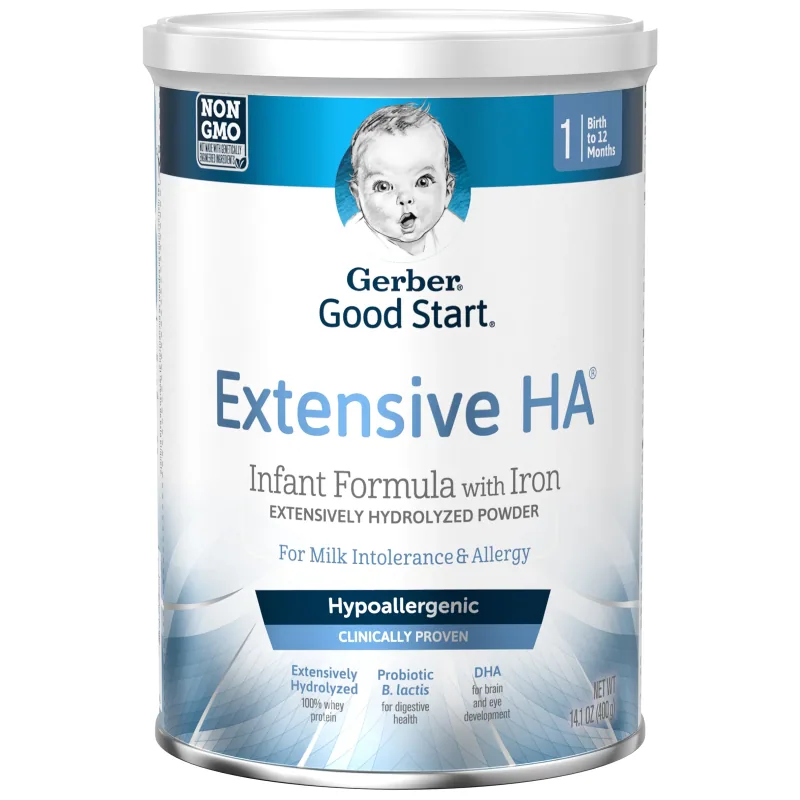
3. Best whey-based eHF: Gerber Extensive HA
Gerber Extensive HA is the Nestlé/Gerber whey-hydrolysate eHF (vs the casein-hydrolysate base in Nutramigen and Alimentum). Whey- hydrolysate empties from the stomach faster than casein-hydrolysate, which can benefit CMPA infants who also experience reflux symptoms. With Bifidobacterium lactis Bb12 probiotic.
For families with both CMPA and significant reflux symptoms, Gerber Extensive HA is the differentiating eHF pick. Less mainstream than Nutramigen and Alimentum, so insurance coverage may require additional documentation.
Tier 2: Amino acid (AAF), for eHF non-responders and multi-allergy
Approximately 10% of CMPA-affected infants do not tolerate eHF and require escalation to AAF. The clinical indication includes documented eHF failure (continued symptoms after 2-4 weeks of exclusive eHF feeding), eosinophilic esophagitis (EoE), multiple food allergies, or short-bowel syndrome. Insurance coverage for AAF typically requires documentation of eHF failure or specific diagnosis (EoE, multi-allergy) plus pediatric/allergist prescription.
4. Best AAF for eHF non-responders: Neocate Syneo Infant
Neocate Syneo is the Nutricia (Danone) AAF formulation with a distinguishing synbiotic blend: Bifidobacterium breve M-16V live probiotic plus FOS and GOS prebiotic. The probiotic-prebiotic combination is unique among major AAFs and is supported by clinical data on gut microbiome restoration in AAF-fed infants. 100% free amino acids, no intact protein peptides.
For infants escalating from eHF non-response, Neocate Syneo is the default AAF pick. Prescription-only; insurance-covered with documentation of eHF failure. Significantly more expensive than tier 1 eHFs (~$4.80/oz vs ~$3.05/oz).
5. Best alternative AAF: EleCare Infant
EleCare Infant is the Abbott AAF used as the alternative to Neocate when families or insurance carriers prefer the Abbott line. 100% free amino acids; no probiotic. Clinically equivalent amino acid base, the difference is brand-line continuity (families on Alimentum eHF often escalate to EleCare AAF) and insurance contract.
For Abbott-line families, EleCare is the in-line AAF escalation. Prescription-only; insurance-covered with eHF-failure documentation.
6. Best Mead Johnson AAF: Puramino Infant
Puramino is the Mead Johnson (same parent as Nutramigen) AAF formulation. 100% free amino acids; no probiotic. Used when families committed to the Mead Johnson eHF line need AAF escalation without changing manufacturers. Less common in US prescribing patterns than Neocate or EleCare; insurance coverage similar.
For Nutramigen-line families, Puramino is the in-line AAF escalation. Same prescription requirements as other AAFs.
Tier 3: Partially hydrolyzed (pHF), comfort positioning ONLY
Partially hydrolyzed formula is NOT clinically appropriate for diagnosed CMPA. The protein peptides remain large enough to trigger immune reactions in CMPA-affected infants, and AAP plus NASPGHAN both explicitly state that pHF should not be used as CMPA treatment. The "HA" branding on these products refers to "hypoallergenic positioning" in the marketing sense, not the clinical sense.
The legitimate use cases for pHF are: (a) general fussiness, gas, or mild reflux in non-allergic infants, and (b) reducing the theoretical risk of developing CMPA in high-risk infants (parental allergy history). The evidence for (b) is mixed and not all guidelines endorse pHF as primary CMPA prevention.
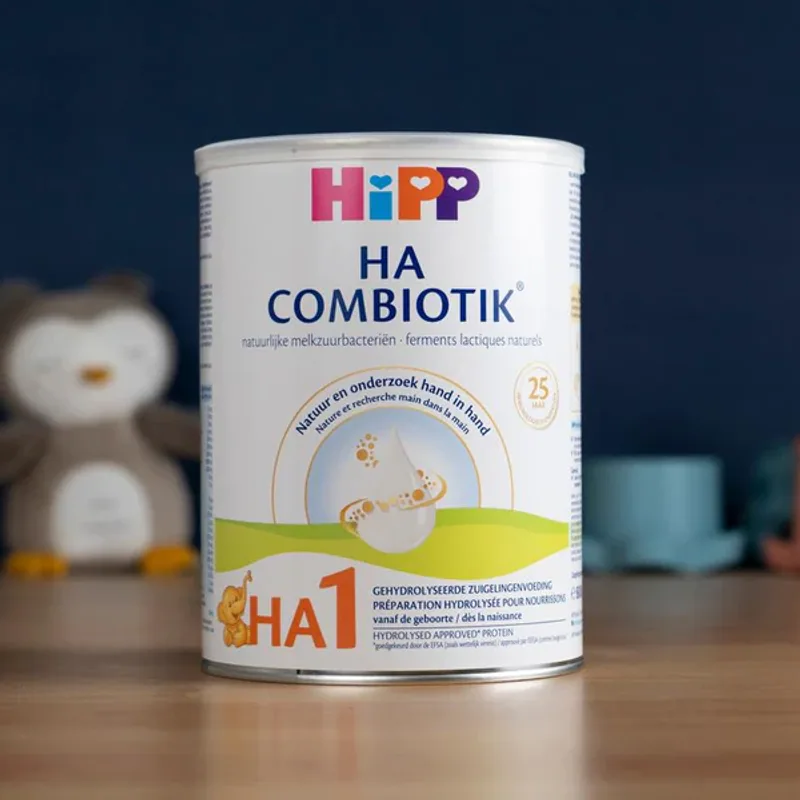
7. Best EU pHF: HiPP HA Stage 1
HiPP HA Stage 1 is the most bioactive-rich pHF available, EU Organic partially hydrolyzed whey with GOS prebiotic and live Limosilactobacillus fermentum hereditum probiotic. For non-CMPA infants experiencing comfort issues, HiPP HA carries the EU Organic plus probiotic-strain advantage that no US-retail pHF matches. Personally imported via Organic's Best Shop.
Critical: if a pediatrician has diagnosed CMPA and recommended extensively hydrolyzed formula, HiPP HA is NOT a substitute for Nutramigen, Alimentum, or Gerber Extensive HA. The pHF protein fragment size is too large to be safe for diagnosed CMPA.
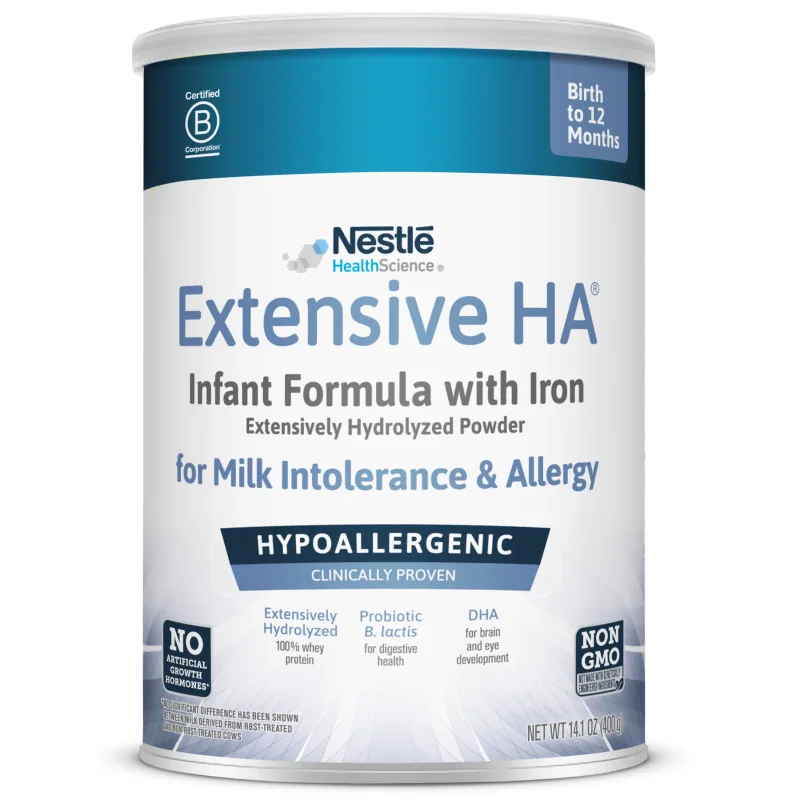
8. Best US-retail pHF: Nestlé NAN HA 1
Nestlé NAN HA 1 is the FDA-registered partially hydrolyzed whey formula commonly recommended by US pediatricians for non-allergic fussy infants. Available at major US retailers, less expensive than eHF (~$1.95/oz vs ~$3.05/oz). For families wanting the pHF positioning without import logistics, NAN HA is the principal pick.
Same critical caveat: NAN HA is NOT a CMPA treatment. If your pediatrician has confirmed CMPA, escalate to eHF tier 1.
Practical considerations for hypoallergenic formula selection
Insurance navigation. eHF and AAF formulas are typically insurance-reimbursed when CMPA diagnosis is documented and a pediatrician or allergist provides a prescription. The reimbursement varies by carrier: some cover 100% as a medical food, others require a deductible plus partial reimbursement. The diagnosis documentation should include either elimination-and-challenge test results, IgE-specific testing, or symptom-resolution-on-elimination patterns. Without documentation, insurance carriers will not cover the eHF/AAF premium.
FSA/HSA eligibility. Even without insurance coverage, eHF and AAF formulas are FSA/HSA-eligible expenses with appropriate documentation. This effectively reduces the cost by your marginal tax rate (typically 22-32%) and is the principal financial relief for families paying out-of-pocket.
Tolerance acquisition timeline. Most CMPA cases resolve by age 2-3 (some by 12 months, some by 5+). The pediatric protocol typically includes periodic milk-protein challenge tests to assess tolerance acquisition. Plan for the formula to be a year-plus commitment with re-evaluation milestones.
Switching protocols. Hypoallergenic formulas have notably different smell and taste profiles than standard formula. eHF is typically bitter; AAF is bland. Infants often initially refuse the new formula. The standard transition protocol is gradual (25%/50%/ 75%/100% over 4-6 days) plus warming the bottle slightly to mask the taste. If your infant refuses Nutramigen, swap to Alimentum or Gerber Extensive HA (different taste profiles). Switch only with pediatric supervision.
Goat milk is NOT a CMPA substitute. Despite occasional recommendations in lay sources, goat-milk formula is NOT appropriate for diagnosed CMPA. Goat milk proteins cross-react with cow milk proteins in ~90% of CMPA cases. AAP, NASPGHAN, and ESPGHAN all explicitly state that goat-milk formula is not a hypoallergenic alternative.
What's NOT in this hypoallergenic ranking
- Soy-protein formulas (Similac Soy Isomil, Enfamil ProSobee): Used for galactosemia and specific medical conditions, not CMPA first-line. AAP guidance does NOT recommend soy formula as CMPA treatment because ~10-15% of CMPA infants also react to soy.
- Goat-milk formulas (Kabrita, Holle Goat, Jovie Goat, Kendamil Goat): NOT hypoallergenic. ~90% cross-reactivity with cow milk in CMPA infants. Goat-milk formulas serve other use cases (digestion preference, flavor preference) but are not a CMPA solution.
- Lactose-free standard formulas (Similac Sensitive, Enfamil Reguline): For diagnosed lactose intolerance (rare in infants), NOT for CMPA. Lactose intolerance and CMPA are distinct conditions.
Frequently asked questions
What is the difference between extensively hydrolyzed and amino acid formula?
Is HiPP HA appropriate for my baby's diagnosed milk allergy?
Will insurance cover hypoallergenic formula for CMPA?
How do I know if my baby has CMPA vs lactose intolerance vs reflux?
Is goat-milk formula a substitute for hypoallergenic formula?
How long will my baby need hypoallergenic formula?
Why does my baby refuse Nutramigen, is there an alternative?
FDA 21 CFR Part 107 governs all infant formula including the exempt-formula category for hypoallergenic medical foods. American Academy of Pediatrics formula-feeding guidance and NASPGHAN clinical resources provide the clinical foundation for the eHF-first / AAF-second tier protocol. The PubMed CMPA-formula literature catalogs the trial data on tolerance acquisition, growth outcomes, and probiotic adjunctive benefit.
Related reading
- Best formula for CMPA, clinical-tier overview
- Nutramigen vs Alimentum
- HiPP HA vs Nutramigen
- Hydrolyzed protein explainer
- What is hypoallergenic formula and when do babies need it
- Is there a formula for lactose-intolerant babies
- Are probiotics in baby formula actually effective?
- Is Holle Goat formula safe for babies with cow milk protein allergy (CMPA)?
- Best Baby Formula for Colic
- Best Baby Formula for Reflux
- FDA Exempt Infant Formula 21 CFR 107.30, The Hypoallergenic Registration Pathway
- Atopic Dermatitis (Eczema) and Infant Formula, The CMPA Overlap
- Eosinophilic Esophagitis (EoE) in Infants, Introduction and Formula Implications
- FPIES, Food Protein-Induced Enterocolitis Syndrome in Infants
- Monthly Cost of Formula Feeding, A Realistic Budget Breakdown
- Allergic Proctocolitis (FPIAP), Blood in Stool from Cow's Milk Protein
This site provides research and comparisons, not medical advice. Consult your pediatrician before changing your baby's formula.
The ranked picks
Typical US retail price, normalised to USD per ounce of powder. Imported European formulas carry shipping and importer margin; US retail brands are typically cheapest per ounce. Subscribe-and-save and private-label pricing can shift the ranking.
Data table
| Formula | Price per ounce |
|---|---|
| NAN HA 1 | $1.60 |
| HiPP HA Stage 1 | $2.03 |
| Gerber Extensive HA | $3.19 |
| Nutramigen with LGG | $3.65 |
| Similac Alimentum | $3.97 |
| EleCare Infant | $4.82 |
| Puramino Infant | $5.11 |
| Neocate Syneo Infant | $5.32 |
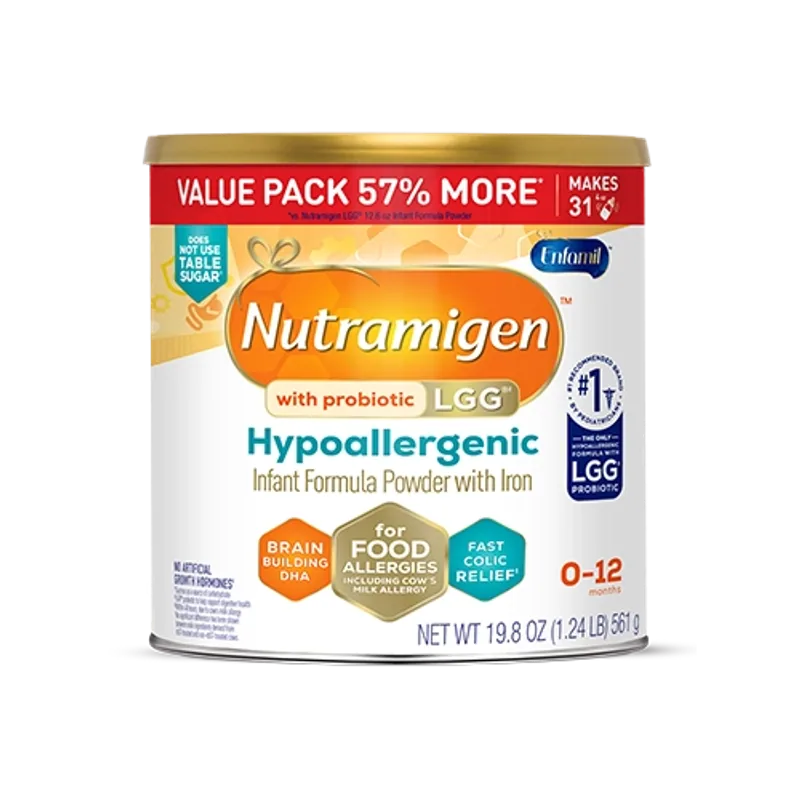
#1 · Best first-line eHF for CMPA (probiotic-included)
Nutramigen with LGG
Extensively hydrolyzed casein with Lactobacillus rhamnosus GG live probiotic. The most-prescribed eHF in US pediatric practice with the largest published clinical evidence base. FDA-registered, FSA/HSA eligible, broad insurance coverage with prescription. The default first-line eHF for newly diagnosed CMPA. ~$3.10/oz.
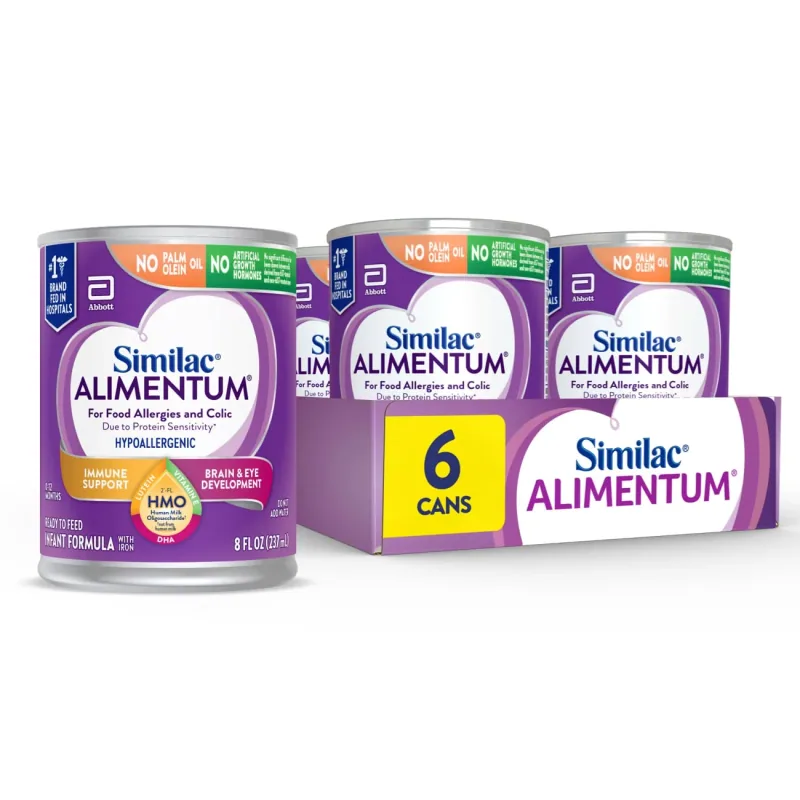
#2 · Best alternative first-line eHF (casein-hydrolyzed)
Similac Alimentum
Extensively hydrolyzed casein, no added palm. Often the alternative when Nutramigen is contraindicated by family preference, smell/taste rejection, or insurance contract. FDA-registered, FSA/HSA eligible, broad coverage with prescription. Powder and ready-to-feed both available. ~$2.95/oz.
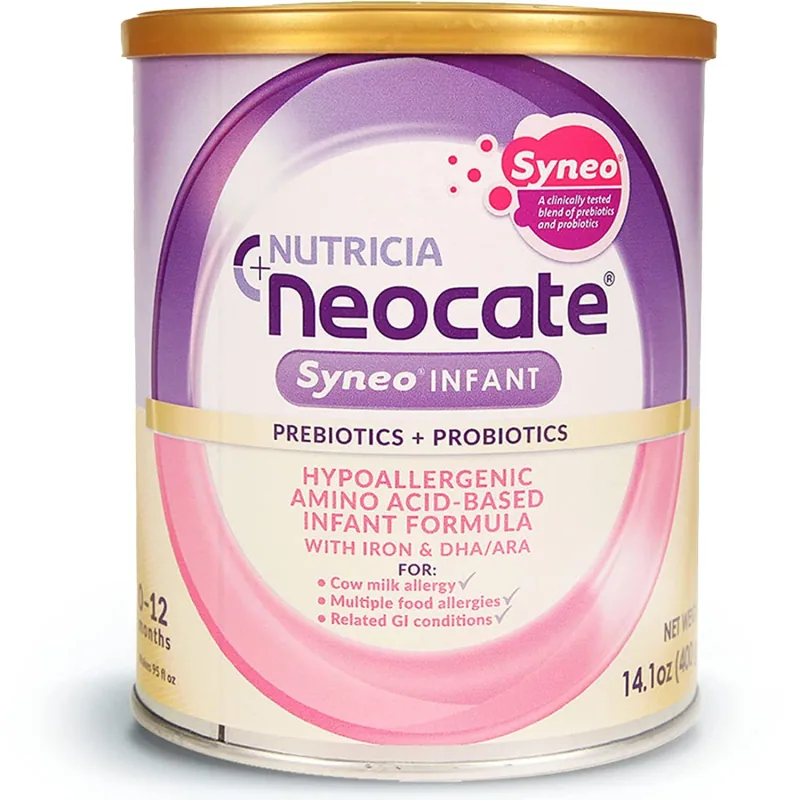
#3 · Best AAF for eHF non-responders (probiotic + prebiotic)
Neocate Syneo Infant
100% free amino acids, for the ~10% of CMPA infants who do not tolerate eHF. Includes Bifidobacterium breve M-16V probiotic plus FOS/GOS prebiotic synbiotic blend. Unique among AAF in including a documented probiotic strain. Prescription-only; insurance-covered with documentation of eHF failure. ~$4.80/oz.
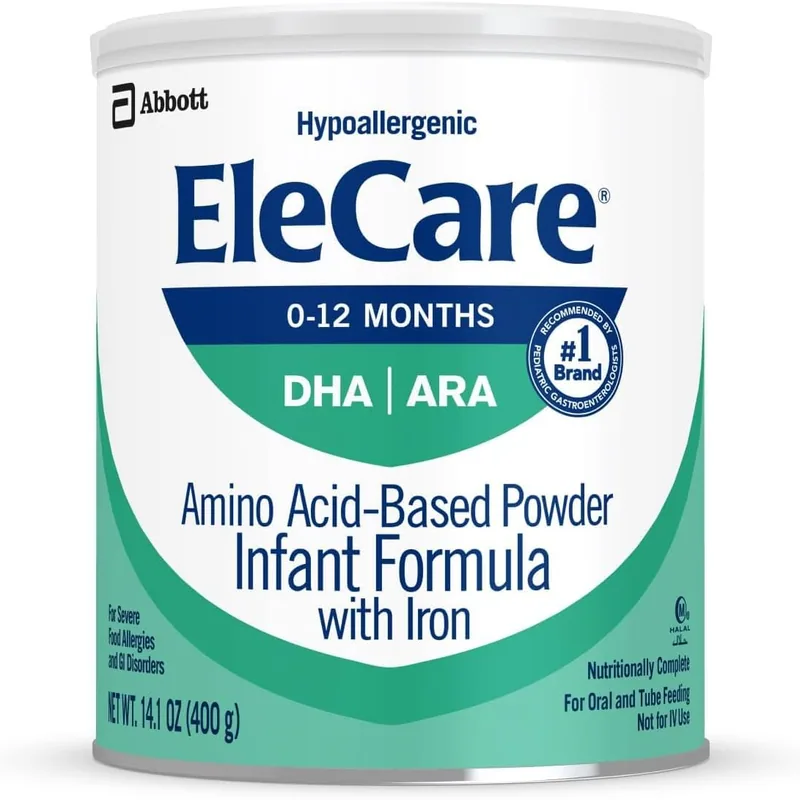
#4 · Best alternative AAF (Abbott formulation)
EleCare Infant
100% free amino acids, unflavored. The Abbott AAF used as alternative to Neocate when family or insurance prefers the Abbott line. No probiotic, clinically equivalent amino acid base. Prescription-only; insurance-covered with eHF-failure documentation. ~$4.50/oz.
#5 · Best whey-based eHF (Nestlé formulation)
Gerber Extensive HA
Extensively hydrolyzed whey (vs casein in Nutramigen and Alimentum). Whey-hydrolysate is faster-emptying gastrically and can suit infants with both CMPA and reflux. With Bifidobacterium lactis Bb12 probiotic. FDA-registered, FSA/HSA eligible. Less mainstream than Nutramigen/Alimentum but defensible eHF pick. ~$3.05/oz.

#6 · Best AAF (Mead Johnson formulation)
Puramino Infant
100% free amino acids, the Mead Johnson AAF (same parent company as Nutramigen). Used when families committed to the Mead Johnson line need AAF escalation. No probiotic. Prescription-only; insurance-covered with eHF-failure documentation. ~$4.65/oz.
#7 · Best partially hydrolyzed (pHF), comfort positioning ONLY
HiPP HA Stage 1
EU Organic partially hydrolyzed whey with GOS prebiotic and live Limosilactobacillus fermentum probiotic. NOT appropriate for diagnosed CMPA, pHF is for comfort/gentle positioning in non-CMPA infants only. The deepest bioactive stack in pHF. Personally imported via Organic's Best. ~$1.85/oz.
#8 · Best US-retail pHF, comfort positioning ONLY
NAN HA 1
Partially hydrolyzed whey, FDA-registered for US retail. NOT appropriate for diagnosed CMPA. The pHF often recommended by US pediatricians for non-CMPA fussiness/gas in lieu of eHF. Less expensive than eHF but clinically distinct, pHF is NOT a CMPA treatment. ~$1.95/oz.