
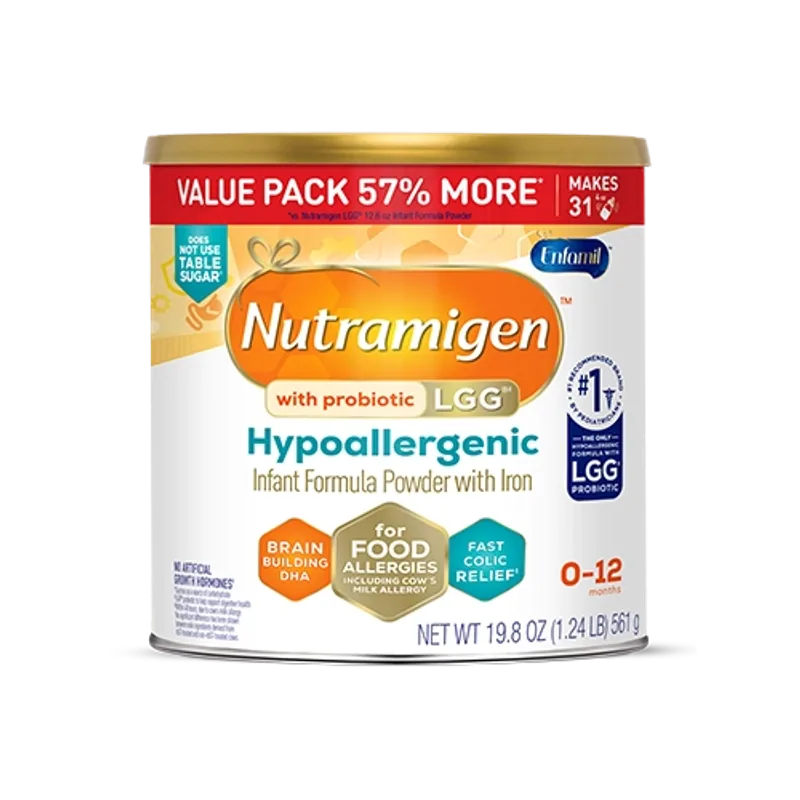

Nutramigen with LGG and Puramino are both Reckitt specialty medical formulas, but they occupy different tiers in the CMPA management hierarchy. Nutramigen is an extensively hydrolyzed casein formula (eHF), the first-line choice for ~90% of CMPA infants. Puramino is an amino acid formula (AAF), 100% elemental free amino acids, reserved for the ~10% of CMPA infants who fail eHF, or for more severe indications (eosinophilic GI disease, short-gut syndrome, multiple food protein allergy). Understanding when each applies is more important than a composition preference.
Nutramigen: extensively hydrolyzed casein peptides (<3,000 Da) + LGG probiotic, corn-syrup primary, palm, soy, and DHA 11.3 mg, ~$4.37/oz. Puramino: 100% free amino acids (elemental) and corn-syrup primary and GOS prebiotic and palm-free and MCT and DHA 11 mg, ~$5.50/oz. Step up from eHF to AAF when eHF isn't enough, more hypoallergenic, more expensive, smaller indication window.
Why this comparison matters
Parents whose infant has been diagnosed with CMPA and who have been prescribed Nutramigen sometimes ask: "what if this isn't working?" or "would a more hypoallergenic formula be better to start?" Understanding the clinical logic of eHF-first, AAF-if-needed helps parents (a) give Nutramigen an adequate trial window, (b) recognize genuine eHF failure signals, (c) understand why pediatricians don't just prescribe AAF as the default (cost, less palatable, smaller bioactive profile), and (d) advocate for AAF escalation when indicated.
The CMPA management ladder
| Step | Category | Examples | When used |
|---|---|---|---|
| 1 | Standard formula | NeuroPro, Pro-Advance, etc. | Healthy term infant, no symptoms |
| 2 | Partial hydrolysate (pHF) | Gentlease, Pro-Total Comfort | Mild "fussiness" (not indicated for true CMPA) |
| 3 | Extensively hydrolyzed (eHF) | Nutramigen, Alimentum | First-line CMPA management (~90%) |
| 4 | Amino acid (AAF) | Puramino, EleCare, Neocate | eHF failure or severe indications (~10%) |
Nutramigen sits at step 3; Puramino sits at step 4. The comparison below is between those two specific tiers, not a horizontal "choose one" decision.
At a glance
| Dimension | Nutramigen with LGG | Puramino Infant |
|---|---|---|
| Manufacturer | Reckitt / Mead Johnson Nutrition | Reckitt / Mead Johnson Nutrition |
| FDA classification | Exempt infant formula 21 CFR 107.30 | Exempt infant formula 21 CFR 107.30 |
| Protein category | Extensively hydrolyzed (eHF) | Amino acid (AAF / elemental) |
| Protein form | Hydrolyzed casein peptides <3,000 Da | 100% free amino acids (L-form) |
| Protein % of formula | ~17% | ~28% (higher due to lower AA bioavailability) |
| Allergenicity | Hypoallergenic (FDA-recognized) | Non-antigenic (most hypoallergenic commercially available) |
| Intended use | Diagnosed CMPA first-line | Severe CMPA, eHF failure, multiple food allergies, EoE, short-gut |
| Lactose | None (lactose-free) | None (lactose-free) |
| Primary carbohydrate | Corn syrup solids and modified corn starch | Corn syrup solids and GOS prebiotic |
| Prebiotic | None | GOS |
| Probiotic | L. rhamnosus GG (LGG) | None |
| 2'-FL HMO | None | None |
| Fat blend | Palm olein, coconut, soy, and safflower | Palm-FREE (safflower, coconut, and soy and MCT) |
| MCT | No | Yes (for fat absorption support) |
| DHA | Schizochytrium algal, ~11.3 mg/100 ml | Algal, ~11 mg/100 ml |
| Red flags | Corn syrup solids* | Corn syrup solids*, (no palm) |
| Fat-blend notes | palm oil, soy | soy |
| Format | 12.6 oz tin | 14.1 oz tin |
| Typical price | ||
| US availability | Broad retail and pharmacy | Pharmacy and specialty retail |
* Corn syrup solids are medically appropriate in both contexts (lactose-free requirement for CMPA/severe-allergy management).
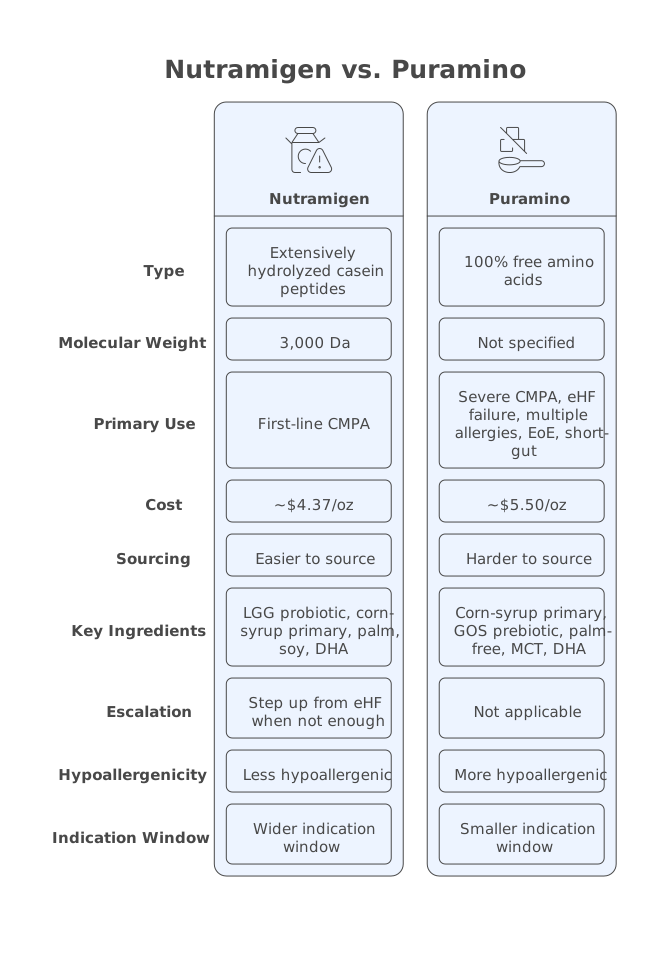
Visual generated with Napkin AI, editorial review by María López Botín. See methodology for our use policy.
Compositional differences that actually matter
1. Protein form: hydrolyzed peptides vs free amino acids
Nutramigen uses extensively hydrolyzed casein, cow milk protein (casein) enzymatically broken down to peptides smaller than 3,000 daltons (often <1,500 Da). Most CMPA infants tolerate peptides this small because their immune systems can't recognize the broken-up protein fragments. But ~10% of CMPA infants remain sensitized to even these tiny peptides, and they continue showing symptoms on eHF.
Puramino uses 100% free amino acids, the protein is broken down to individual amino acid monomers. This is non-antigenic — the immune system has no protein structure to recognize at all. This is as hypoallergenic as a commercially available formula can be.
For the ~10% who fail eHF, AAF is the appropriate step; the peptide-to-amino-acid change eliminates the remaining antigenic potential.
2. Indication difference: first-line vs salvage / severe
Nutramigen: diagnosed CMPA, first-line treatment. Most CMPA infants start here; most respond adequately within 2-4 weeks.
Puramino: indicated for:
- eHF trial failure, continued CMPA symptoms after 2-4 weeks of consistent eHF use
- Severe CMPA presentations (anaphylaxis risk, severe eczema, severe enteropathy)
- Multiple food protein allergy (cow milk, soy, and others)
- Eosinophilic esophagitis (EoE) or other eosinophilic GI diseases
- Short-gut syndrome or severe intestinal malabsorption
- Failure to thrive secondary to food protein allergy
AAF is not prescribed as a "just to be safe" alternative, the cost, palatability issues, and reduced bioactive profile make it a step-up, not a default.
3. Bioactive layer: different strategies
Nutramigen includes LGG probiotic, specifically studied for CMPA tolerance acceleration. No added prebiotic.
Puramino includes GOS prebiotic (galacto-oligosaccharide) + PDX (polydextrose). No added probiotic. GOS at AAF level supports gut microbiota in the severely-restricted diet context.
Different bioactive philosophies for different clinical tiers: LGG for tolerance acceleration (where tolerance reintroduction is the goal); GOS prebiotic for microbiome support in severe-allergy infants (where tolerance reintroduction is less the immediate focus).
4. Fat blend: palm-free and MCT in Puramino
Puramino uses a palm-free fat blend and MCT (medium-chain triglycerides). MCT is specifically designed for easier fat absorption, relevant for infants with compromised GI tract, malabsorption, or short-gut. This is standard AAF formulation.
Nutramigen uses a standard US palm-inclusive blend (palm olein and coconut, soy, and safflower). No MCT.
For infants with malabsorption-adjacent indications (one reason for AAF escalation), Puramino's MCT contribution supports fat absorption that Nutramigen's standard blend may not adequately provide.
5. Price: Puramino ~26% more expensive
Nutramigen ~$4.37/oz. Puramino ~$5.50/oz. ~26% price premium for AAF. The cost difference reflects: (a) free amino acid ingredient cost (AAFs use synthetic or fermentation-derived free amino acids at high purity, expensive sourcing), (b) specialty production and quality control, (c) smaller production volume (10% of CMPA market). Most US insurance covers AAF with documented CMPA and eHF failure or severe indication documentation.
6. Availability: Puramino harder to source
Nutramigen is available at most major US retailers (Target, Walmart, CVS, Walgreens, Amazon). Nutramigen is often in physical pharmacy retail.
Puramino is typically pharmacy-ordered or specialty-distributor- ordered. Most Target/Walmart stores do not carry it in standard shelving. This is typical of AAF distribution, lower volume, specialty supply chains. Allow 2-5 days for pharmacy order.
7. Recall history
Nutramigen (Reckitt): Nutramigen Powder was recalled voluntarily in December 2023 for Cronobacter sakazakii contamination in lots produced at Reckitt's Zeeland facility. Recall resolved; current production passed FDA inspection.
Puramino (Reckitt): no active recall specific to Puramino. Same manufacturer as Nutramigen; subject to the same FDA oversight and FSMA recall authority.
Regulatory framework
Both are FDA exempt infant formulas under 21 CFR 107.30. Both classified as hypoallergenic per FDA standards (Puramino is "most hypoallergenic commercially available"). Both medically appropriate lactose-free compositions.
International context: in the EU, equivalent AAF formulas include Neocate LCP, Nutricia Amino Acid Formula, and others. The EU regulates AAF under "food for special medical purposes" (EU Regulation 2016/128). EU Organic certification does not extend to AAF (synthetic amino acid ingredients are not eligible).
When to escalate from Nutramigen to Puramino
Discuss with your pediatrician if any of these occur on a consistent Nutramigen trial (2-4+ weeks):
- Persistent CMPA symptoms (reflux, vomiting, blood in stool, severe eczema, poor weight gain, fussiness attributable to feeds)
- Growth faltering (weight-for-age dropping across percentiles)
- Signs suggesting concurrent food allergy (multiple food reactions, atopic skin flares correlating with feed changes)
- Gastrointestinal signs suggesting enteropathy (chronic diarrhea, blood, mucus, severe abdominal distension)
- Failure to thrive despite adequate caloric intake
Do not self-escalate. Pediatric GI or allergist consultation is typically warranted before AAF prescription.
Real-world parent experience
Following site methodology, observations below come from parent feedback across families. These are not clinical recommendations. Where my own feeding observations are referenced, they are clearly labeled as parent-experience notes; manufacturer claims and regulatory data are cited separately so the source weight stays explicit.
Taste and smell. Puramino is more bitter than Nutramigen, free amino acids taste more unpleasant than even hydrolyzed peptides. Many parents report initial rejection from infants transitioning to Puramino; a 3-7 day transition window with partial volume mixing often helps. If severe taste aversion, pediatrician may approve small amount of flavoring (rice cereal) in older infants. Do not add flavorings without medical guidance.
Stool consistency. Both produce dark, loose-to-formed stools typical of specialty formulas. Puramino's GOS contribution often produces slightly softer stool than Nutramigen. Stool color/consistency is not a primary CMPA-improvement indicator; reduction in blood, mucus, and feeding distress is.
Weight gain. Both provide adequate calories and balanced macro- nutrition. Puramino's higher protein % (28 vs 17) is designed to compensate for lower amino-acid metabolic efficiency; most infants gain adequately on either.
Transition timing. Going Nutramigen → Puramino: 7-10 day gradual transition. Going Puramino → Nutramigen (for eventual CMPA resolution trial): 10-14 day very gradual transition, the more hypoallergenic tier is typically reintroduced gradually to detect any re-sensitization.
Verdict: when each applies
Use Nutramigen (eHF) if:
- You have a new CMPA diagnosis: Nutramigen is first-line
- Your baby responds well to an eHF trial (most CMPA infants do)
- You want the LGG probiotic tolerance acceleration option
- Cost and retail availability matter
Escalate to Puramino (AAF) if:
- Your pediatrician or pediatric GI/allergist has documented:
- eHF trial failure after 2-4 weeks
- Severe CMPA presentation (anaphylaxis risk, severe enteropathy)
- Multiple food protein allergy
- Eosinophilic esophagitis or other eosinophilic GI disease
- Short-gut syndrome / severe malabsorption
- Failure to thrive secondary to food allergy
Pick neither if:
- You don't have a CMPA diagnosis, neither is appropriate
- You have CMPA but want the Abbott equivalent, consider Similac Alimentum (eHF, Abbott) or EleCare (AAF, Abbott)
- You want EU-equivalent eHF, consider HiPP HA Combiotik (imported)
- You want an AAF alternative to Puramino — EleCare (Abbott) or Neocate Syneo (Nutricia, includes synbiotic)
What you can't infer from this comparison
Both are safe, FDA-registered specialty medical formulas. AAF is not "better" than eHF in absolute terms, it's a different tier for a specific clinical context. Starting with AAF when eHF would have sufficed provides no clinical benefit and costs significantly more. eHF failure and AAF indication are clinical judgments; don't self-escalate. Conversely, if eHF genuinely fails, delaying AAF escalation can perpetuate symptoms and nutrient deficits.
Frequently asked questions
Should I ask for Puramino instead of Nutramigen as a first step?
How long should I try Nutramigen before escalating?
Why does Puramino cost so much more?
Is Puramino really non-allergenic?
Does Puramino have a probiotic like Nutramigen's LGG?
Can my baby return to Nutramigen or standard formula eventually?
Is this Reckitt-vs-Abbott the same as Nutramigen vs EleCare?
What about the Nutramigen powder 2023 recall?
Related reading
- Nutramigen brand hub
- Puramino brand hub
- Nutramigen vs Similac Alimentum, eHF head-to-head
- CMPA and formula
- Hydrolyzed casein explainer
- Amino acid formulas explainer
- GOS explainer
- Probiotics in formula
- Enfamil ProSobee vs Nutramigen - Soy Formula vs eHF (Different Clinical Categories, Don't Confuse Them)
- Gerber Extensive HA vs Nutramigen - Whey-Based eHF vs Casein-Based eHF (Nestlé vs Reckitt)
- Neocate Syneo vs EleCare - AAF with Synbiotic vs AAF Stripped (Nutricia vs Abbott)
- Neocate Syneo vs Puramino - Two Bioactive Amino Acid Formulas Head-to-Head (Nutricia Synbiotic vs Reckitt Prebiotic)
- Nutramigen vs EleCare - Cross-Manufacturer eHF to AAF Step-Up (Reckitt eHF vs Abbott AAF)
- Similac Alimentum vs Puramino - Cross-Manufacturer eHF to AAF Step-Up (Abbott eHF vs Reckitt AAF)
Primary sources
- Nutramigen / Reckitt (Mead Johnson), manufacturer product information. nutramigen.com
- Puramino Infant / Reckitt (Mead Johnson), manufacturer product information. puraminoinfant.com
- FDA 21 CFR Part 107 (incl. 107.30 exempt infant formula). ecfr.gov
- FDA infant formula guidance documents (incl. exempt infant formula guidance). fda.gov
- American Academy of Pediatrics, clinical report on hypoallergenic infant formulas. aap.org
- ESPGHAN position on CMPA management: Koletzko et al., JPGN, multiple years.
This site provides research and comparisons, not medical advice. Consult your pediatrician before changing your baby's formula.