
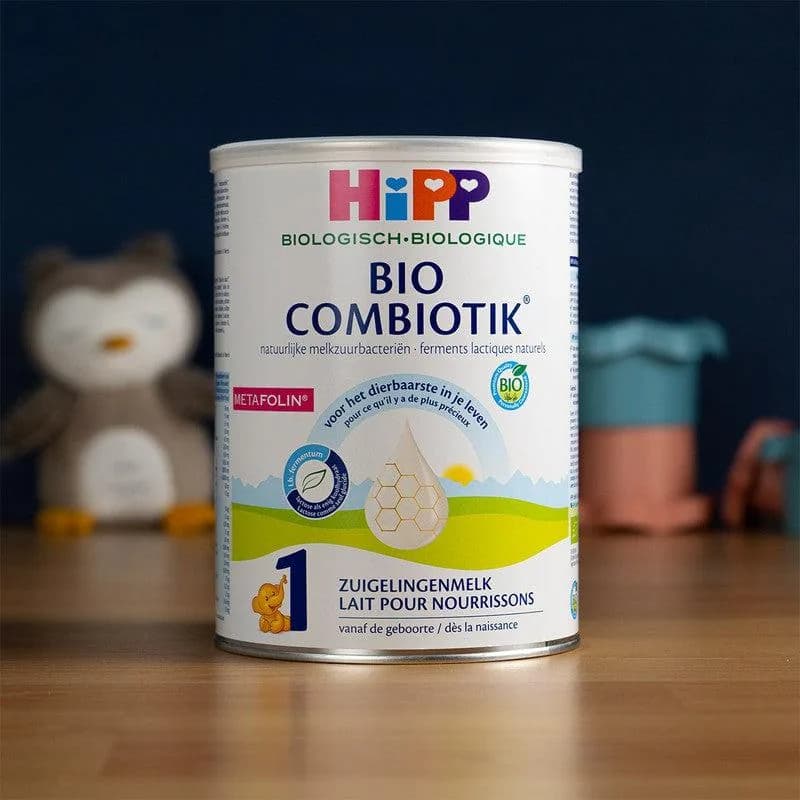
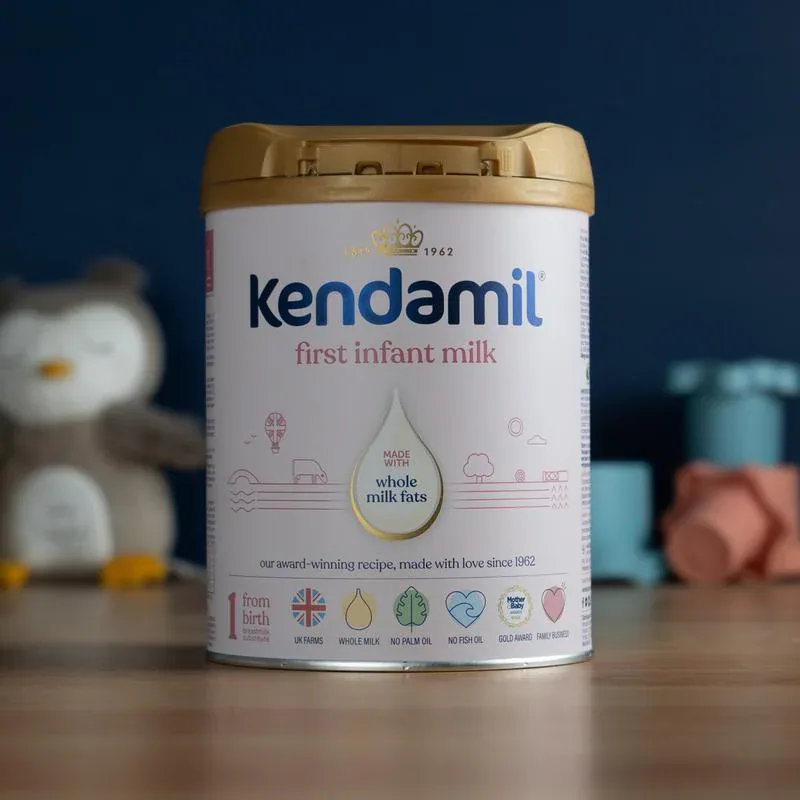
EU Organic with bioactives against whole-milk fat at a lower price. HiPP Dutch is EU Organic with the Combiotik pairing of L. fermentum and GOS, plus Metafolin folate, on a palm-inclusive blend at ~$1.77/oz. Kendamil Classic is UK Red Tractor rather than organic, with palm-free whole-milk fat, GOS and FOS at 9:1 and folic acid, at ~$1.30/oz.
HiPP Dutch Stage 1 and Kendamil Classic Stage 1 are the two most-asked- about "European flagship" formulas for parents, but they're not directly equivalent. HiPP Dutch is EU Organic certified; Kendamil Classic is not organic (that's the separate Kendamil Organic SKU). Kendamil Classic is UK Red Tractor, a farmer welfare and traceability standard, not an organic certification. This matters for parents whose shortlist criteria include "organic" as a must-have.
At a glance
| Dimension | HiPP Dutch Stage 1 | Kendamil Classic Stage 1 |
|---|---|---|
| Manufacturer | HiPP (Germany, Dutch-market SKU) | Kendal Nutricare (UK) |
| Age range | 0-6 months | 0-6 months |
| Regulation | EU 2016/127 and 2018/848 organic | EU 2016/127 (not organic-certified) |
| Organic certification | EU Organic (SKAL) | Not organic: UK Red Tractor farmer standard only |
| Protein | Skimmed cow milk and whey | Whole cow milk and whey |
| Whey:casein | 60:40 | 60:40 |
| Primary carbohydrate | Lactose (only added) | Lactose (only added) |
| Prebiotic | GOS | GOS and FOS (9:1 ratio) |
| Probiotic | L. fermentum hereditum (Combiotik) | None |
| Folate form | Metafolin (L-methylfolate) | Folic acid |
| DHA source | Fish oil, ~13.2 mg/100 ml | Fish oil, ~16.1 mg/100 ml |
| Fat blend | Palm, rapeseed, sunflower | Whole-milk fat, sunflower, coconut, and rapeseed (NO palm) |
| Fat-blend notes | Palm oil | None |
| Tin size | 800 g | 800 g |
| Typical price | ||
| US availability | Organic's Best, 5-10 day shipping | Organic's Best and select US retail under FDA enforcement discretion |
Typical US retail price, normalised to USD per ounce of powder. Imported European formulas carry shipping and importer margin; US retail brands are typically cheapest per ounce. Subscribe-and-save and private-label pricing can shift the ranking.
Data table
| Formula | Price per ounce |
|---|---|
| HiPP Dutch Stage 1 | $1.77 |
| Kendamil Classic Stage 1 | $1.30 |
Why this comparison matters
Kendamil has strong brand recognition in US parent communities for its whole-milk-fat-and-palm-free differentiator, but many parents searching "Kendamil" assume that broad recognition means "organic." Kendamil Classic is not organic. For organic, whole-milk-fat, and palm-free, the correct SKU is Kendamil Organic Stage 1, covered in the parallel comparison HiPP Dutch vs Kendamil Organic.
Compositional differences that actually matter
1. Organic certification: HiPP has it, Kendamil Classic does not
This is the single most consequential point in this comparison, and the one Kendamil's brand recognition often blurs.
HiPP Dutch Stage 1 carries EU Organic certification (Regulation 2018/848) via SKAL. The milk is from organic-certified dairy; the vegetable oils are organic; the whole formulation is organic except for the mandatory vitamin/mineral fortification.
Kendamil Classic Stage 1 carries UK Red Tractor, a farmer welfare and traceability assurance (animal welfare minimum standards, UK-origin, antibiotic restrictions), but not an organic certification. Red Tractor permits conventional farming practices that EU Organic would not (conventional feed inputs, conventional veterinary approaches on non-dairy conditions, etc.).
For "organic" as a must-have, HiPP Dutch wins on certification alone. For organic, whole-milk-fat, and palm-free, the correct Kendamil SKU is Kendamil Organic Stage 1.
2. Fat blend: palm vs palm-free whole-milk fat
This is Kendamil's signature differentiator and the point parents most commonly choose Kendamil for.
HiPP Dutch uses a palm-inclusive vegetable oil blend (palm, rapeseed, sunflower), standard EU-formulation approach.
Kendamil Classic uses whole-milk fat as the primary fat source, supplemented by sunflower, coconut, and rapeseed oils. No palm oil. The whole-milk fat naturally provides palmitic acid at the sn-2 position (matching breast-milk structure), without requiring the sn-2 palmitate (OPO) processing step that palm-based formulas use to simulate breast-milk fatty acid stereochemistry.
For parents avoiding palm oil, Kendamil Classic wins cleanly. See the palm oil explainer.
3. Bioactive stack: Combiotik vs GOS and FOS prebiotic-only
HiPP Dutch: GOS prebiotic and L. fermentum hereditum live probiotic (Combiotik pairing).
Kendamil Classic: GOS and FOS (9:1 ratio) prebiotic blend, no probiotic. The 9:1 GOS:FOS ratio is the well-studied European research ratio (same as used in Aptamil and some Nutrilon formulations).
Both brands have defensible prebiotic strategies. Kendamil's 9:1 ratio has broader prebiotic fiber coverage (two oligosaccharide classes). HiPP's GOS and live probiotic adds the bacterial strain. Neither replicates breast-milk HMO complexity. See GOS and FOS explainers.
4. Folate form: Metafolin vs folic acid
HiPP uses Metafolin (L-methylfolate), bioactive form. Kendamil Classic uses folic acid, synthetic oxidized form requiring MTHFR conversion. See Metafolin vs folic acid.
5. DHA level
Kendamil Classic supplies ~16.1 mg DHA / 100 ml (fish oil), the highest of the EU organic Stage 1 field. HiPP Dutch supplies ~13.2 mg / 100 ml (fish oil). Both well above EU minimum; Kendamil's ~22% higher level matches closer to upper-range breast-milk DHA.
6. Protein base: whole cow milk vs skimmed cow milk and whey
Kendamil Classic uses whole cow milk as the protein base (fat intact, not skimmed). This is unusual, most EU and US infant formulas use skimmed cow milk as the protein source and add back fat separately from vegetable oil blends. Using whole milk preserves native milk-fat globules and contributes some MFGM-associated lipids naturally, although Kendamil doesn't quantify or position this as "added MFGM."
HiPP Dutch uses the conventional skimmed-cow-milk and added-vegetable- oil approach.
7. Price per ounce
Kendamil Classic ~$1.30/oz; HiPP Dutch ~$1.77/oz. Kendamil Classic is ~8% cheaper per ounce, meaningful on a 100-oz/week feeding schedule. The price reflects Kendamil Classic's non-organic status; the Kendamil Organic SKU (organic and whole-milk fat) runs at ~$1.95/oz, above HiPP Dutch.
Regulatory framework
Both formulas comply with EU Regulation 2016/127 (infant formula composition, lactose predominance, mandatory DHA, vitamin/mineral ranges per Annex I). HiPP Dutch adds EU Regulation 2018/848 (organic); Kendamil Classic does not.
Neither is FDA-registered. Kendamil has some US retail distribution under FDA enforcement discretion (Kendamil is occasionally found at select Target locations and US retailers under this framework). HiPP Dutch is import-only via Organic's Best and similar resellers. See the buying European formula pillar.
Real-world parent experience
Following site methodology, the observations below come from my personal use across both kids plus a stable pool of parent-feedback notes from families on both formulas. They carry the parent-experience label rather than being claimed as regulatory or clinical facts, because individual infant variation on stool consistency, smell preference, and mixability is large enough that any specific point can reverse for a specific baby. Read these as context, not prediction.
Smell and taste. Kendamil Classic has a richer, creamier character, the whole-milk fat contributes noticeably to mouthfeel and taste. HiPP Dutch has a lighter, sweeter profile typical of Dutch skimmed-milk formulas. Infants transitioning from breast milk often adapt faster to Kendamil's richer dairy character.
Mixability. Kendamil can foam more when shaken vigorously (whole- milk fat contribution), gentle stirring or rolled-bottle mixing avoids this. HiPP dissolves cleanly with typical shake preparation. Both use 70°C preparation water.
Stool consistency. HiPP families commonly report softer, more yogurt-like stools (L. fermentum probiotic). Kendamil Classic families report moderate-to-soft stools, the palm-free fat blend tends toward slightly softer consistency than palm-inclusive formulas. Neither is concerning.
Switching between them. Use a 4-6 day gradual transition. The whole-milk-fat → palm-inclusive switch (Kendamil → HiPP) can shift stool character noticeably for 7-10 days. The probiotic add/remove is the other main observable change.
Verdict: when to pick each
Pick HiPP Dutch Stage 1 if:
- EU Organic certification is a must-have
- Combiotik probiotic (L. fermentum) matters
- Metafolin bioavailable folate matters
- You don't weight palm-free as a deal-breaker
Pick Kendamil Classic Stage 1 if:
- Palm-free is a must-have
- Whole-milk fat appeals (native sn-2 palmitate, creamier profile)
- UK Red Tractor farmer welfare standard and UK origin matters
- Higher DHA level (~16.1 mg/100 ml) is a target
- Lower per-ounce price matters
- You accept non-organic status (Kendamil Classic is Red Tractor, not organic: Kendamil Organic is the organic SKU)
Pick Kendamil Organic Stage 1 if:
- You want both organic certification and palm-free whole-milk fat. Kendamil Organic is the only EU Organic, whole-milk-fat, and palm-free SKU available to families.
What you can't infer from this comparison
Neither is indicated for diagnosed cow milk protein allergy, see CMPA pillar. Neither is reflux-specific. "Kendamil has whole-milk fat" is a composition fact, not a clinical-superiority claim; "HiPP has a probiotic" is also a composition fact. Individual infant response is the dominant variable.
Frequently asked questions
Is Kendamil Classic Stage 1 organic?
What's the difference between Kendamil Classic and Kendamil Organic?
Does Kendamil Classic have palm oil?
Does HiPP Dutch have whole-milk fat?
Is HiPP Dutch or Kendamil Classic better for a newborn?
Can I switch from HiPP Dutch to Kendamil Classic?
Is Kendamil Classic available at US retail?
Related reading
- HiPP brand hub
- Kendamil brand hub
- HiPP Dutch Stage 1 vs Kendamil Organic Stage 1, the apples-to-apples EU Organic comparison
- Kendamil Classic Stage 1 vs Kendamil Organic Stage 1, intra-brand (coming soon)
- HiPP vs Holle vs Kendamil compared side-by-side
- Palm oil in infant formula, explainer
- Organic certifications compared
- Kendamil Classic Stage 1 vs Lebenswert Stage 1 - UK Whole-Milk Fat vs German Bioland Organic
Primary sources
- HiPP, manufacturer product information. hipp.com
- Kendamil / Kendal Nutricare, manufacturer product information. kendamil.com
- UK Red Tractor, farmer assurance standard. redtractor.org.uk
- EU Regulation 2016/127, infant formula compositional requirements. eur-lex.europa.eu
- EU Regulation 2018/848, organic production. eur-lex.europa.eu
This site provides research and comparisons, not medical advice. Consult your pediatrician before changing your baby's formula.