
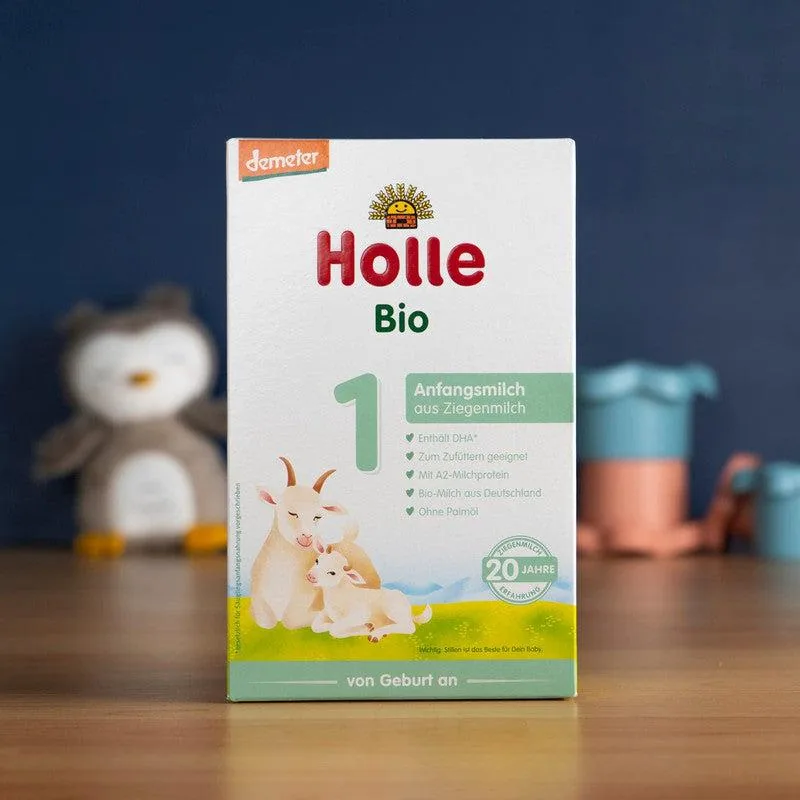
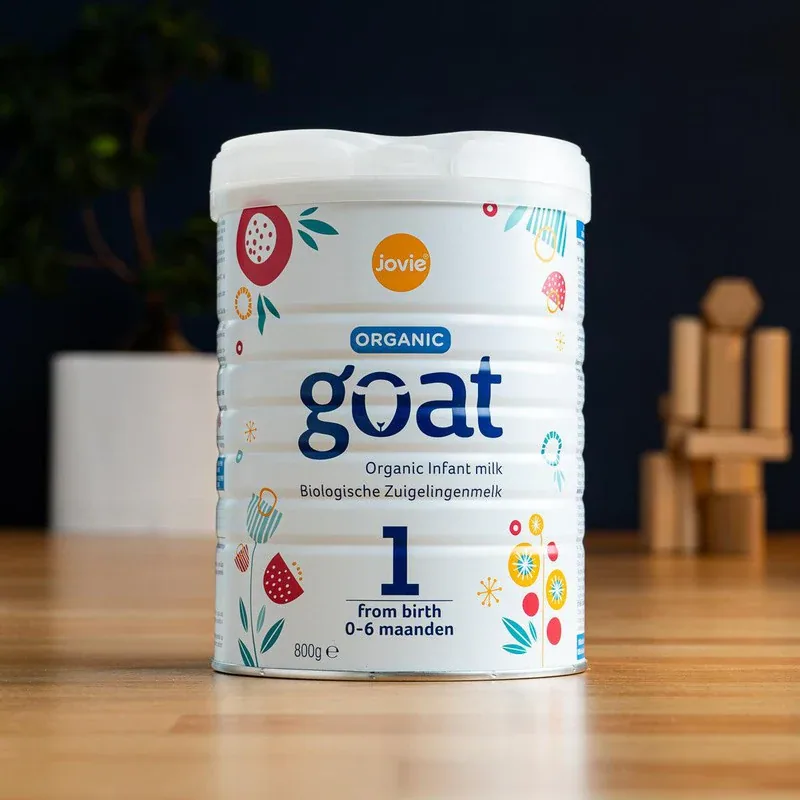
Holle Goat Stage 1 and Jovie Goat Stage 1 are the two principal organic goat-milk Stage 1 options in the EU-import segment. Both excellent fat- blend specifications (no palm, no soy). Both lactose-only carbohydrate. Both EU Organic. The differentiation is Holle's Demeter biodynamic overlay (the strictest organic standard available in any infant formula worldwide) versus Jovie's GOS prebiotic addition (Holle Goat omits prebiotic entirely, Jovie includes GOS).
Holle Goat Stage 1 is a Demeter biodynamic and EU Organic German formula with whole goat milk, lactose-only carbohydrate, no GOS, no HMO, no probiotic, fat blend with no palm and no soy, fish-oil DHA, ~$2.41/oz delivered. Jovie Goat Stage 1 is an EU Organic Dutch formula with whole goat milk, lactose-only carbohydrate, GOS prebiotic, no HMO, no probiotic, fat blend with no palm and no soy, fish-oil DHA, ~$2.30/oz delivered. Demeter biodynamic minimalism vs EU Organic plus GOS prebiotic.
Why this comparison matters
Within the organic goat-milk Stage 1 segment (a niche but growing US import category), Holle Goat and Jovie Goat are the two most-stocked options at Organic's Best Shop. Families typically arrive at this matchup having ruled in goat-milk over cow-milk and ruled in EU-organic over US-retail (Kabrita is the non-organic Dutch goat option at US retail; Kendamil Goat is the UK non-organic whole-milk-fat goat option). The Holle vs Jovie decision narrows to organic-tier strictness versus prebiotic inclusion.
At a glance
| Dimension | Holle Goat Stage 1 | Jovie Goat Stage 1 |
|---|---|---|
| Manufacturer | Holle (Swiss-Dutch / German manufacturing) | Ausnutria-affiliated Dutch operation |
| Origin | Germany | Netherlands (NL) |
| Age range | 0-6 months (Stage 1) | 0-6 months (Stage 1) |
| Regulation | EU 2016/127 (FDA enforcement discretion for US import) | EU 2016/127 (FDA enforcement discretion for US import) |
| Organic certification | Demeter biodynamic and EU Organic (strictest tier) | EU Organic |
| Protein source | Whole goat milk | Whole goat milk |
| Whey:casein ratio | Goat-milk native | Goat-milk native |
| Primary carbohydrate | Lactose only added | Lactose only added |
| Prebiotic | None | GOS |
| Probiotic | None | None |
| HMO | None | None |
| Folate form | Folic acid | Folic acid |
| Fat blend | Goat-milk fat plus rapeseed and sunflower (no palm, no soy) | Goat-milk fat plus rapeseed and sunflower (no palm, no soy) |
| DHA source | Fish oil, ~15 mg/100 ml | Fish oil, ~14 mg/100 ml |
| Iron | 0.54 mg/100 ml | 0.6 mg/100 ml |
| Fat-blend notes | None | None |
| Format | 400 g tin | 800 g tin |
| Typical US price | ||
| US availability | Personal import via Organic's Best Shop, 5-10 day shipping | Personal import via Organic's Best Shop, 5-10 day shipping |
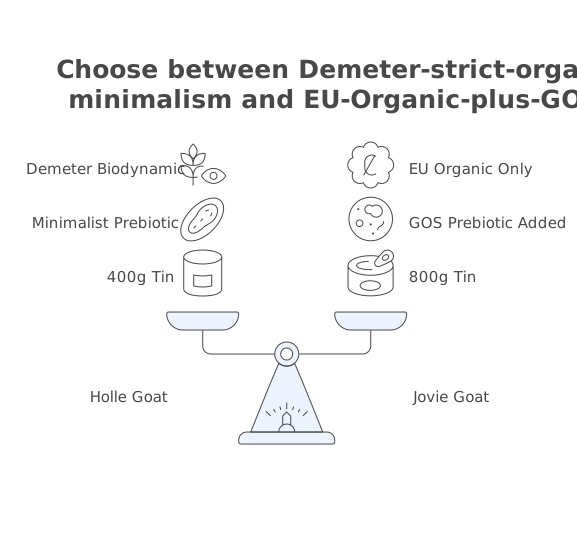
Visual generated with Napkin AI, editorial review by María López Botín. See methodology for our use policy.
Compositional differences that actually matter
Three dimensions where Holle Goat and Jovie Goat diverge.
1. Organic certification: Demeter biodynamic vs EU Organic
The defining difference. Demeter is the international biodynamic agriculture certification, named after the Greek harvest goddess and based on Rudolf Steiner's biodynamic farming philosophy. Demeter certification requires:
- Whole-farm conversion to biodynamic methods (not parcel-by-parcel)
- Animal welfare standards stricter than EU Organic baseline
- Specific biodynamic-preparation use in soil management
- Closed-loop nutrient cycling (compost, manure, on-farm feed)
- 50%+ on-farm feed for dairy cattle, often 100%
Holle's Demeter line carries this overlay on top of baseline EU Organic. The practical effect for the infant formula is incrementally cleaner sourcing standards relative to baseline EU Organic.
Jovie carries baseline EU Organic certification. EU Organic is itself a meaningful standard (no synthetic pesticides, no GMOs, animal welfare requirements, etc.) but does not match Demeter's whole-farm and biodynamic-method requirements. See organic certifications compared for the tier framework.
For families weighting strictest-possible organic certification, Holle Goat is the answer in goat-milk Stage 1. For families satisfied with baseline EU Organic, Jovie's GOS inclusion is more compelling.
2. Prebiotic: none vs GOS
Holle Goat is intentionally minimalist: no GOS, no FOS, no probiotic, no HMO. The formulation philosophy follows Holle's broader Demeter ethos — minimal additions, lactose-only carbohydrate, no fortifications beyond EU 2016/127 mandatory nutrients plus DHA.
Jovie Goat adds GOS prebiotic. This is unusual among EU-organic goat formulas (most goat-milk Stage 1 formulas omit prebiotic to match the goat-milk's natural oligosaccharide profile). Jovie's GOS contributes to the gut-microbiome shift toward Bifidobacterium dominance, similar to GOS contribution in cow-milk formulas. See GOS explainer.
For families weighting minimalism, Holle Goat. For families weighting GOS prebiotic inclusion, Jovie Goat.
3. Format and supply: 400 g vs 800 g
Holle Goat ships in 400 g tins (Demeter / EU-organic packaging convention for the smaller size). Jovie Goat ships in 800 g tins (the larger standard EU format). The 400 g format means roughly half the storage time per tin, which can affect open-container freshness if a family consumes slowly. The 800 g format means fewer reorder cycles but longer open exposure.
Pricing per ounce: Holle Goat ~$2.41/oz, Jovie ~$2.30/oz, a ~$0.11/oz gap. At typical 100 oz/month goat-milk consumption (slightly less than cow-milk because of higher caloric density per scoop in some preparations), that's ~$11/month difference. Not a decisive cost driver.
Regulatory framework
Both formulas comply with EU Regulation 2016/127 and operate under FDA enforcement discretion for personally-imported infant formula via Organic's Best Shop.
Holle Goat carries Demeter biodynamic certification (Demeter International, the global biodynamic certifier) plus EU Organic. Holle is one of two infant formula brands offering Demeter-certified goat formula globally (the other being Töpfer's biodynamic line, which has limited US presence).
Jovie Goat carries EU Organic certification (Dutch certification body). Among Dutch goat-milk Stage 1 formulas, Jovie is the EU-organic representative; Kabrita is the non-organic Dutch goat option.
For the broader regulatory comparison, see FDA vs EFSA standards compared.
Real-world parent experience
Following site methodology, the observations below come from my personal testing across both formulas plus a stable pool of parent-feedback notes from families. Read these as context, not prediction.
Smell and taste. Both have a clean goat-milk profile. Holle Goat is slightly creamier from the German-Demeter goat-milk source. Jovie is slightly tangier (Dutch goat-milk has a marginally different flavor profile). Most infants accept either; switching between them is typically uneventful.
Mixability. Both dissolve cleanly at 70°C. Both occasionally leave trace residue from the goat-milk fat character; resolves with extra swirling. Standard preparation works for both.
Stool consistency. Both families typically report soft stools. Jovie's GOS contribution can produce slightly looser patterns the first 5-7 days as gut bacteria adapt; Holle's no-GOS approach produces consistent stool character throughout. Both within normal range for healthy term infants.
Switching between them. Use a 4-6 day gradual transition. Same protein species (goat) means small adjustment. The bioactive shift (no-GOS to GOS or reverse) can produce 5-7 days of stool adjustment. Most infants tolerate the change.
Verdict: when to pick each
Pick Holle Goat Stage 1 if:
- Demeter biodynamic certification (strictest organic) matters
- Minimalist composition (no GOS, no fortifications beyond EU mandatory) is your philosophy
- Smaller 400 g format suits your consumption pattern
- You want the strictest-organic goat-milk Stage 1 available
Pick Jovie Goat Stage 1 if:
- EU Organic certification is sufficient for your organic baseline
- GOS prebiotic addition matters for gut-microbiome support
- Larger 800 g format reduces reorder logistics
- Slightly lower per-ounce price matters
Pick neither if:
- Whole-milk-fat goat (preserving native MFGM) is the priority (look at Kendamil Goat Stage 1)
- 2'-FL HMO bioactive in goat-milk format is the priority (look at Kabrita Stage 1)
- Diagnosed CMPA (goat is not a safe substitute, see hypoallergenic formula explained)
What you can't infer from this comparison
Neither is hypoallergenic. Both are minimalist on bioactive additions relative to cow-milk premium formulas (Kendamil Organic with HMO, HiPP Dutch with probiotic, Enfamil NeuroPro with HMO+MFGM); the goat-milk segment as a whole tends toward cleaner ingredient lists with fewer fortifications. Holle Goat's Demeter strictness applies to the dairy sourcing and farming methods; it does not change the nutritional composition relative to baseline EU Organic.
Frequently asked questions
What is Demeter biodynamic certification?
Does Holle Goat have prebiotics?
Is Holle Goat or Jovie cheaper?
Can I switch from Holle Goat to Jovie or vice versa?
Are both Holle Goat and Jovie EU Organic?
Which has higher DHA: Holle Goat or Jovie?
Is goat-milk formula safer or healthier than cow-milk for healthy infants?
Related reading
- Holle brand hub
- Jovie brand hub
- Holle Goat Stage 1, full SKU record
- Jovie Goat Stage 1, full SKU record
- Jovie vs Kabrita, the Dutch goat head-to-head
- Holle Cow Stage 1 vs Holle Goat Stage 1 for the in-family cow vs goat
- Kendamil Goat Stage 1, full SKU record for the UK whole-milk-fat goat alternative
- Buying European formula in the USA
- Organic certifications compared
- Goat milk protein explainer
- GOS explainer
- HiPP Dutch Stage 1 vs Jovie Goat Stage 1 - EU Organic Cow with Combiotik vs EU Organic Goat
- Holle Goat Stage 1 vs Kendamil Goat Stage 1 - Demeter Biodynamic Minimalist vs UK Whole-Milk-Fat Goat
- Jovie Goat Stage 1 vs Kendamil Goat Stage 1 - EU Organic Dutch Goat with GOS vs UK Whole-Milk-Fat Goat
- Jovie Goat Stage 1 vs Similac Pro-Advance - EU Organic Goat-Milk vs US 2'-FL HMO Cow-Milk
- Kendamil Organic Stage 1 vs Jovie Goat Stage 1 - UK Organic Cow with Whole-Milk Fat and 2'-FL HMO vs EU Organic Dutch Goat
Primary sources
- Holle, official manufacturer information. holle.ch
- Jovie, official Dutch manufacturer information. jovie.com
- Demeter International: The biodynamic certification body. demeter.net
- EU Regulation 2016/127: Infant formula compositional requirements. eur-lex.europa.eu
- FDA enforcement discretion: Personally-imported infant formula framework. fda.gov
This site provides research and comparisons, not medical advice. Consult your pediatrician before changing your baby's formula.