
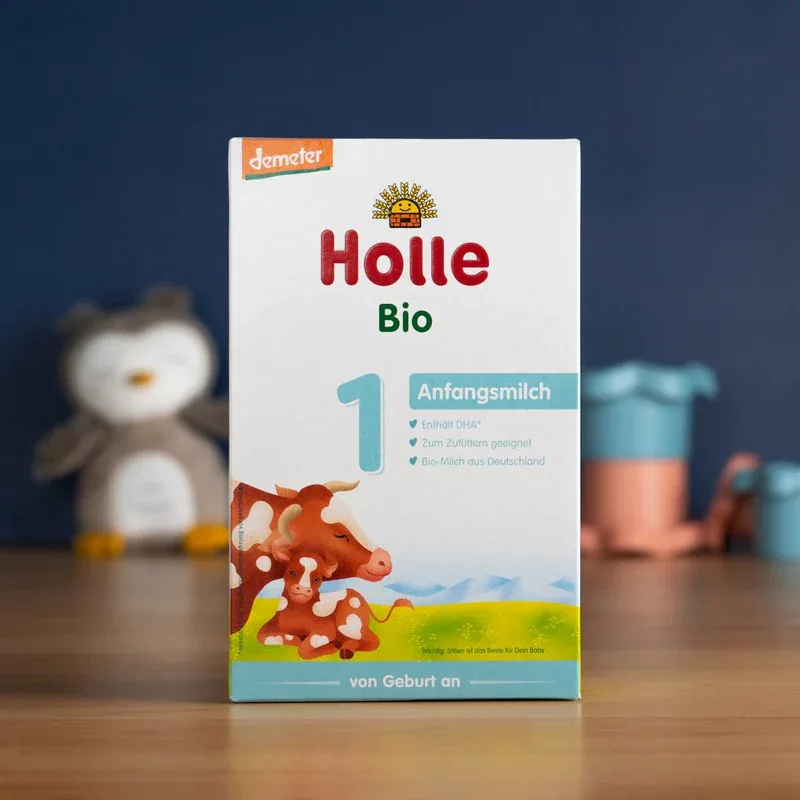
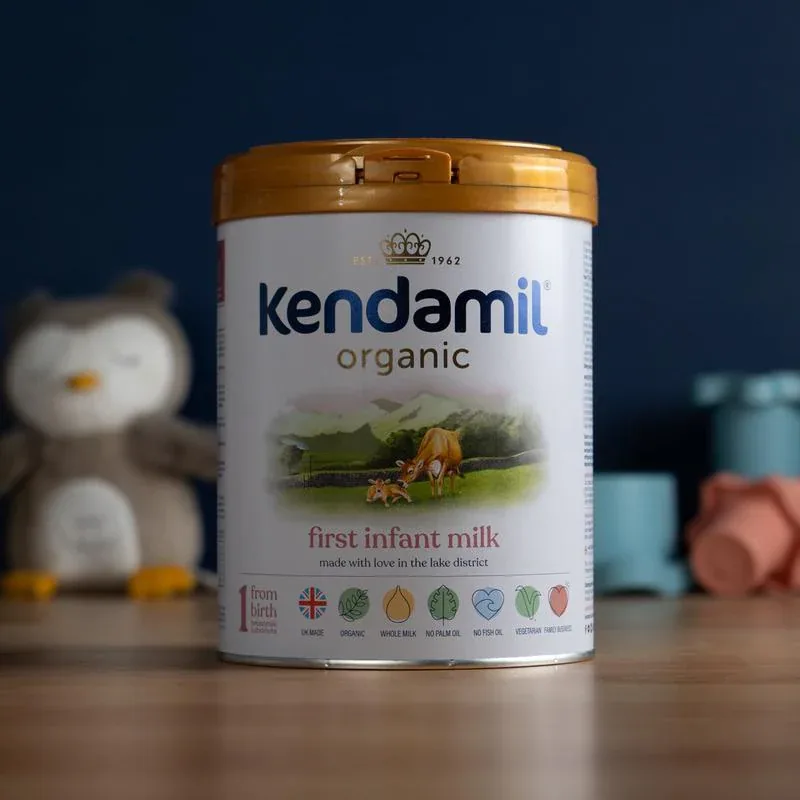
Holle Cow Stage 1 and Kendamil Organic Stage 1 are the EU Organic flagships with the two most distinctive above-EU-baseline certifications: Holle's Demeter biodynamic (strictest mainstream farming standard) and Kendamil Organic's UK Soil Association (stricter than EU Organic baseline, different farming-methodology focus). Both are EU 2016/127 compliant, both lactose-only, both via Organic's Best. The meaningful divergence is fat blend and bioactive strategy, not organic-certification rigor.
Holle Cow Stage 1 carries EU Organic and Demeter biodynamic with traditional minimal-additive composition, palm-inclusive fat blend, no prebiotic or probiotic, folic acid, ~$1.95/oz. Kendamil Organic Stage 1 carries EU Organic and UK Soil Association with whole-milk fat (palm-free), GOS prebiotic, higher DHA (~16.1 mg), at the same ~$1.95/oz. Same price tier, opposite fat strategies, different farming-standard emphases.
Why this comparison matters
Parents who've narrowed their shortlist to "EU Organic and above-baseline certification" often end up between Holle Cow and Kendamil Organic — and the decision isn't about which is "more organic" (both meaningfully exceed EU Organic baseline) but about which above-baseline dimension matters more. Demeter's biodynamic agriculture vs Soil Association's whole-farm welfare-and-integrity model. And on the composition side, palm-inclusive traditional vs whole-milk-fat palm-free.
At a glance
| Dimension | Holle Cow Stage 1 | Kendamil Organic Stage 1 |
|---|---|---|
| Manufacturer | Holle AG (Switzerland/Germany) | Kendal Nutricare (UK) |
| Age range | 0-6 months | 0-6 months |
| Regulation | EU 2016/127 and 2018/848 organic | EU 2016/127 and 2018/848 organic |
| Organic certification | EU Organic and Demeter biodynamic | EU Organic and UK Soil Association |
| Protein | Skimmed cow milk and whey | Whole cow milk and whey (organic) |
| Whey:casein | 60:40 | 60:40 |
| Primary carbohydrate | Lactose (only added) | Lactose (only added) |
| Prebiotic | None | GOS |
| Probiotic | None | None |
| Folate form | Folic acid | Folic acid |
| DHA source | Fish oil, ~15 mg/100 ml | Fish oil, ~16.1 mg/100 ml |
| Fat blend | Palm, rapeseed, coconut, sunflower | Whole-milk fat (organic) and sunflower, coconut, and rapeseed (NO palm) |
| Fat-blend notes | Palm oil | None |
| Tin size / format | 400 g cardboard box and foil pouch | 800 g metal tin |
| Typical price | ||
| US availability | Organic's Best, 5-10 day shipping | Organic's Best, 5-10 day shipping |
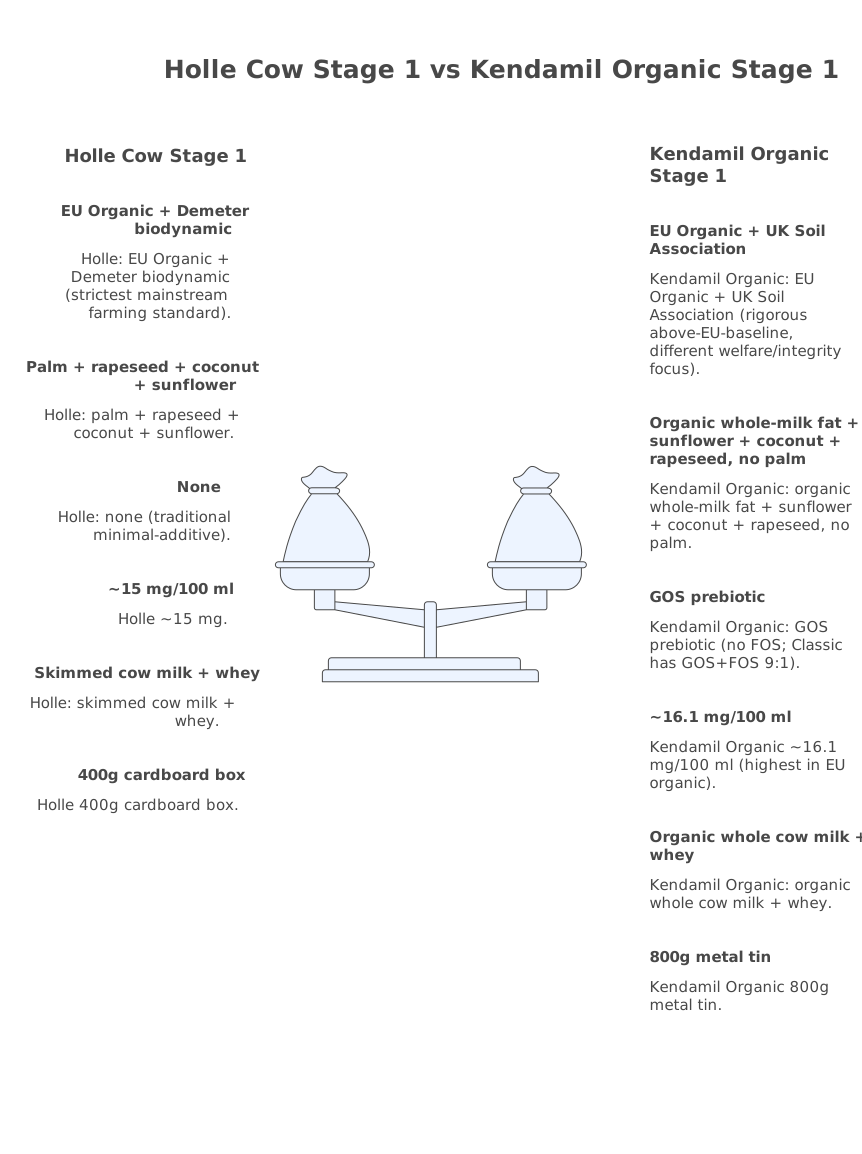
Visual generated with Napkin AI, editorial review by María López Botín. See methodology for our use policy.
Compositional differences that actually matter
1. Certification tier: Demeter vs UK Soil Association
Both are above-EU-Organic-baseline certifications, but they emphasize different dimensions:
- Demeter (Holle): biodynamic agriculture, closed-loop farm operations, biodynamic preparations (homeopathic soil amendments), cosmological planting calendars, strict herd-composition rules, highest animal welfare minimums among mainstream standards.
- UK Soil Association (Kendamil Organic): UK private organic certifier, widely regarded as rigorous above-EU-baseline, stricter animal welfare minimums than EU baseline, pesticide restrictions, GMO prohibition, but without Demeter's biodynamic framework.
Demeter is stricter on farming-methodology; Soil Association is stricter on some welfare and integrity dimensions with more conventional (non-biodynamic) philosophy. Neither is "more organic" per se, both meaningfully exceed EU Organic baseline. See organic certifications compared.
2. Fat blend: palm-inclusive vs whole-milk fat palm-free
Holle Cow: palm, rapeseed, coconut, and sunflower vegetable oil blend (all organic). Kendamil Organic: organic whole-milk fat as primary fat source, organic sunflower, coconut, and rapeseed, no palm.
Kendamil Organic's whole-milk fat provides native palmitic acid at the sn-2 position (matching breast-milk fatty acid stereochemistry) without requiring the sn-2 palmitate (OPO) processing step that palm- based formulas use to simulate breast-milk fatty acid distribution.
For palm-avoidant families, Kendamil Organic wins. For families comfortable with palm oil in vegetable oil blends (the majority), the fat-blend difference is modest on measurable outcomes. See the palm oil explainer.
3. Bioactive additions: both minimal, Kendamil adds GOS
Holle Cow: no prebiotic, no probiotic, no HMO, no MFGM, no lactoferrin. Traditional Holle-family minimal-additive philosophy.
Kendamil Organic: GOS prebiotic (no FOS: Kendamil Classic has GOS and FOS 9:1; Kendamil Organic simplifies to GOS-only for its organic line). No probiotic.
Neither is bioactive-heavy vs HiPP Dutch (Combiotik probiotic). Holle's approach is "minimize additives, maximize milk quality." Kendamil Organic's approach is "add one well-studied prebiotic fiber (GOS) without probiotic strain."
4. Protein base: skimmed, whey vs whole milk, and whey
Kendamil Organic uses organic whole cow milk as protein base, preserving native milk-fat globules and their MFGM-associated lipid structures. Holle Cow uses the conventional skimmed-cow-milk approach with fat added separately via vegetable oil blend.
5. DHA level
Kendamil Organic ~16.1 mg DHA / 100 ml (highest in EU organic Stage 1 field). Holle Cow ~15 mg. Both fish oil. Kendamil Organic's ~7% higher value reflects Kendamil's deliberate upper-range DHA targeting.
6. Price per ounce: effectively identical
Both ~$1.95/oz via Organic's Best subscribe-and-save. Kendamil Organic's 800 g tin is more packaging-efficient than Holle's 400 g box, but the whole-milk-fat, Soil Association, and GOS additions bring the price up to match Holle's Demeter premium. Parents can choose based on composition preference without material price difference.
7. Format: box vs tin
Holle Cow: 400 g cardboard box with foil pouch, smaller format, more frequent repurchases, environmental packaging. Kendamil Organic: 800 g metal tin with scoop, larger format, fewer repurchases, longer opened shelf life.
Regulatory framework
Both comply with EU Regulation 2016/127 (infant formula composition) and EU Regulation 2018/848 (organic). Holle adds Demeter International biodynamic certification; Kendamil Organic adds UK Soil Association certification. Neither is FDA-registered; families import under FDA enforcement discretion. Kendamil has some US retail distribution (select Target locations) under FDA enforcement discretion; Holle is import-only via resellers. See the buying European formula pillar.
Real-world parent experience
Following site methodology, the observations below come from my personal use across both kids plus a stable pool of parent-feedback notes from families on both formulas. They carry the parent-experience label rather than being claimed as regulatory or clinical facts, because individual infant variation on stool consistency, smell preference, and mixability is large enough that any specific point can reverse for a specific baby. Read these as context, not prediction.
Smell and taste. Kendamil Organic has a pronouncedly creamier, richer profile, whole-milk fat contributes noticeably to mouthfeel and aroma. Holle Cow has traditional Swiss/German dairy character, cleaner, drier, more cereal-like notes. Infants transitioning from breast milk often adapt faster to Kendamil Organic's richer profile.
Mixability. Kendamil Organic can foam slightly when shaken, gentle stirring or roll-bottle mixing prevents this. Holle's foil pouch can clump at cold-water preparation; 70°C water and prompt stirring resolves.
Stool consistency. Kendamil Organic families commonly report moderate-to-soft stools (palm-free, whole-milk-fat contribution). Holle families report moderate firmness typical of palm-inclusive formulas. Neither is concerning.
Switching between them. Use a 4-6 day gradual transition. Both EU Organic and lactose-only and 60:40 whey:casein makes macro transition smooth. Main observable shift: palm ↔ palm-free fat-blend stool character change (7-10 days adjustment) plus the GOS addition/removal.
Verdict: when to pick each
Pick Holle Cow Stage 1 if:
- Demeter biodynamic certification is a target (above Soil Association, strictest mainstream farming standard)
- Traditional minimal-additive composition resonates
- Swiss/German biodynamic heritage (since 1933) matters
- Smaller format (400 g box) fits your storage and purchase rhythm
Pick Kendamil Organic Stage 1 if:
- Palm-free composition is required
- Whole-milk fat appeals (native sn-2 palmitate, creamier profile)
- UK Soil Association certification resonates
- GOS prebiotic inclusion matters
- Higher DHA (~16.1 mg/100 ml) is a target
- Larger 800 g tin format matters for logistics
Pick either if:
- You want above-EU-Organic-baseline certification, lactose-only, and cow- milk Stage 1, and neither biodynamic farming nor palm-free is a dominant criterion. Both deliver EU 2016/127 baseline with credible certification-ladder premium.
What you can't infer from this comparison
Neither is indicated for diagnosed cow milk protein allergy, see the CMPA pillar. Neither is reflux-specific. Demeter certification is a farming standard, not a direct nutritional-superiority claim; whole-milk fat is a composition fact, not a clinical-outcome guarantee.
Frequently asked questions
Is Demeter stricter than Soil Association?
Does Kendamil Organic have Demeter certification?
Does Holle Cow have a prebiotic?
Is Kendamil Organic palm-free?
Which has higher DHA: Holle Cow or Kendamil Organic?
Is Holle or Kendamil Organic more expensive?
Can I switch from Holle Cow to Kendamil Organic?
Related reading
- Holle brand hub
- Kendamil brand hub
- HiPP Dutch Stage 1 vs Kendamil Organic Stage 1, the EU Organic and bioactive comparison
- HiPP Dutch Stage 1 vs Holle Cow Stage 1: Combiotik vs Demeter
- Holle Cow Stage 1 vs Kendamil Classic Stage 1: Demeter vs non-organic whole-milk
- HiPP vs Holle vs Kendamil, three-way European flagship
- Palm oil explainer
- Organic certifications compared
Primary sources
- Holle AG, manufacturer product information. holle.ch
- Kendamil / Kendal Nutricare, manufacturer product information. kendamil.com
- Demeter International, biodynamic certification registry. demeter.net
- UK Soil Association, organic certification standards. soilassociation.org
- EU Regulation 2016/127, infant formula compositional requirements. eur-lex.europa.eu
- EU Regulation 2018/848, organic production. eur-lex.europa.eu
This site provides research and comparisons, not medical advice. Consult your pediatrician before changing your baby's formula.