
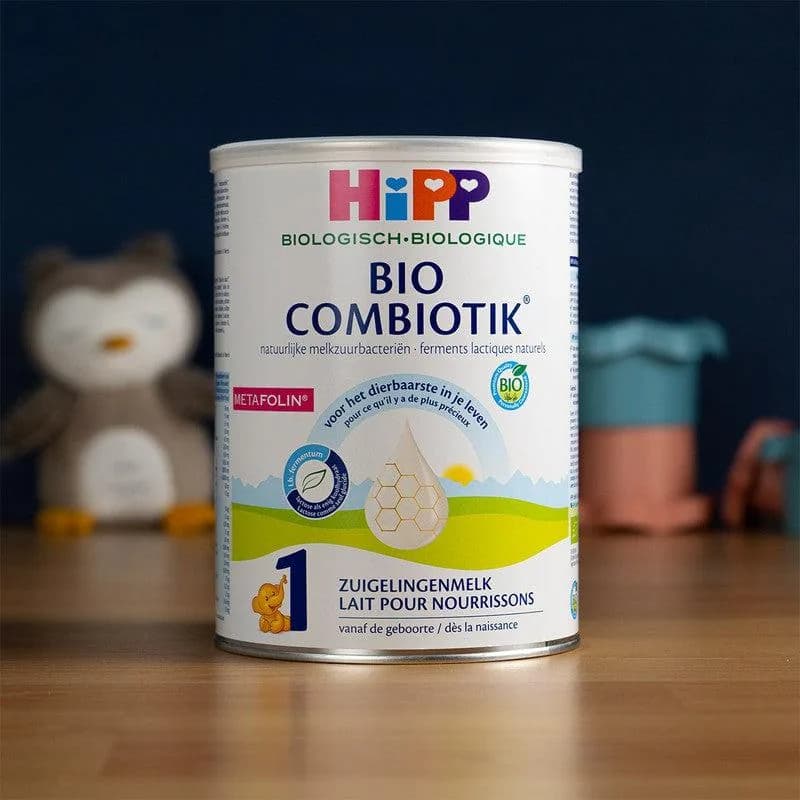
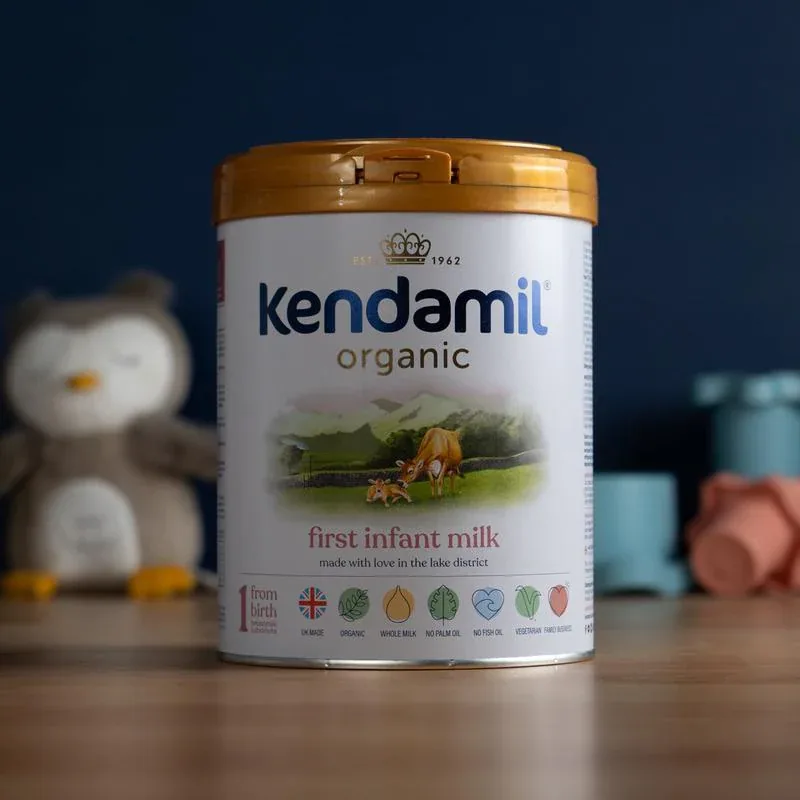
Both are EU Organic Stage 1 cow-milk formulas imported through Organic's Best on the same 5-10 day shipping. HiPP adds the Combiotik pairing of L. fermentum and GOS, plus Metafolin folate, on a palm-inclusive blend at ~$1.77/oz. Kendamil Organic uses palm-free whole-milk fat, GOS only, folic acid, and more DHA at 16.1 mg against 13.2, at ~$1.95/oz.
HiPP Dutch Stage 1 and Kendamil Organic Stage 1 are the apples-to- apples EU Organic Stage 1 decision. Both carry EU Organic certification. Both are lactose-only added carbohydrate. Both are 60:40 whey:casein. Both ship from the EU via Organic's Best with 5-10 day transit. The divergence is narrow but consequential: bioactive stack (HiPP wins) vs fat blend composition (Kendamil Organic wins, whole-milk fat, palm-free).
At a glance
| Dimension | HiPP Dutch Stage 1 | Kendamil Organic Stage 1 |
|---|---|---|
| Manufacturer | HiPP (Germany, Dutch-market SKU) | Kendal Nutricare (UK) |
| Age range | 0-6 months | 0-6 months |
| Regulation | EU 2016/127 and 2018/848 organic | EU 2016/127 and 2018/848 organic |
| Organic certification | EU Organic (SKAL) | EU Organic and UK Soil Association |
| Protein | Skimmed cow milk and whey | Whole cow milk and whey (organic) |
| Whey:casein | 60:40 | 60:40 |
| Primary carbohydrate | Lactose (only added) | Lactose (only added) |
| Prebiotic | GOS | GOS |
| Probiotic | L. fermentum hereditum (Combiotik) | None |
| Folate form | Metafolin (L-methylfolate) | Folic acid |
| DHA source | Fish oil, ~13.2 mg/100 ml | Fish oil, ~16.1 mg/100 ml |
| Fat blend | Palm, rapeseed, sunflower | Whole-milk fat (organic) and organic sunflower, coconut, and rapeseed (NO palm) |
| Fat-blend notes | Palm oil | None |
| Tin size | 800 g | 800 g |
| Typical price | ||
| US availability | Organic's Best, 5-10 day shipping | Organic's Best, 5-10 day shipping |
Typical US retail price, normalised to USD per ounce of powder. Imported European formulas carry shipping and importer margin; US retail brands are typically cheapest per ounce. Subscribe-and-save and private-label pricing can shift the ranking.
Data table
| Formula | Price per ounce |
|---|---|
| HiPP Dutch Stage 1 | $1.77 |
| Kendamil Organic Stage 1 | $1.95 |
Why this comparison matters
For parents whose shortlist requires EU Organic certification (ruling out Kendamil Classic) AND specifically weight palm-free fat and probiotic depth, HiPP Dutch and Kendamil Organic are the realistic final two. Both brands have decades of EU infant-formula track record, both comply with EU 2016/127 on every mandatory dimension, both are clean on recall history.
Compositional differences that actually matter
1. Fat blend: palm-inclusive vs palm-free whole-milk fat
This is Kendamil Organic's signature differentiator within the EU Organic Stage 1 field.
HiPP Dutch: palm-inclusive vegetable oil blend (organic palm, organic rapeseed, organic sunflower), the standard EU-organic formulation approach.
Kendamil Organic: organic whole-milk fat as the primary fat source, supplemented by organic sunflower, coconut, and rapeseed oils. No palm oil. The whole-milk fat naturally provides palmitic acid at the sn-2 position (matching breast-milk structure), without requiring the sn-2 palmitate (OPO) processing step that palm-based formulas use to simulate breast-milk fatty acid stereochemistry.
For parents whose shortlist criteria include "EU Organic AND palm- free," Kendamil Organic is essentially the only answer on the EU market, it's the unique SKU that combines both attributes. HiPP Dutch, Holle Cow, and Lebenswert are all palm-inclusive. See the palm oil explainer.
2. Bioactive stack: Combiotik vs GOS-only
HiPP Dutch: GOS prebiotic and L. fermentum hereditum live probiotic (Combiotik).
Kendamil Organic: GOS prebiotic only, no probiotic, no FOS. (Note: Kendamil Classic uses GOS and FOS 9:1; Kendamil Organic simplifies to GOS-only for its organic line.)
HiPP wins decisively on bioactive depth. For parents who weight "living probiotic strain in infant formula", whether for documented gut- colonization benefit or as general microbiome support: HiPP is the answer. See the GOS explainer.
3. Folate form: Metafolin vs folic acid
HiPP: Metafolin (L-methylfolate), bioactive. Kendamil Organic: folic acid, synthetic oxidized. For MTHFR-sensitive families, HiPP's Metafolin is metabolically more efficient. See Metafolin vs folic acid.
4. DHA level: Kendamil Organic ~22% higher
Kendamil Organic supplies ~16.1 mg DHA / 100 ml; HiPP Dutch supplies ~13.2 mg / 100 ml. Both from fish oil. Both above EU 2016/127 minimum. The ~22% higher Kendamil value sits in the upper range of typical breast-milk DHA. Kendamil Organic consistently delivers the highest DHA level among EU Organic Stage 1 formulas.
5. Protein base: skimmed, whey vs whole milk, and whey
Kendamil Organic uses organic whole cow milk as the protein base, preserving native milk-fat globules and their associated lipid structures. HiPP Dutch uses the conventional skimmed-cow-milk approach and adds fat separately from vegetable oils.
The functional implication is modest, both formulas meet all EU 2016/127 composition requirements. Whole-milk protein processing is closer to traditional dairy production and retains some MFGM-associated lipids that skimmed-milk processing removes (though neither Kendamil nor any EU organic formula quantifies or positions this as "added MFGM").
6. Certification layering
Both carry EU Organic (Regulation 2018/848). Kendamil Organic adds UK Soil Association, the UK's private organic certifier, widely regarded as a rigorous organic standard with stricter animal welfare minimums than EU baseline. It's above-EU in some respects, below Demeter (biodynamic) in others. HiPP Dutch has SKAL (the Netherlands EU-Organic certifier), equivalent to EU baseline, not above.
For parents weighting "UK-origin organic with stricter welfare," Kendamil Organic wins this sub-dimension.
7. Price per ounce: HiPP cheaper
HiPP Dutch ~$1.77/oz; Kendamil Organic ~$1.95/oz. ~10% price difference. Kendamil Organic's premium reflects whole-milk-fat and UK-origin, Soil Association, and higher DHA level, real cost inputs. HiPP Dutch's pricing reflects HiPP's broader EU scale and SKAL (not Soil Association) certification.
Regulatory framework
Both formulas comply with EU Regulation 2016/127 (infant formula composition) and EU Regulation 2018/848 (organic). Neither is FDA-registered. families import under FDA enforcement discretion. See the buying European formula pillar.
Kendamil Organic additionally carries UK Soil Association organic certification beyond EU baseline.
Real-world parent experience
Following site methodology, the observations below come from my personal use across both kids plus a stable pool of parent-feedback notes from families on both formulas. They carry the parent-experience label rather than being claimed as regulatory or clinical facts, because individual infant variation on stool consistency, smell preference, and mixability is large enough that any specific point can reverse for a specific baby. Read these as context, not prediction.
Smell and taste. Kendamil Organic has a pronouncedly creamier, richer character, whole-milk fat contributes noticeably to mouthfeel, aroma, and aftertaste. HiPP Dutch has a lighter, sweeter, more neutral profile. Infants transitioning from breast milk often adapt faster to Kendamil Organic.
Mixability. Kendamil Organic can foam more when vigorously shaken, gentle stirring or rolled-bottle mixing prevents this. HiPP dissolves cleanly with typical shake preparation. Both use 70°C water.
Stool consistency. HiPP families commonly report softer, more yogurt-like stools (L. fermentum probiotic contribution). Kendamil Organic families report moderate-to-soft stools, the palm-free whole-milk-fat blend tends toward slightly softer than palm-inclusive. Neither is concerning.
Switching between them. Use a 4-6 day gradual transition. Both are EU Organic, lactose-only, 60:40 whey:casein, the macro transition is smooth. Main observable shifts: stool consistency (palm ↔ whole-milk-fat) and stool pattern (probiotic add/remove).
Verdict: when to pick each
Pick HiPP Dutch Stage 1 if:
- Documented probiotic strain (L. fermentum) matters
- Metafolin bioavailable folate matters (MTHFR or general optimization)
- Lower per-ounce price matters
- Palm oil inclusion is acceptable
Pick Kendamil Organic Stage 1 if:
- Palm-free is a must-have and organic is also a must-have (the unique dual criterion Kendamil Organic uniquely fills on the EU market)
- Whole-milk fat appeals (native sn-2 palmitate, creamier profile, MFGM-associated lipids retained)
- UK Soil Association certification resonates (above EU baseline)
- Higher DHA level (~16.1 mg/100 ml) is a target
- You accept the ~10% price premium vs HiPP
Pick either if:
- You want EU Organic, lactose-only, and cow-milk Stage 1 and neither "Combiotik probiotic depth" nor "palm-free whole-milk fat" is a dominant preference. Both deliver identical baseline nutrition on every EU 2016/127 mandatory dimension.
What you can't infer from this comparison
Neither is indicated for diagnosed cow milk protein allergy, see the CMPA pillar. Neither is reflux-specific. The whole-milk-fat approach in Kendamil Organic is a composition difference, not a clinical-superiority claim; likewise HiPP's Combiotik is a composition difference, not a guaranteed clinical outcome. Both are safe, compliant Stage 1 options.
Frequently asked questions
Is Kendamil Organic Stage 1 better than HiPP Dutch Stage 1?
Does Kendamil Organic have a probiotic?
Does HiPP Dutch have palm oil?
Is Kendamil Organic the same as Kendamil Classic?
What is UK Soil Association certification?
Which has more DHA: HiPP Dutch or Kendamil Organic?
Can I switch from HiPP Dutch to Kendamil Organic?
Related reading
- HiPP brand hub
- Kendamil brand hub
- HiPP Dutch Stage 1 vs Kendamil Classic Stage 1. EU Organic vs Red Tractor non-organic
- Kendamil Classic Stage 1 vs Kendamil Organic Stage 1, intra-brand (coming soon)
- HiPP vs Holle vs Kendamil compared side-by-side
- Palm oil explainer
- Metafolin vs folic acid
- Organic certifications compared
Primary sources
- HiPP, manufacturer product information. hipp.com
- Kendamil / Kendal Nutricare, manufacturer product information. kendamil.com
- UK Soil Association, organic certification standards. soilassociation.org
- EU Regulation 2016/127, infant formula compositional requirements. eur-lex.europa.eu
- EU Regulation 2018/848, organic production. eur-lex.europa.eu
This site provides research and comparisons, not medical advice. Consult your pediatrician before changing your baby's formula.