
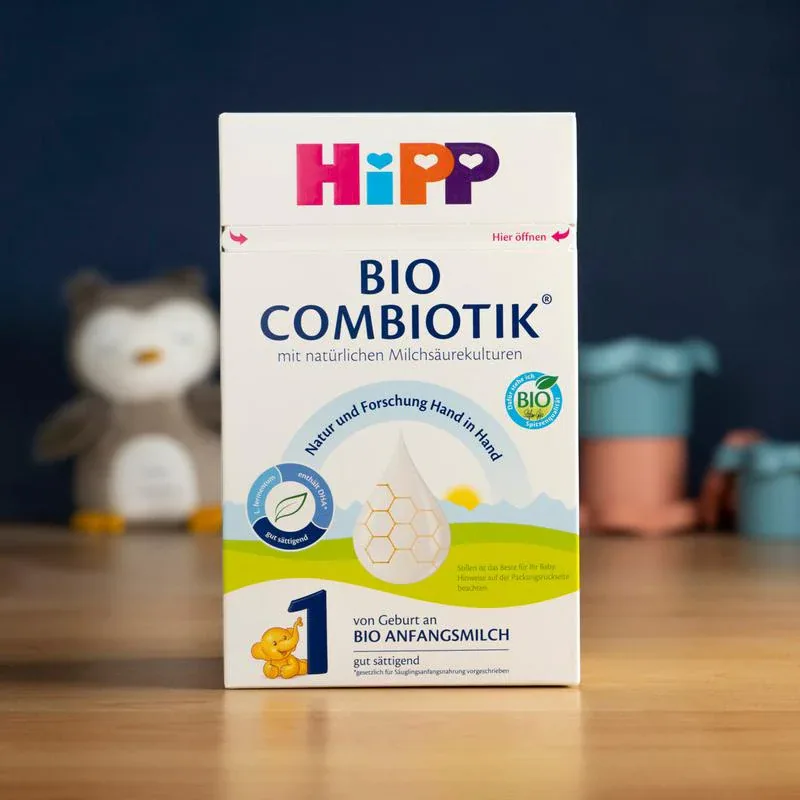
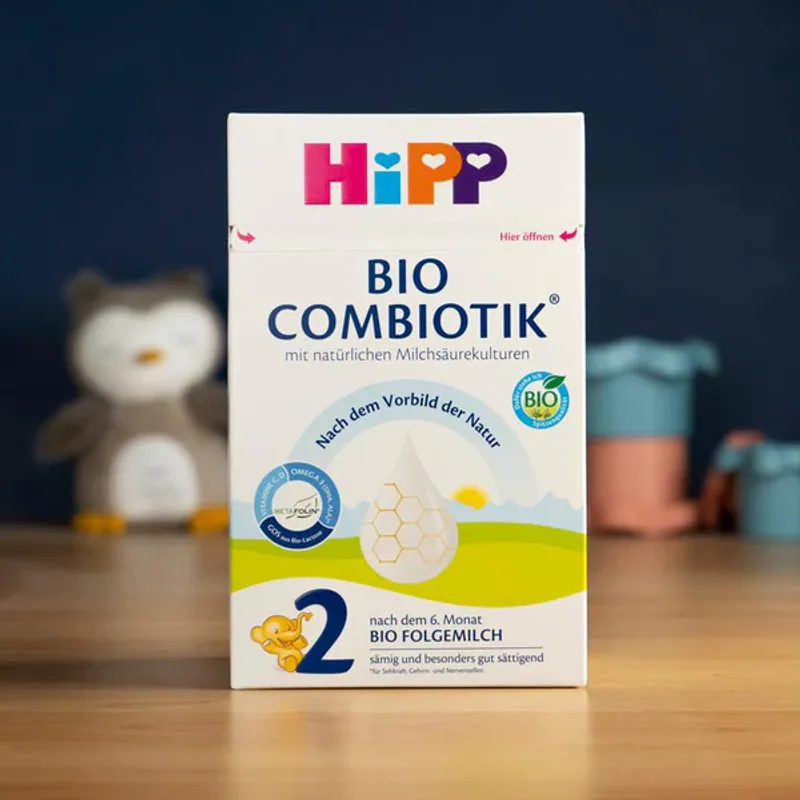
HiPP German Stage 1 and Stage 2 are the German-market HiPP Bio formulas (not the Dutch Combiotik variant that most families know). The German version is EU Organic and German Bio certified and includes GOS prebiotic, but not the live probiotic that distinguishes HiPP Dutch Combiotik. This stage transition preserves that German-specific composition across the 0-6 → 6-10 month window. For families who have specifically sourced HiPP German (rather than HiPP Dutch), understanding the stage transition matters.
Stage 1 (0-6m): EU Organic and German Bio and GOS only (no probiotic) + Metafolin and protein 1.25 g/100 ml and iron 0.5 mg and DHA 14 mg + 600 g tin. Stage 2 (6-10m): same organic certifications, same GOS, Metafolin, and protein 1.4 g and iron 1.0 mg (+100%) and DHA 14 mg. Same philosophy continues; distinct from HiPP Dutch Combiotik (which adds probiotics).
Why this comparison matters
families importing EU formulas typically default to HiPP Dutch (full Combiotik). Some families specifically source HiPP German for reasons including: (a) personal preference for GOS-only bioactive without live probiotic, (b) EU Organic and German Bio certification preference, (c) different supply chain availability. For these families, the Stage 1 → Stage 2 question applies specifically to HiPP German's composition, which differs from HiPP Dutch's.
At a glance
| Dimension | HiPP German Stage 1 | HiPP German Stage 2 |
|---|---|---|
| Age range | 0-6 months | 6-10 months (narrower than Dutch Stage 2's 6-12) |
| EU regulation | EU 2016/127 | EU 2016/128 |
| EU Organic | Yes | Yes |
| German Bio | Yes | Yes |
| FDA status | Not FDA-registered (personal import enforcement discretion) | Not FDA-registered (personal import enforcement discretion) |
| Energy | 66 kcal / 100 ml | 68 kcal / 100 ml |
| Protein | 1.25 g / 100 ml | 1.4 g / 100 ml (+12%) |
| Whey:casein | 60:40 | 60:40 |
| Primary carbohydrate | Lactose | Lactose |
| Carbohydrates | 7.3 g / 100 ml | 8.2 g / 100 ml |
| Fat | 3.5 g / 100 ml | 3.3 g / 100 ml |
| Iron | 0.5 mg / 100 ml | 1.0 mg / 100 ml (+100%) |
| DHA | 14 mg / 100 ml | 14 mg / 100 ml |
| Prebiotic | GOS only | GOS only |
| Probiotic | None (distinct from HiPP Dutch Combiotik) | None |
| HMO | None | None |
| Folate | Metafolin (same as HiPP Dutch) | Metafolin |
| Fat blend | RSPO palm, rapeseed, sunflower, and coconut | RSPO palm, rapeseed, sunflower, and coconut |
| Format | 600 g tin | 600 g tin |
| Typical price (US) |
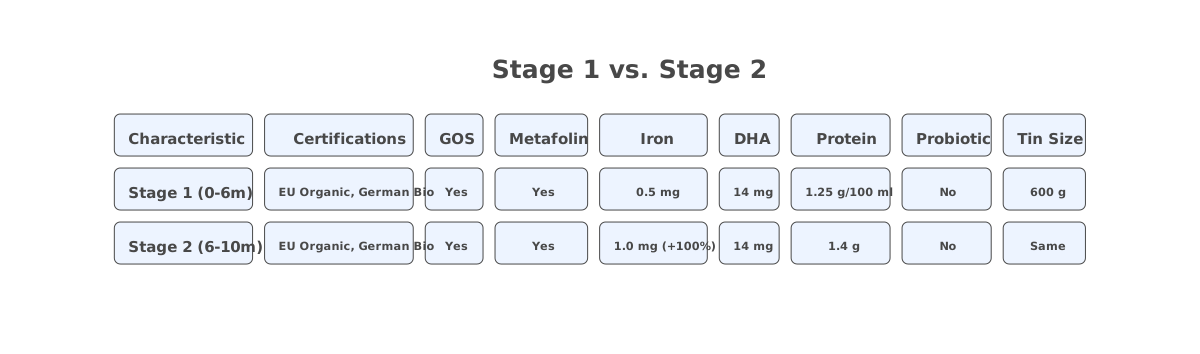
Visual generated with Napkin AI, editorial review by María López Botín. See methodology for our use policy.
What changes from Stage 1 to Stage 2
1. Iron doubles
Stage 1: 0.5 mg → Stage 2: 1.0 mg / 100 ml. +100%, same proportional increase as HiPP Dutch Stage 1 → Stage 2. Matches EU follow-on standard.
2. Protein rises meaningfully
Stage 1: 1.25 g → Stage 2: 1.4 g / 100 ml. +12%, larger proportional increase than HiPP Dutch (+1.5%) or Holle Cow (-6% actually). The protein bump in HiPP German reflects slightly different formulation priorities than HiPP Dutch.
3. Energy, carbs, and fat: typical stage adjustments
Energy 66 → 68 kcal. Carbs 7.3 → 8.2 g. Fat 3.5 → 3.3 g. Same general pattern as other EU stage progressions.
4. Age window ends at 10 months
HiPP German Stage 2 is labeled 6-10 months, narrower than HiPP Dutch Stage 2's 6-12 months. After 10 months, families on HiPP German typically transition to HiPP German Stage 3 (12+ months) or Stage 4 (18+ months): German line has deeper toddler-tier progression than Dutch line.
5. DHA stays at 14 mg
Constant across stages. Slightly lower than HiPP Dutch (13.2-13.6 mg Stage 1, depending on formulation year).
6. Everything else preserved
- EU Organic and German Bio certification
- Lactose primary
- 60:40 whey:casein
- GOS prebiotic (no FOS, no HMO)
- No probiotic (distinct from Dutch Combiotik)
- Metafolin folate (same as Dutch, the bioactive L-methylfolate)
- RSPO palm, rapeseed, sunflower, and coconut fat blend
- Iron sulfate form
- 600 g tin
HiPP German vs HiPP Dutch: the probiotic question
The main compositional difference between HiPP German and HiPP Dutch is the probiotic layer:
| Attribute | HiPP German | HiPP Dutch |
|---|---|---|
| EU Organic | Yes | Yes |
| Prebiotic | GOS only | GOS only |
| Probiotic | None | L. fermentum and L. rhamnosus (Combiotik) |
| Metafolin | Yes | Yes |
| RSPO palm | Yes | Yes |
| DHA | 14 mg | 13.2-13.6 mg |
Families specifically wanting the Combiotik synbiotic (GOS and probiotics) should source HiPP Dutch. Families preferring GOS-only approach with the same EU Organic and Metafolin quality choose HiPP German.
Why this matters: Combiotik has published evidence for infant gut microbiota support; GOS-only provides prebiotic fermentation substrate without live organism introduction. Both approaches are clinically appropriate; the Combiotik adds active probiotic effect; GOS-only is simpler composition.
When to make the transition
HiPP's guidance: Stage 2 from 6 months. The decision is rarely binary — the recommendation below documents the typical pediatric-aligned threshold plus the family circumstances that justify staying on the current formula a little longer.
Practical transition timing for parents on HiPP German:
- Not before 6 months: Stage 2 iron unnecessary for 0-6 month window.
- At 6 months, typical transition.
- By 8-10 months: HiPP German Stage 2 window ends at 10 months; plan transition to Stage 3 by 9-10 months.
Transitioning Stage 1 → Stage 2
Most composition preserved (EU Organic, German Bio, GOS, and Metafolin and RSPO palm). Changes: iron (+100%) and protein (+12%). Typical 10-day gradual transition.
After Stage 2: HiPP German Stage 3 pathway
Unlike HiPP Dutch (which has Stage 3 at 10 and months), HiPP German has more clearly defined toddler tiers: Stage 3 (12+ months, Kindermilch) and sometimes Stage 4 (18+ months) depending on year and SKU availability. Plan transition to next stage by 10 months if continuing HiPP German through toddlerhood.
Real-world parent experience
Following site methodology, observations come from US parent feedback on HiPP German use. Not clinical recommendations. Where my own feeding observations are referenced, they are clearly labeled as parent-experience notes; manufacturer claims and regulatory data are cited separately so the source weight stays explicit.
Smell and taste. HiPP German has a slightly different smell profile than HiPP Dutch, some parents report less probiotic- fermentation character (expected, given no probiotic). Stage 1 and Stage 2 are very similar in smell/taste.
Stool consistency. Without the probiotic active fermentation contribution, HiPP German stools may be slightly firmer than HiPP Dutch. Stage 2 transition produces typical iron-related minor darkening.
Supply considerations. HiPP German is generally imported through specialized EU reseller channels. Supply consistency can vary more than HiPP Dutch (which has larger US-directed import volume).
Why families choose HiPP German over Dutch. Common reasons: (a) specific preference for GOS-only bioactive, (b) previous sensitivity to probiotic-containing formulas, (c) desire for slightly higher DHA (14 vs 13.2-13.6 mg), (d) personal or family preference based on origin country.
Verdict: which to pick when
Use HiPP German Stage 1 if:
- Your baby is 0-6 months
- You value EU Organic and German Bio certification
- You want GOS prebiotic without live probiotic
- You want Metafolin bioactive folate
Transition to HiPP German Stage 2 if:
- Your baby is 6-10 months
- You want HiPP German composition continuity with age-appropriate iron
Plan transition by 10 months to:
- HiPP German Stage 3 (12+ months)
- HiPP Dutch Stage 3 (10+ months, Combiotik)
- Whole cow milk at 12 months (AAP guidance)
Pick neither if:
- You want the full Combiotik synbiotic (GOS and probiotics), consider HiPP Dutch Stage 1 → Stage 2 progression
- You want whole milk fat and palm-free, consider Kendamil Classic Stage 1 → Stage 2 (conventional) or Kendamil Organic Stage 1 → Stage 2 (EU Organic)
- You want minimalist pure-milk (no GOS), consider Holle Cow Stage 1 → Stage 2
What you can't infer from this comparison
Both are safe EU Organic and German Bio formulas for their respective age ranges. HiPP German's absence of probiotic vs HiPP Dutch's Combiotik is a real compositional difference, but neither approach is universally superior, the Combiotik adds active probiotic effect; GOS-only is simpler. Individual infant response varies. The Stage 1 → Stage 2 transition is primarily about age-appropriate iron and protein fortification.
Frequently asked questions
When should I switch HiPP German from Stage 1 to Stage 2?
What's the difference between HiPP German and HiPP Dutch?
Why would I pick HiPP German over HiPP Dutch?
Does HiPP German use Metafolin like HiPP Dutch?
Why does HiPP German Stage 2 age window end at 10 months, not 12?
Does the price change much between Stage 1 and Stage 2?
Is HiPP German more or less expensive than HiPP Dutch?
Can I switch between HiPP German and HiPP Dutch at the stage transition?
Related reading
- HiPP brand hub
- HiPP Dutch Stage 1 vs Stage 2, sibling Dutch Combiotik progression
- HiPP Dutch Stage 2 vs Stage 3
- HiPP Dutch Stage 1 vs HiPP German Stage 1, variant comparison (if exists)
- EU infant formula regulation
- Organic certifications compared
- GOS explainer
- Iron in infant formula
Primary sources
- HiPP GmbH, manufacturer product information. hipp.de
- EU Regulation 2018/848. EU organic production and labelling. eur-lex.europa.eu
- EU Regulation 2016/127. EU compositional requirements for infant formula. eur-lex.europa.eu
- EU Regulation 2016/128. EU compositional requirements for follow-on formula. eur-lex.europa.eu
- EFSA Scientific Opinion on compositional requirements for infant formula. efsa.europa.eu
This site provides research and comparisons, not medical advice. Consult your pediatrician before changing your baby's formula.