
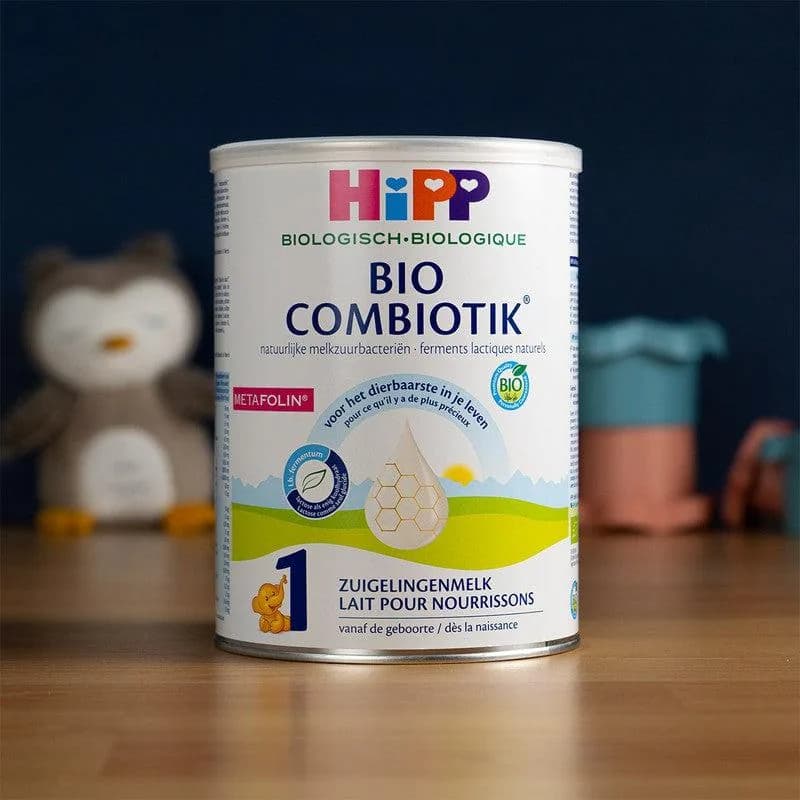
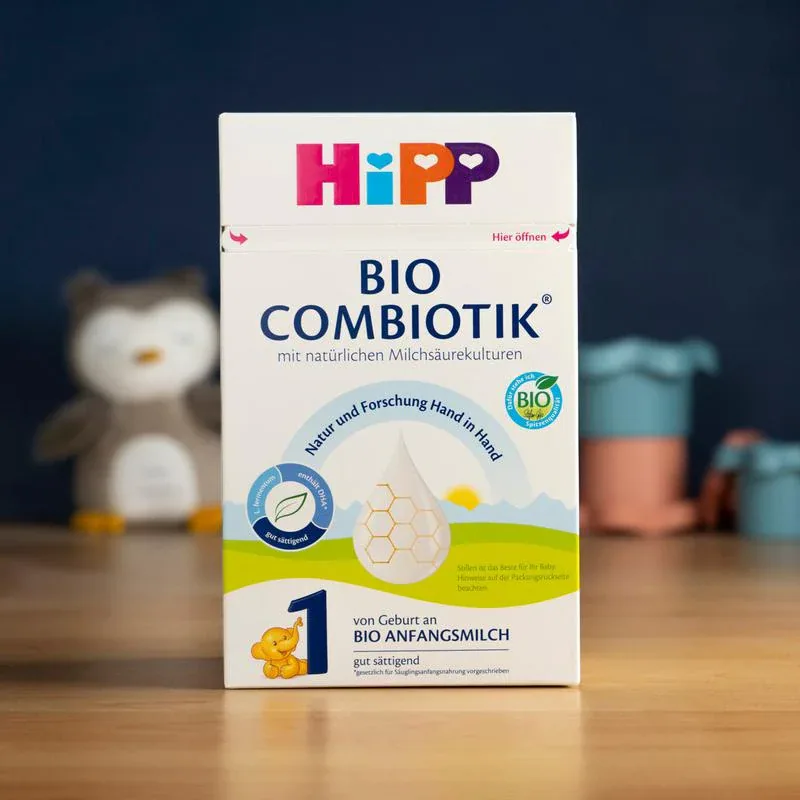
Same HiPP Group quality; the differences are the probiotic strain and the certification overlay. Dutch carries EU Organic, Limosilactobacillus fermentum hereditum and Metafolin bioactive folate at ~$1.77/oz. German adds a German Bio overlay, uses Bifidobacterium lactis BB-12 and folic acid, at ~$1.94/oz. Both are lactose-led with a palm-inclusive fat blend.
HiPP Dutch Stage 1 and HiPP German Stage 1 are the two HiPP Combiotik Stage 1 variants families most often choose between. Both come from the HiPP Group with shared quality control and shared regulatory backbone (EU 2016/127 plus EU Organic). They diverge on probiotic strain (Limosilactobacillus fermentum hereditum in Dutch vs Bifidobacterium lactis BB-12 in German), bioactive folate form (Metafolin in Dutch only), and certification overlay (German Bio added on the German variant). The Dutch variant is the most-imported HiPP at US retail; the German variant is the original HiPP heritage product.
At a glance
| Dimension | HiPP Dutch Stage 1 | HiPP German Stage 1 |
|---|---|---|
| Manufacturer | HiPP Group (Dutch manufacturing operation) | HiPP Group (German manufacturing) |
| Origin | Netherlands (NL) | Germany (DE) |
| Age range | 0-6 months (Stage 1) | 0-6 months (Stage 1) |
| Regulation | EU 2016/127 (FDA enforcement discretion for US import) | EU 2016/127 (FDA enforcement discretion for US import) |
| Organic certification | EU Organic (SKAL Dutch certifier) | EU Organic plus German Bio |
| Protein source | Skimmed cow milk and whey | Skimmed cow milk and whey |
| Whey:casein ratio | 60:40 | 60:40 |
| Primary carbohydrate | Lactose only added | Lactose primary |
| Prebiotic | GOS | GOS |
| Probiotic | Limosilactobacillus fermentum hereditum (live probiotic strain) | Bifidobacterium lactis BB-12 (live probiotic strain) |
| Folate form | Metafolin (bioactive folate) | Folic acid |
| Fat blend | Palm oil (RSPO) and rapeseed and sunflower (no soy) | Palm oil (RSPO) and rapeseed and sunflower (no soy) |
| DHA source | Algal oil, ~13.2 mg/100 ml | Algal oil, ~14 mg/100 ml |
| Iron | 0.5 mg/100 ml | 0.5 mg/100 ml |
| Fat-blend notes | Palm oil (RSPO-certified) | Palm oil (RSPO-certified) |
| Format | 800 g tin | 600 g box |
| Typical US price | ||
| US availability | Personal import via Organic's Best Shop, 5-10 day shipping | Personal import via Organic's Best Shop, 5-10 day shipping |
Typical US retail price, normalised to USD per ounce of powder. Imported European formulas carry shipping and importer margin; US retail brands are typically cheapest per ounce. Subscribe-and-save and private-label pricing can shift the ranking.
Data table
| Formula | Price per ounce |
|---|---|
| HiPP Dutch Stage 1 | $1.77 |
| HiPP German Stage 1 | $1.94 |
Why this comparison matters
For families committed to HiPP at the EU-import tier, the Dutch vs German decision is the most-frequent intra-brand split. Both share HiPP Group's manufacturing standards, both are EU 2016/127 compliant, both are EU Organic. Distribution differs: the Dutch variant is the most-stocked HiPP at Organic's Best Shop and other US import resellers because of US-import-friendly packaging and stable supply. The German variant is HiPP's original heritage product and carries the German Bio certification overlay valued in the EU market specifically. The practical decision for families narrows to probiotic strain preference, bioactive folate inclusion, and regional certification overlay.
Compositional differences that actually matter
Four dimensions where HiPP Dutch and HiPP German diverge.
1. Probiotic strain: L. fermentum vs B. lactis BB-12
The defining difference. HiPP Dutch's Combiotik delivers Limosilactobacillus fermentum hereditum CECT5716, a Lactobacillus- family strain originally isolated from human breast milk and supported by clinical evidence for term-infant gut microbiome modulation and respiratory infection reduction. HiPP German uses Bifidobacterium lactis BB-12, a Bifidobacterium-family strain widely used in adult probiotics with extensive clinical evidence in both adults and infants for gut microbiome support and immune-system effects.
Neither strain is clinically superior; they target different bacterial genera in the gut. L. fermentum hereditum is the rarer ingredient (fewer formulas use it globally); B. lactis BB-12 is more widely deployed across infant and adult products. Families with strain- specific preferences (typically based on prior pediatric advice or research interest) pick accordingly. For most families approaching HiPP Combiotik for the first time, both strains are clinically acceptable.
2. Folate form: Metafolin vs folic acid
HiPP Dutch uses Metafolin (L-methylfolate calcium), the bioactive form of folate that the body uses directly without conversion through the MTHFR enzymatic step. HiPP German uses standard folic acid. Roughly 30-50% of the population has reduced MTHFR activity, which can theoretically reduce folic-acid utilization efficiency. Both folate forms support adequate folate status for term infants without diagnosed MTHFR conditions.
Among EU-imported Stage 1 formulas, HiPP Dutch is one of the few delivering Metafolin. The bioactive-folate inclusion is a Dutch HiPP distinguishing feature; HiPP German's folic-acid use is the European mainstream convention.
3. Certification overlay: German Bio added in German variant
Both variants are EU Organic. HiPP German additionally carries the German Bio mark, a German-domestic organic recognition that adds some German-specific organic standards on top of EU Organic baseline. For German consumers, German Bio is a valued certification overlay; for US importers, the practical effect is minimal beyond EU Organic itself. See organic certifications compared.
4. Format and pricing: 800 g tin vs 600 g box
HiPP Dutch ships in 800 g tins (the EU-import standard format used by Holle, Aptamil, Loulouka). HiPP German ships in 600 g boxes (the German-domestic packaging convention, similar to Lebenswert's 500 g box). The 800 g format provides longer per-tin coverage and slightly better economics; the 600 g format means more frequent reorders but smaller open-container exposure.
Pricing per ounce is essentially identical: Dutch ~$1.77/oz, German ~$1.94/oz, a negligible $0.02/oz gap. Both share identical 5-10 day import shipping windows and stock-buffer recommendations.
Regulatory framework
Both formulas comply with EU Regulation 2016/127 and operate under FDA enforcement discretion for personally-imported infant formula via Organic's Best Shop and similar US import resellers. Neither is FDA-registered, neither is WIC-eligible.
HiPP's manufacturing operations in the Netherlands and Germany share the HiPP Group's quality-control standards. The Dutch variant is certified by SKAL (Dutch organic certifier); the German variant is certified by EU Organic plus the German Bio mark. For the broader regulatory comparison, see FDA vs EFSA standards compared.
Real-world parent experience
Following site methodology, the observations below come from my personal testing across both formulas plus a stable pool of parent-feedback notes from families on both HiPP variants. Read these as context, not prediction.
Smell and taste. Both have HiPP's clean, slightly creamier profile from the lactose-only carbohydrate plus palm-oil contribution. The two variants are nearly indistinguishable to most parents at reconstituted concentration; some report slightly different mouthfeel related to the fermented-component differences in earlier production lots, but the current 2026 formulations are very close.
Mixability. Both dissolve cleanly at 70°C preparation. Both are fine with standard preparation; minimal differences in mixability.
Stool consistency. Dutch families often report softer stools from the L. fermentum hereditum probiotic contribution. German families report similar soft pattern from the B. lactis BB-12 contribution. Both within normal range for healthy term infants on lactose-primary diets with prebiotic-plus-probiotic stimulation.
Switching between them. Use a 4-6 day gradual transition. Same HiPP Group manufacturing means very small structural shift. The probiotic strain swap (L. fermentum to B. lactis or reverse) plus folate form swap (Metafolin to folic acid or reverse) typically produces minimal observable adjustment. Most infants tolerate the switch within 2-4 days.
Verdict: when to pick each
Pick HiPP Dutch Stage 1 if:
- L. fermentum hereditum probiotic strain matters (clinical evidence preference)
- Metafolin bioactive folate matters (MTHFR concern or strong bioactive-form preference)
- 800 g tin format works for your consumption pattern
- Standard EU-import packaging is your preference
Pick HiPP German Stage 1 if:
- B. lactis BB-12 probiotic strain matters (extensive clinical evidence in both adult and infant uses)
- German Bio certification overlay matters
- 600 g box format suits your consumption pattern (smaller, more frequent reorders)
- Original HiPP heritage product is the preference
Pick neither if:
- Soy-free with palm-free is required (look at Loulouka Stage 1 or Kendamil Classic Stage 1)
- Whole-milk-fat preservation matters (look at Kendamil Classic or Kendamil Organic)
- Demeter biodynamic strictest organic is required (look at Holle Cow Stage 1)
What you can't infer from this comparison
Both variants share HiPP Group's manufacturing standards; differences between them are not quality-tier differences. The probiotic-strain choice is a meaningful preference axis but not a clinical-superiority axis for healthy term infants. Neither variant is hypoallergenic; for HiPP's hypoallergenic line, see HiPP HA Stage 1. Both contain palm oil (RSPO-certified, in standard form rather than sn-2 structured palm).
Frequently asked questions
Why are there Dutch and German HiPP variants?
Which HiPP variant has the live probiotic, Dutch or German?
What is Metafolin and why does only the Dutch variant have it?
Is HiPP Dutch or HiPP German cheaper?
Can I switch between HiPP Dutch and HiPP German?
Is HiPP UK Stage 1 different from Dutch and German?
Does HiPP Dutch or German have palm oil?
Related reading
- HiPP brand hub
- HiPP Dutch Stage 1, full SKU record
- HiPP German Stage 1, full SKU record
- HiPP Dutch Stage 1 vs Stage 2, the Dutch progression
- When to switch formula stages, the German progression
- HiPP Dutch vs Aptamil UK
- HiPP Dutch vs Holle Cow
- Buying European formula in the USA
- Organic certifications compared
- GOS explainer
- Palm oil explainer
- Is HiPP Combiotik the same as HiPP Bio?
- What's the difference between HiPP Dutch and HiPP German?
Primary sources
- HiPP, official manufacturer information. hipp.com
- HiPP Germany, the German-market variant. hipp.de
- EU Regulation 2016/127: Infant formula compositional requirements. eur-lex.europa.eu
- FDA enforcement discretion: Personally-imported infant formula framework. fda.gov
This site provides research and comparisons, not medical advice. Consult your pediatrician before changing your baby's formula.