
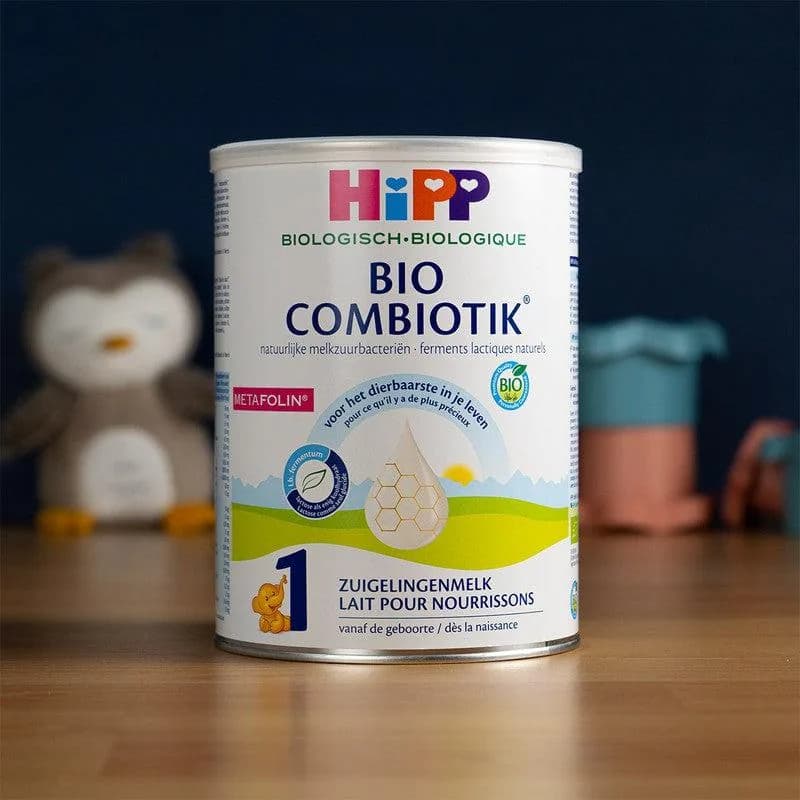
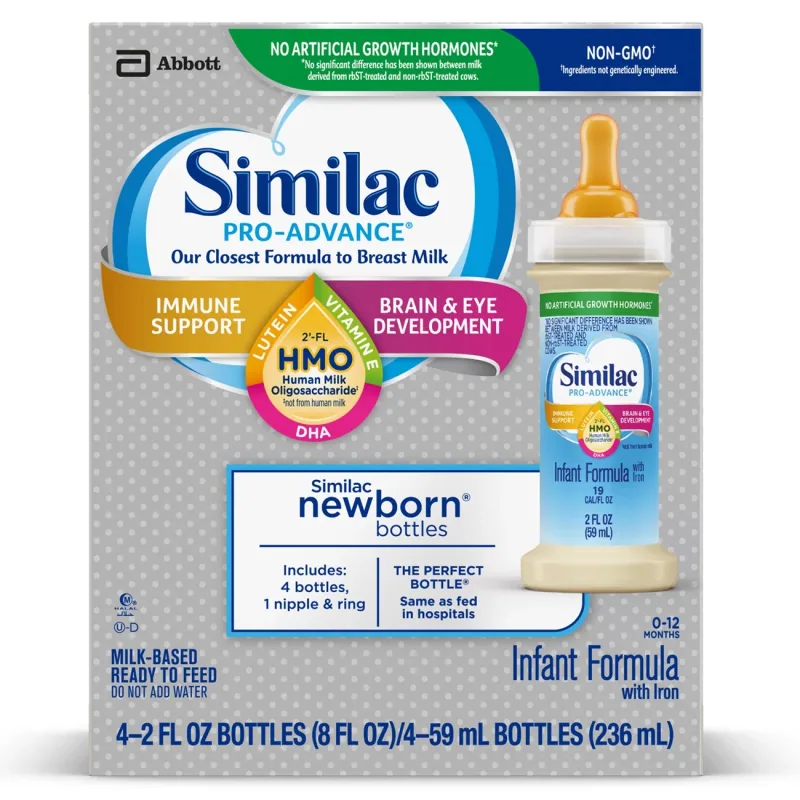
Similac Pro-Advance and HiPP Dutch Stage 1 frame the "big three" decision for parents comparing mainstream convenience against European organic import. Similac Pro-Advance is Abbott Nutrition's flagship with 2'-FL HMO, FDA-registered, the most-common WIC-contracted premium variant, on Target shelves next-day. HiPP Dutch Stage 1 is HiPP GmbH's flagship Combiotik. EU Organic certified, Metafolin folate, GOS prebiotic, and a live L. fermentum probiotic strain, imported through Organic's Best Shop with 5-10 day shipping. Both sit at the premium end of their respective regulatory frameworks. The compositional lens and logistics tell you which one matches.
HiPP Dutch Stage 1 and Similac Pro-Advance are both lactose-primary Stage 1 cow-milk formulas with added bioactive prebiotic strategies. HiPP brings Metafolin folate, GOS prebiotic, and L. fermentum probiotic on EU Organic certified Combiotik, at ~$1.77/oz with 5-10 day import. Similac brings 2'-FL HMO plus GOS on FDA-registered conventional supply, WIC-eligible, at ~$1.51/oz with next-day retail. Right choice depends on organic priority, HMO preference, and logistics tolerance.
Why this comparison matters
This is one of the three or four pairings parents type into Google most. Similac is the default baseline many pediatricians still mention; HiPP is the European alternative Instagram parenting accounts elevated after the 2022 Abbott Sturgis recall. Both are legitimate picks for a healthy term infant. The compositional and logistical differences are real but narrower than the "EU is cleaner" or "US is registered" marketing positioning implies.
At a glance
| Dimension | HiPP Dutch Stage 1 | Similac Pro-Advance |
|---|---|---|
| Manufacturer | HiPP GmbH (Dutch line) | Abbott Nutrition |
| Origin | Netherlands | USA (Sturgis, Michigan and Columbus, Ohio) |
| Age range | 0-6 months (Stage 1) | 0-12 months |
| Regulation | EU 2016/127 and 2018/848 organic | FDA 21 CFR 107 |
| Organic certification | EU Organic (SKAL Dutch) | None |
| Protein | Skimmed cow milk, 60:40 whey:casein | Skimmed cow milk, 60:40 whey:casein |
| Primary carbohydrate | Lactose | Lactose |
| Prebiotic | GOS | GOS and 2'-FL HMO |
| Probiotic | L. fermentum CECT5716 | None |
| Folate form | Metafolin (L-5-MTHF) | Folic acid |
| Fat blend | Palm, rapeseed, coconut, sunflower | Soy, coconut, safflower/sunflower, rapeseed (no palm olein) |
| DHA source | Fish oil, ~13.2 mg/100 ml | Algal oil, ~11.3 mg/100 ml |
| ARA | ~13.2 mg/100 ml | ~22.6 mg/100 ml |
| Fat-blend notes | Palm oil | Soy oil, synthetic beta-carotene |
| Typical US price | ||
| US availability | Organic's Best, 5-10 day shipping | Target, Amazon, Walmart, WIC, next-day |
| Affiliate commission | Yes (Organic's Best) | No |
The site's commercial relationship with HiPP (via Organic's Best) is disclosed. Similac generates no commission. The editorial framework below applies the same standard to both; see the disclosure for how money moves.
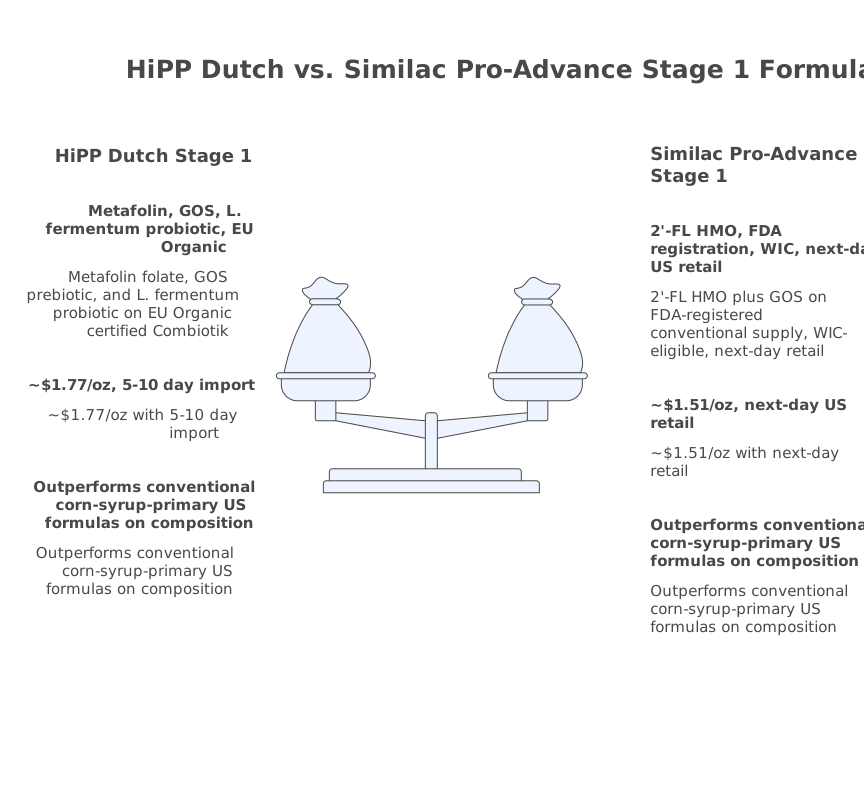
Visual generated with Napkin AI, editorial review by María López Botín. See methodology for our use policy.
Compositional differences that actually matter
Six dimensions where HiPP Dutch and Similac Pro-Advance diverge in ways parents care about.
1. Bioactive strategy: HMO vs probiotic (the headline difference)
Similac Pro-Advance includes 2'-FL HMO (2'-fucosyllactose), the most- studied human milk oligosaccharide commercially available. HiPP Dutch does not include 2'-FL HMO in the standard Combiotik line, instead it includes GOS prebiotic plus L. fermentum CECT5716 live probiotic.
Both strategies aim at the same biological target: shifting the infant gut microbiome closer to the breast-fed Bifidobacterium-dominant pattern. 2'-FL HMO has the larger published clinical evidence base, particularly from RCTs demonstrating modest reduction in respiratory and GI infection rates. L. fermentum CECT5716 has clinical evidence specific to the strain, smaller effect size than HMO overall but with a direct colonization pathway. See the 2'-FL HMO explainer and GOS explainer for the underlying mechanisms.
Families weighting HMO breadth pick Similac. Families weighting live probiotic seeding pick HiPP.
2. Folate form: Metafolin vs folic acid
HiPP uses Metafolin (L-5-methyltetrahydrofolate, the bioactive folate form); Similac uses folic acid. For parents with known MTHFR variants — 40-60% of the general population carries at least one reduced-function allele: Metafolin bypasses the enzymatic conversion that folic acid requires. See the Metafolin vs folic acid explainer for the pathway.
For typical infants without known MTHFR status, folic acid works adequately. For families that have tested and know a variant is present, Metafolin is the more conservative choice.
3. Organic certification: EU Organic vs conventional
HiPP Dutch carries EU Organic (Regulation 2018/848) certified by SKAL Dutch organic authority. Similac Pro-Advance is not organic: Abbott's conventional dairy supply chain meets FDA 21 CFR 107 but not USDA Organic requirements. No synthetic pesticides are detected in either product at shelf-life analysis, but the agricultural supply chain differs: EU Organic mandates grass-based feed where possible and excludes prophylactic antibiotics entirely.
For parents where organic certification carries weight independent of residue data, HiPP wins this dimension cleanly.
4. Fat blend: palm oil vs soy
HiPP uses a palm-inclusive vegetable-oil blend (palm, rapeseed, coconut, sunflower), palm is a red flag some parents avoid. Similac Pro-Advance notably excludes palm olein (a point Abbott markets explicitly) but uses soy oil as part of its blend. Neither adds sn-2 palmitate enrichment.
For parents specifically avoiding palm oil, Similac wins. For parents specifically avoiding soy derivatives, HiPP wins. Parents avoiding both would look at Bobbie or Kendamil.
5. DHA and ARA profile
Both deliver DHA and ARA. HiPP uses fish-oil DHA (~13.2 mg/100 ml) with balanced ARA (~13.2 mg). Similac uses algal-oil DHA (~11.3 mg/100 ml) with higher ARA (~22.6 mg). Both produce adequate tissue DHA for term infants. See the DHA explainer and ARA explainer for sourcing rationale.
6. Age range and stage transition
HiPP Dutch Stage 1 is a 0-6 month formula per EU 2016/127 staging; at 6 months HiPP expects families to transition to Stage 2. Similac Pro- Advance is labeled 0-12 months as a single stage. In practice, many US families using HiPP Dutch stay on Stage 1 past 6 months (clinically fine for a baby also eating solids) and transition timing is flexible. See when to switch formula stages for the framework.
Regulatory framework: what each covers
Similac Pro-Advance complies with FDA 21 CFR Part 107, pre-market notification, mandatory nutrient levels, quality control under Part 106, mandatory recall authority under FSMA. Abbott's Sturgis facility was the site of the 2022 Cronobacter recall and subsequent national shortage; the plant reopened under FDA consent decree with enhanced monitoring. Pro-Advance specifically was not the product at the center of the recall (Similac PM 60/40 and specialty SKUs were), but market trust for the broader Abbott portfolio was affected. See Abbott 2022 recall aftermath for the full timeline.
HiPP Dutch Stage 1 complies with EU Regulation 2016/127 (infant formula composition, mandatory lactose predominance and mandatory DHA) plus EU Regulation 2018/848 (organic). Not FDA-registered; families import under enforcement discretion. This pathway is stable and well-established.
For the complete regulatory side-by-side, see FDA vs EFSA standards compared.
Real-world parent experience
Following site methodology, the observations below come from my personal use across both kids plus a stable pool of parent-feedback notes from families on both formulas. They carry the parent-experience label rather than being claimed as regulatory or clinical facts, because individual infant variation on stool consistency, smell preference, and mixability is large enough that any specific point can reverse for a specific baby. Read these as context for expectations, not prediction.
Smell and taste. Similac Pro-Advance has the classic US mainstream formula smell, slightly sweet, recognizably "formula". HiPP Dutch is more dairy-forward without added sweetness. Most infants accept both; flavor preference is idiosyncratic.
Mixability. Both dissolve cleanly at 70°C recommended preparation temperature. Similac produces slightly more foam on vigorous shaking (the soy oil component in the blend); swirling reduces this.
Stool consistency. Slight variation typical. HiPP Dutch often produces slightly firmer stools (palm-oil and fish-oil DHA effect); Similac Pro-Advance trends softer, consistent with the 2'-FL HMO and GOS combined prebiotic load.
Switching between them. Clinically straightforward for healthy term infants. Use a 4-6 day gradual transition protocol. Expect 5-10 days of minor stool adjustment.
Verdict: when to pick each
Pick HiPP Dutch Stage 1 if:
- Metafolin bioactive folate is relevant (MTHFR family history or conservative folate preference)
- Live probiotic (L. fermentum CECT5716) fits your microbiome-support view more than HMO strategy
- EU Organic certification matters independent of residue data
- You want to avoid soy derivatives entirely
- You can maintain 2-4 weeks of stock and tolerate 5-10 day shipping
Pick Similac Pro-Advance if:
- 2'-FL HMO breadth is the priority for bioactive strategy
- FDA registration is a baseline you need
- You're WIC-eligible and Similac is your state's contracted brand
- Same-day retail availability weighs heavily
- Budget priority: Pro-Advance runs cheaper per ounce at standard US retail
Pick either if:
- You're choosing between these and reduced-lactose sensitive formulas or corn-syrup-primary variants. Both Pro-Advance and HiPP Dutch are materially closer to breast-milk composition than any reduced-lactose variant.
What you can't infer from this comparison
Neither is indicated for diagnosed cow milk protein allergy (CMPA). For that, see CMPA explained. Neither is a reflux-specific formula; Similac for Spit-Up and HiPP AR exist for that indication. Neither is appropriate for preterm infants without pediatrician guidance: Similac offers NeoSure and Abbott offers preterm-specific formulations through hospital channels.
Frequently asked questions
Is HiPP Dutch Stage 1 or Similac Pro-Advance closer to breast milk?
Can I switch from Similac Pro-Advance to HiPP Dutch Stage 1?
Which is cheaper per ounce?
Is HiPP Dutch FDA-registered?
Does Similac Pro-Advance have Metafolin?
Was Similac Pro-Advance affected by the 2022 Abbott recall?
Is HiPP Dutch better than Similac if I'm looking at composition alone?
Related reading
- HiPP brand hub
- Similac brand hub
- HiPP Dutch Stage 1, full SKU record
- Similac Pro-Advance, full SKU record
- HiPP Dutch Stage 1 vs Bobbie Original, the US organic premium alternative to Similac
- Similac Pro-Advance vs Enfamil NeuroPro, the intra-US mainstream comparison
- Is European formula safer than US formula?
- FDA vs EFSA standards compared
- Abbott 2022 recall aftermath
Primary sources
- HiPP Netherlands, official Dutch-market product information. hipp.nl
- Similac Pro-Advance, official product information (Abbott Nutrition). similac.com
- EU Regulation 2016/127: Infant formula and follow-on formula compositional requirements. eur-lex.europa.eu
- FDA 21 CFR Part 107. US infant formula regulation. ecfr.gov
This site provides research and comparisons, not medical advice. Consult your pediatrician before changing your baby's formula.