
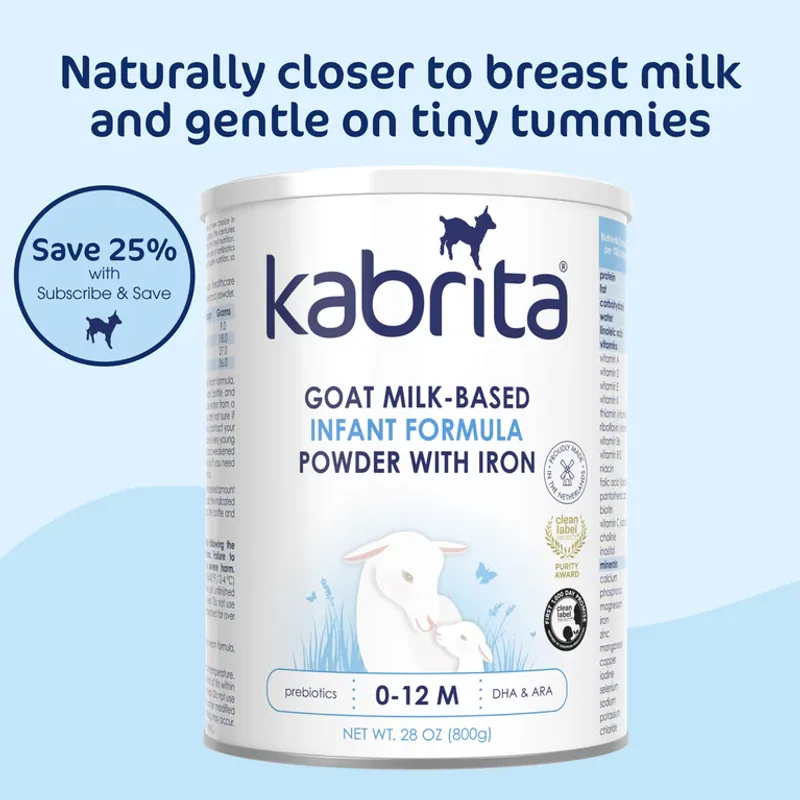
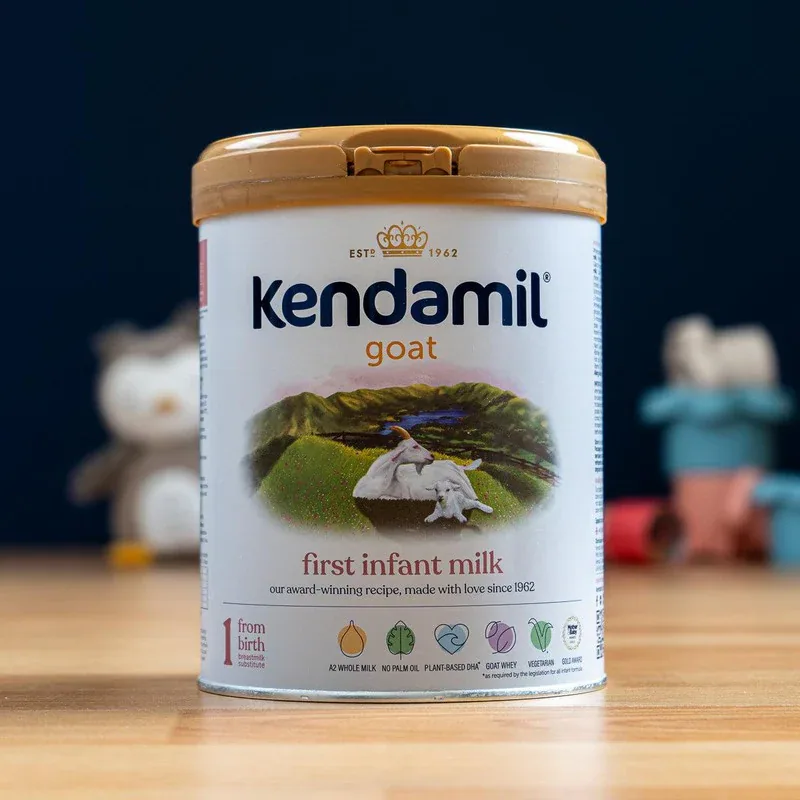
Goat-milk formula is a small category with strong opinions in it, and these two are the poles. Both are European Stage 1 goat formulas reaching US families, both are lactose-only, and both are at US retail rather than behind an import window. What they do with the fat, and with everything you can add to a formula, could hardly be more different.
Kabrita engineers its fat with sn-2 palmitate and adds GOS plus 2'-FL HMO, at $2.71 an ounce. Kendamil Goat keeps the whole goat milk fat, adds no prebiotic at all, avoids palm and soy entirely, carries 16.1 mg DHA, and costs $2.41. Neither is suitable for a diagnosed cow milk protein allergy.
At a glance
| Kabrita Stage 1 | Kendamil Goat Stage 1 | |
|---|---|---|
| Made in | Netherlands | United Kingdom |
| Protein | Goat milk | Goat milk |
| Primary carbohydrate | Lactose | Lactose |
| Fat approach | Vegetable blend with sn-2 palmitate (structured OPO) | Whole goat milk fat retained |
| Palm oil | Yes, as sn-2 palmitate | None |
| Soy | Yes, soybean oil | None |
| DHA per 100 ml | 13.4 mg | 16.1 mg |
| ARA per 100 ml | 13.4 mg | 8 mg |
| Protein per 100 ml | 1.5 g | 1.4 g |
| Iron per 100 ml | 1.1 mg, as iron sulfate | 0.66 mg, as iron pyrophosphate |
| Prebiotic | GOS | – |
| HMO | 2'-FL | – |
| Certifications | FDA enforcement discretion, Non-GMO Project Verified | UK Red Tractor, Vegetarian Society |
| Typical price | ~$37.99 per tin, $2.71/oz | ~$67.99 per tin, $2.41/oz |
Typical US retail price, normalised to USD per ounce of powder. Imported European formulas carry shipping and importer margin; US retail brands are typically cheapest per ounce. Subscribe-and-save and private-label pricing can shift the ranking.
Data table
| Formula | Price per ounce |
|---|---|
| Kabrita Stage 1 | $2.71 |
| Kendamil Goat Stage 1 | $2.41 |
Start here: neither one is for a milk allergy
Goat-milk formula is bought under a persistent misunderstanding, so it goes first. Goat milk proteins cross-react with cow milk proteins in roughly 90% of infants with diagnosed CMPA. The AAP, NASPGHAN and ESPGHAN all state that goat-milk formula is not a hypoallergenic substitute.
A baby with a diagnosed cow milk protein allergy needs an extensively hydrolysed or amino acid formula under pediatric direction, and neither product on this page qualifies. See CMPA explained.
What goat milk plausibly offers a non-allergic infant is different: smaller fat globules, a softer curd, and naturally A2-only beta-casein. That is a comfort argument, not an allergy one.
The fat: engineered or retained
This is the axis the whole comparison turns on, and the two brands answer the same question — how do you get breast-milk-like fat into a tin — in ways that have almost nothing in common.
Kabrita engineers it. The fat is a vegetable blend — soybean, sunflower, coconut — with sn-2 palmitate, the structured OPO form that places palmitic acid in the sn-2 position where breast milk carries around 70% of its own. That matters because pancreatic lipase cleaves the sn-1 and sn-3 positions, and palmitic acid released from those binds calcium into insoluble soaps that leave with the stool. Structuring the fat avoids that chain. See sn-2 palmitate.
Kendamil retains it. The goat milk fat is kept rather than stripped and replaced, so the palmitic acid is already in the milk and in the right position, with no palm and no soy anywhere in the blend.
Both land in the upper half of the fat-blend hierarchy, and by different means: whole milk fat sits first, structured palm third, with the conventional palm blend below both. See palm oil.
Everything else added, or nothing
Kabrita carries GOS and 2'-FL HMO, which is genuinely uncommon in a goat formula — most of the category is minimalist by tradition.
Kendamil Goat carries no prebiotic and no HMO at all. That is a deliberate position rather than an omission: the Kendamil Goat line is built on the milk doing the work.
If bioactive depth is what you are shopping for, Kabrita wins that comparison outright. If a short ingredient list is the point, Kendamil does. There is no evidence base that settles it for a healthy term infant.
The protein: same species, adjusted or not
Both formulas take their protein from goat milk, which is where the similarity ends on this axis too. Kabrita adjusts its protein to a 60:40 whey-to-casein ratio, the proportion breast milk carries and the one cow-milk formulas have been engineered toward for decades. Goat milk does not arrive at 60:40 on its own, so reaching it means adding goat whey.
The Atlas does not record a whey-to-casein ratio for Kendamil Goat, so this page will not state one. What its record does say is that the milk is whole rather than reconstructed from skimmed powder and added fat. Protein quantity is close either way: 1.5 g per 100 ml against 1.4.
DHA, ARA and iron
Kendamil Goat carries more DHA, 16.1 mg per 100 ml against 13.4. Kabrita carries more ARA, 13.4 against 8, and pairs it one-to-one with its DHA, which is the ratio EU rules are written around.
Neither uses fish oil. Both take DHA from algae and ARA from the fungus Mortierella alpina — Kabrita from Crypthecodinium cohnii, Kendamil from Schizochytrium. Kendamil's Vegetarian Society certification makes that visible on the tin, but the underlying sourcing is the same choice in both, and it is the reason neither carries the fishy note that fish-oil formulas sometimes have.
Iron differs in both amount and form. Kabrita carries 1.1 mg per 100 ml as iron sulfate, Kendamil 0.66 mg as iron pyrophosphate. Sulfate is the more bioavailable of the two and the long-standing default; pyrophosphate is chosen for being less reactive with the fat blend and less likely to carry a metallic taste, at some cost in absorption. So the gap in delivered iron is wider than the milligram figures alone suggest. Both sit inside the EU band, and neither is underfortified for a healthy term infant, but a baby with known iron concerns is a pediatric conversation rather than a label one.
Price, and the tin-size trap
Kendamil Goat is the cheaper of the two per ounce — $2.41 against $2.71 — even though its tin costs considerably more, $67.99 against $37.99. The Kendamil tin holds far more formula. Comparing goat formulas on the shelf price gets this exactly backwards, and goat formula is expensive enough that the error is worth real money over a month.
Verdict: when to pick each
Pick Kabrita if:
- You want GOS and 2'-FL HMO in a goat formula, which few others offer
- The sn-2 palmitate structured fat is the feature you are after
- The lower price per tin fits the week's budget better than the lower price per ounce
Pick Kendamil Goat if:
- Whole goat milk fat is the priority
- You want no palm and no soy anywhere in the blend
- You want the higher DHA figure
- You are buying by cost per ounce rather than cost per tin
Neither, if the reason for considering goat milk is a diagnosed cow milk protein allergy. That is a pediatric conversation about extensively hydrolysed or amino acid formula, and no goat formula belongs in it.
What you can't infer from this comparison
Neither formula is organic. Neither is hypoallergenic in the FDA sense, and neither is anti-reflux. Both reach US families under FDA enforcement discretion rather than 21 CFR 107 registration, which is lawful for personal use but is not the same regulatory position as a US-registered formula. For the organic goat options, the best goat milk formulas guide covers Holle Goat and Jovie alongside these two.
Prices move. The figures here carry the verification date on each linked SKU record.
Frequently asked questions
Is Kabrita or Kendamil Goat better?
Which is cheaper, Kabrita or Kendamil Goat?
Is goat milk formula good for cow milk allergy?
Does Kabrita contain palm oil?
Does Kendamil Goat have prebiotics?
Are both available in the US?
Related reading
- CMPA explained
- Is goat milk formula easier to digest than cow?
- sn-2 palmitate
- Palm oil in infant formula
- Best goat milk formulas
- Kabrita brand hub
- Kendamil brand hub
Primary sources
- EU Commission Delegated Regulation 2016/127, the composition rules both formulas are made to, including the mandatory DHA range and the ARA-to-DHA requirement. eur-lex.europa.eu
- FDA infant formula guidance, including the enforcement discretion pathway under which both reach US families. fda.gov
- AAP formula-feeding guidance, including why goat-milk formula is not a hypoallergenic substitute for a diagnosed cow milk protein allergy. aap.org
This site provides research and comparisons, not medical advice. Consult your pediatrician before changing your baby's formula.