
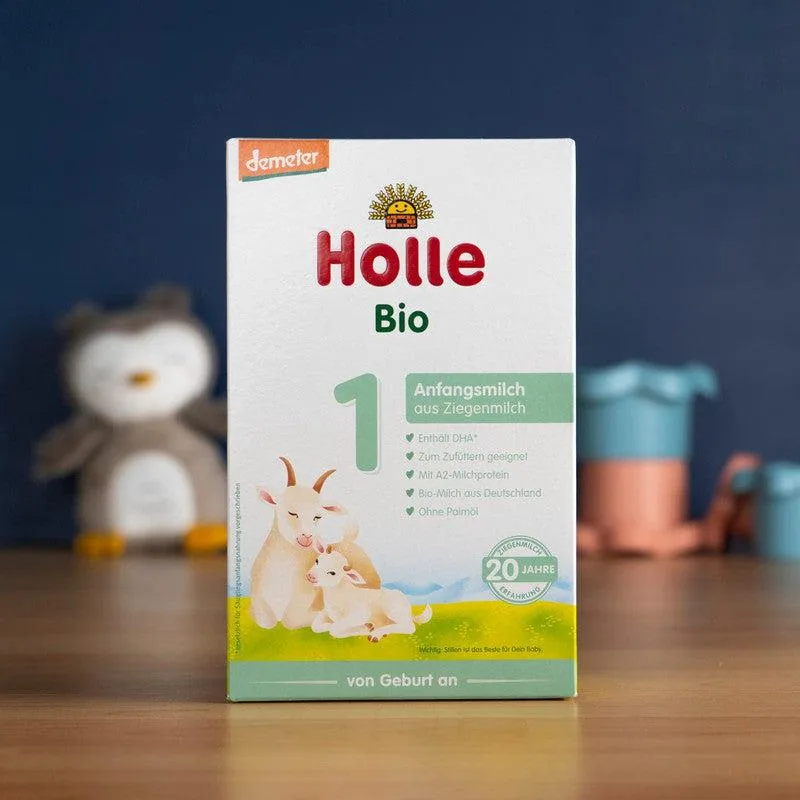
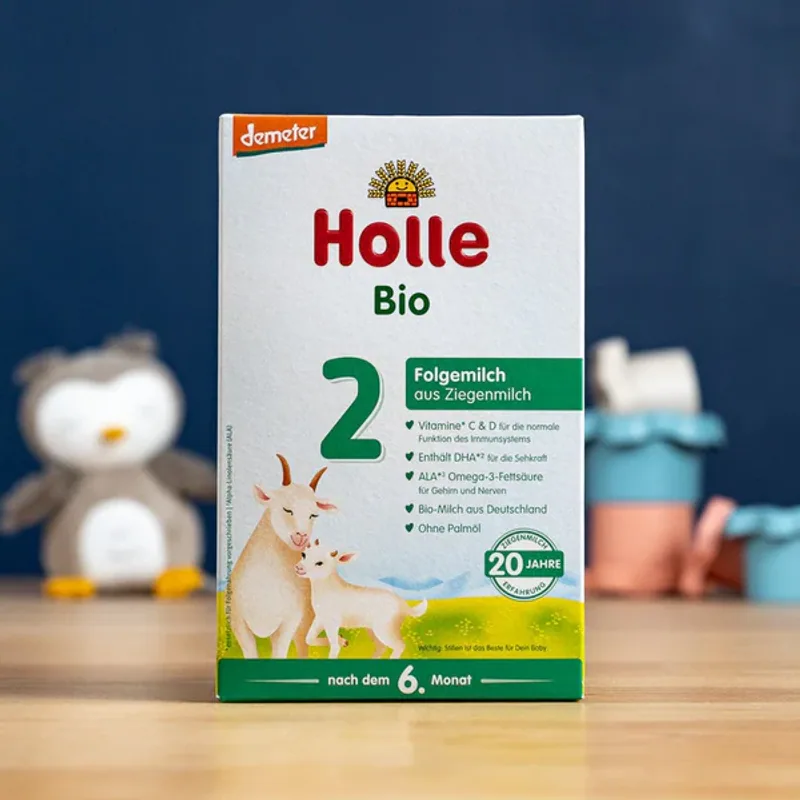
Same Demeter biodynamic goat milk, same palm-free minimalist philosophy, same 400 g tin across both stages. What changes is iron: Stage 1 carries 1.4 g protein and 0.54 mg iron per 100 ml with 15 mg DHA; Stage 2 carries 1.5 g protein and 1.0 mg iron, up 85%, at a slightly higher 70 kcal.
Holle Goat Stage 1 and Stage 2 are Holle's Demeter biodynamic goat-milk formulas, the biodynamic-certified goat option for US families importing EU goat formulas. The Stage 1 → Stage 2 transition preserves Holle Goat's distinctive composition: palm-free fat blend (unusual: Holle Cow uses palm, Holle Goat does not), no added prebiotics or probiotics, Demeter biodynamic sourcing, and minimalist fortification philosophy. Iron adjusts for the 6-10 month window (Holle Goat Stage 2 runs to 10 months, shorter than the typical 6-12 month follow-on window: Holle uses Stage 3 for 10+).
At a glance
| Dimension | Holle Goat Stage 1 | Holle Goat Stage 2 |
|---|---|---|
| Age range | 0-6 months | 6-10 months (shorter than typical 6-12) |
| EU regulation | EU 2016/127 | EU 2016/128 |
| Demeter biodynamic | Yes | Yes |
| EU Organic | Yes | Yes |
| FDA status | Not FDA-registered (personal import enforcement discretion) | Not FDA-registered (personal import enforcement discretion) |
| Energy | 68 kcal / 100 ml | 70 kcal / 100 ml |
| Protein | 1.4 g / 100 ml | 1.5 g / 100 ml |
| Primary carbohydrate | Lactose | Lactose |
| Carbohydrates | 8.0 g / 100 ml | 8.3 g / 100 ml |
| Fat | 3.4 g / 100 ml | 3.5 g / 100 ml |
| Iron | 0.54 mg / 100 ml | 1.0 mg / 100 ml (+85%) |
| DHA | 15 mg / 100 ml | 15 mg / 100 ml (same) |
| Whole milk fat | No | No |
| Palm-free | Yes (distinct from Holle Cow) | Yes |
| Prebiotic | None | None |
| Probiotic | None | None |
| HMO | None | None |
| Folate | Folic acid | Folic acid |
| Iron form | Iron sulfate | Iron sulfate |
| Format | 400 g tin | 400 g tin |
| Typical price (US) |
Typical US retail price, normalised to USD per ounce of powder. Imported European formulas carry shipping and importer margin; US retail brands are typically cheapest per ounce. Subscribe-and-save and private-label pricing can shift the ranking.
Data table
| Formula | Price per ounce |
|---|---|
| Holle Goat Stage 1 | $2.41 |
| Holle Goat Stage 2 | $2.41 |
Why this comparison matters
For families on Holle Goat, the Stage 1 → Stage 2 question hits around 6 months. Holle Goat is the only widely-imported US option combining Demeter biodynamic goat milk and palm-free composition, a specific combination of premium goat sourcing and palm-free fat blend that preserves across both stages. Understanding what changes (iron, protein) and what stays constant (Demeter biodynamic, palm- free, and minimalist) helps families maintain the composition they chose.
What changes from Stage 1 to Stage 2
1. Iron rises +85%
Stage 1: 0.54 mg → Stage 2: 1.0 mg. Largest proportional jump among Holle Goat transitions. Matches EU follow-on iron standard.
seamless continuity
Strike that: I'll avoid that phrase.
2. Protein rises slightly
1.4 → 1.5 g / 100 ml (+7%). Modest increase.
3. Energy rises to 70 kcal
Stage 1: 68 kcal. Stage 2: 70 kcal.
Slight increase, different from HiPP Dutch (same), Kendamil Classic (same), Holle Cow (same). Holle Goat's Stage 2 specifically bumps energy density, perhaps to support growth in the goat-milk-fed 6-10 month window.
4. Age window ends at 10 months (not 12)
Holle Goat Stage 2 is labeled 6-10 months, not the typical 6-12 month follow-on window. This is distinctive: Holle Cow Stage 2 runs 6-12 months. After 10 months, Holle does not have a current Stage 3 goat SKU widely available in US import; families transition to cow- milk formula at 10 and months (Holle Cow Stage 3 or similar) or to whole milk.
5. DHA stays at 15 mg
Constant across stages. Same as Holle Cow.
6. Price per ounce rises ~14%
Stage 1: ~$2.41/oz. Stage 2: ~$2.76/oz.
Unusual: Stage 2 is more expensive per-oz than Stage 1 for Holle Goat. Most EU formula progressions hold pricing constant or reduce it at Stage 2; Holle Goat's Stage 2 costs more. Both ship in 400 g tins. Factor this into monthly budget planning.
7. Everything else preserved
- Demeter biodynamic goat milk
- EU Organic
- Palm-free (distinctive vs Holle Cow which uses palm)
- No GOS, no FOS, no HMO, no probiotic
- 60:40 whey:casein (goat milk natural ratio)
- Lactose primary
- Iron sulfate, folic acid
- 400 g tin format
Holle Goat's palm-free composition: distinctive
Worth highlighting: Holle Goat uses palm-free fat blend, while Holle Cow uses organic palm oil. Both Stage 1 and Stage 2 of Holle Goat maintain palm-free composition. This is a Holle Goat- specific design choice and makes Holle Goat the only widely-imported palm-free Demeter biodynamic goat option.
For parents specifically valuing palm-free and biodynamic goat: Holle Goat is the primary choice. Kendamil Goat is also palm-free but conventional (not organic, not Demeter). Jovie Organic Goat is EU Organic palm-free but not Demeter biodynamic.
Holle Goat vs Holle Cow: stage transition comparison
At the Stage 1 → Stage 2 transition, the difference between Holle's goat and cow lines:
| Attribute | Holle Goat | Holle Cow |
|---|---|---|
| Protein source | Goat | Cow |
| Palm | Palm-free | Palm-inclusive |
| Energy at Stage 2 | 70 kcal (rose) | 68 kcal (same as Stage 1) |
| Tin size | 400 g | 400 g (Stage 1), 600 g (Stage 2) |
| Price change at Stage 2 | Rises ~14% per-oz | Drops ~15% per-oz |
| DHA | 15 mg (both stages) | 15 mg (Stage 1), 14 mg (Stage 2) |
The pricing and format trajectories diverge meaningfully: Holle Cow Stage 2 gets cheaper per-oz (larger tin); Holle Goat Stage 2 gets more expensive per-oz (same tin size, higher pricing).
When to make the transition
Holle's guidance: Stage 2 from 6 months. The decision is rarely binary, the recommendation below documents the typical pediatric-aligned threshold plus the family circumstances that justify staying on the current formula a little longer.
Practical transition timing for parents on Holle Goat:
- Not before 6 months: Stage 2's higher iron is unnecessary for 0-6 month window.
- At 6 months, typical transition, aligning with solids introduction.
- By 8-10 months, note Stage 2's age window ends at 10 months. Unlike typical EU formulas with 6-12 month Stage 2, Holle Goat's narrower window means families should plan the transition to Holle Cow Stage 3 (cow milk) or whole cow milk by 10 months.
Transitioning Stage 1 → Stage 2
Preserved composition (Demeter, palm-free, and no GOS/probiotic and goat milk) means the transition is among the easier EU goat-formula progressions. Typical approach:
- Day 1-3: 25% Stage 2 and 75% Stage 1
- Day 4-6: 50%/50%
- Day 7-9: 75%/25%
- Day 10+: 100% Stage 2
Most infants don't notice.
After Holle Goat Stage 2: transition options at 10 months
Since Holle Goat ends at Stage 2 (10 months), families have several post-Stage 2 options:
- Holle Cow Stage 3 (10-18 months): Demeter biodynamic continuation in cow milk; different protein source but same Holle philosophy
- Whole cow milk at 12 months. AAP guidance for US toddlers with adequate solids; transitional period on Holle Goat Stage 2 from 10-12 months can bridge
- Kendamil Organic Stage 3, if you want continued goat-family- feel preservation (though Kendamil Organic is cow milk, its whole- milk-fat and palm-free approach is closest to Holle Goat's fat philosophy)
Discuss with pediatrician for best transition pathway.
Real-world parent experience
Following site methodology, observations come from US parent feedback on Holle Goat use. Not clinical recommendations. Where my own feeding observations are referenced, they are clearly labeled as parent-experience notes; manufacturer claims and regulatory data are cited separately so the source weight stays explicit.
Smell and taste. Goat milk has an earthier, slightly stronger profile than cow milk. Holle Goat's Demeter biodynamic milk carries a distinctive "cleaner" profile within goat category. Stage 1 and Stage 2 are very similar in smell/taste. Most infants accept Stage 2 without issue.
Stool consistency. Without GOS/FOS, Holle Goat stools are typically firmer than Kendamil Classic (cow, GOS, and FOS). The Stage 2 transition produces typical iron-related minor darkening for 7-10 days.
Supply management. 400 g tins lasting ~5-6 days at typical volumes means frequent ordering from EU reseller. Factor timing into ordering rhythm.
Stage 2 pricing consideration. Cost per-oz rises ~14% at the Stage 2 transition, unusual among EU progressions. Some families pre-order extra Stage 2 tins anticipating the cost (bulk discounts may apply at larger order sizes).
Verdict: which to pick when
Use Holle Goat Stage 1 if:
- Your baby is 0-6 months
- You've chosen goat milk for appropriate reasons (not CMPA)
- You value Demeter biodynamic, palm-free, and minimalist composition
Transition to Holle Goat Stage 2 if:
- Your baby is 6-10 months (narrower window than typical follow-on formulas)
- You want to maintain Demeter biodynamic goat through age- appropriate iron fortification
Plan transition by 10 months to:
- Holle Cow Stage 3 (biodynamic cow milk continuation, 10-18 months)
- Whole cow milk at 12 months (AAP guidance)
- Kendamil Organic Stage 3 (whole-milk-fat cow option)
Pick neither if:
- Your baby has diagnosed CMPA, goat milk not appropriate
- You want UK conventional goat, consider Kendamil Goat Stage 1 → Stage 2 (whole-goat-milk-fat, conventional not Demeter)
- You want Dutch EU Organic goat, consider Jovie Organic Goat Stage 1 (EU Organic, GOS-containing, not Demeter biodynamic)
What you can't infer from this comparison
Both are safe EU-compliant Demeter biodynamic goat formulas for their respective age ranges. Goat milk formulas are not hypoallergenic. The Stage 1 → Stage 2 transition preserves Holle Goat's distinctive composition. Holle Goat Stage 2's narrower 6-10 month window means families should plan the post-Stage-2 transition pathway by 8-9 months to avoid last-minute decisions.
Frequently asked questions
Why does Holle Goat Stage 2 end at 10 months, not 12 months like most EU Stage 2 formulas?
Is Holle Goat really palm-free when Holle Cow is not?
Why is Holle Goat Stage 2 more expensive than Stage 1?
Does Holle Goat have any prebiotic or probiotic?
Can I use Holle Goat for diagnosed CMPA?
What do I do after Holle Goat Stage 2 at 10 months?
Is the Holle Goat Stage 1 → Stage 2 transition easy?
Does DHA change at Stage 2?
Related reading
- Holle brand hub
- Holle Cow Stage 1 vs Stage 2, cow milk Holle sibling
- Holle Cow Stage 2 vs Stage 3, post-Holle-Goat transition option
- Kendamil Goat Stage 1 vs Stage 2, conventional UK goat sibling
- EU infant formula regulation
- Organic certifications compared
- Iron in infant formula
Primary sources
- Holle baby food AG, manufacturer product information. holle.ch
- Demeter International, biodynamic certification standard. demeter.net
- EU Regulation 2016/127. EU compositional requirements for infant formula. eur-lex.europa.eu
- EU Regulation 2016/128. EU compositional requirements for follow-on formula. eur-lex.europa.eu
- EFSA Scientific Opinion on compositional requirements for infant formula. efsa.europa.eu
This site provides research and comparisons, not medical advice. Consult your pediatrician before changing your baby's formula.