
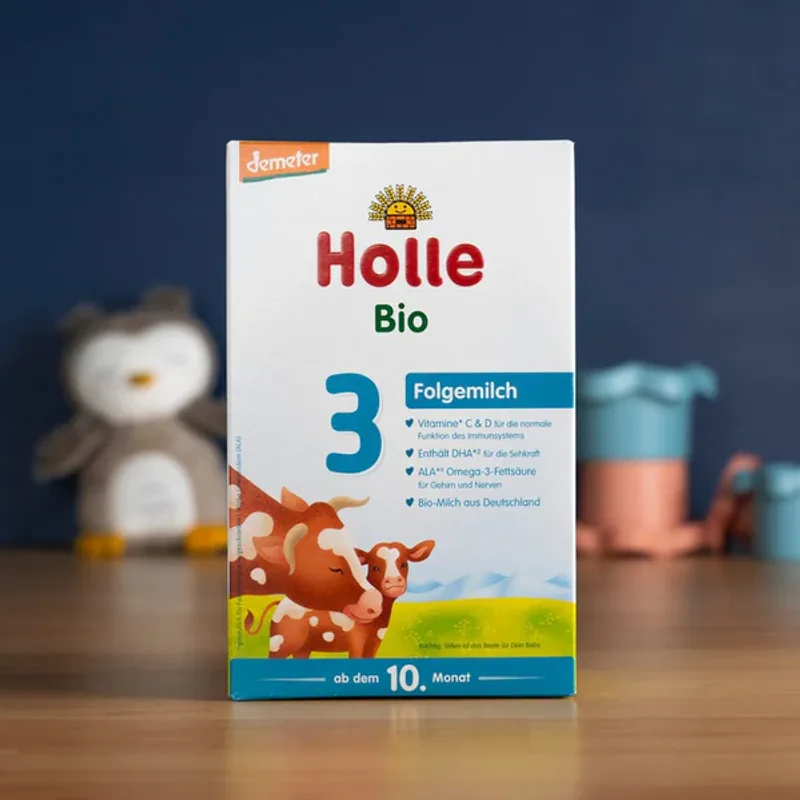
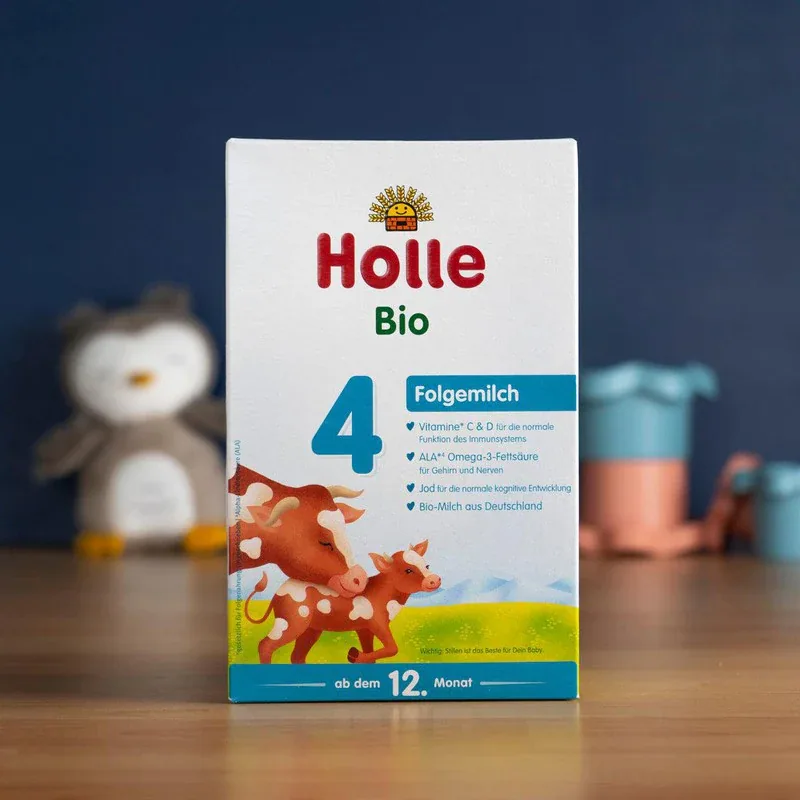
Stage 3 (10-18m): Demeter biodynamic and protein 1.5 g/100 ml and iron 1.2 mg, DHA 14 mg, energy 68 kcal, and no GOS/probiotic. Stage 4 (12-36m): same Demeter and protein 1.8 g (+20%) and iron 1.1 mg (slight decrease) and DHA 10 mg (-29%) and energy 70 kcal (higher). Late-toddler profile with higher protein and lower DHA.
Holle Cow Stage 3 and Stage 4 are Holle's Demeter biodynamic toddler-transition progression. Stage 3 (10-18 months) extends the follow-on philosophy through early toddlerhood; Stage 4 (12-36 months) is a dedicated late-toddler formula with distinctive composition adjustments: protein rises to 1.8 g (+20%), DHA drops to 10 mg (-29%), energy rises to 70 kcal. For families who continue Demeter biodynamic formula past 12 months (most transition to whole cow milk at 12 months per AAP), understanding Stage 4's composition matters.
At a glance
| Dimension | Holle Cow Stage 3 | Holle Cow Stage 4 |
|---|---|---|
| Age range | 10-18 months | 12-36 months |
| EU regulation | EU 2016/128 (young-child) | EU 2016/128 (young-child) |
| Demeter biodynamic | Yes | Yes |
| Energy | 68 kcal / 100 ml | 70 kcal / 100 ml |
| Protein | 1.5 g / 100 ml | 1.8 g / 100 ml (+20%) |
| Whey:casein | 60:40 | 60:40 |
| Primary carbohydrate | Lactose | Lactose |
| Carbohydrates | 8.4 g / 100 ml | 8.9 g / 100 ml |
| Fat | 3.3 g / 100 ml | 3.0 g / 100 ml |
| Iron | 1.2 mg / 100 ml | 1.1 mg / 100 ml (slightly lower) |
| DHA | 14 mg / 100 ml | 10 mg / 100 ml (-29%) |
| Prebiotic | None | None |
| Probiotic | None | None |
| HMO | None | None |
| Folate | Folic acid | Folic acid |
| Format | 600 g tin | 600 g tin |
Typical US retail price, normalised to USD per ounce of powder. Imported European formulas carry shipping and importer margin; US retail brands are typically cheapest per ounce. Subscribe-and-save and private-label pricing can shift the ranking.
Data table
| Formula | Price per ounce |
|---|---|
| Holle Cow Stage 3 | $1.95 |
| Holle Cow Stage 4 | $1.95 |
Why this comparison matters
Most families transition to whole cow milk at 12 months per AAP. European families more commonly use toddler formulas through 24-36 months. Holle Cow Stage 3 and Stage 4 serve families who continue EU biodynamic formula through toddlerhood. Understanding Stage 4's specific compositional priorities (higher protein, lower DHA, higher energy) helps families decide whether extended biodynamic formula use fits their toddler's context.
What changes from Stage 3 to Stage 4
1. Protein rises +20%
1.5 → 1.8 g/100 ml. Substantial increase matches late-toddler protein needs. Matches Kendamil Organic Stage 3's 1.8 g density.
2. DHA drops notably
14 → 10 mg/100 ml (-29%). Assumption: 12-36 month toddlers get DHA from solid-food diet (fish when appropriate, fortified foods, diverse diet). Formula DHA reduced as solids contribute.
3. Iron slightly decreases
1.2 → 1.1 mg/100 ml. Assumption: toddler iron intake from meat, iron-fortified foods, legumes contributes significantly by 12-36 months.
4. Energy increases
68 → 70 kcal/100 ml. Supports continued toddler growth.
5. Everything else preserved
- Demeter biodynamic certification
- EU Organic
- Lactose primary, 60:40 whey:casein (not casein-flipped like Kendamil Organic Stage 3)
- No GOS, no FOS, no probiotic, no HMO (Holle minimalist philosophy)
- Organic palm, rapeseed, sunflower, and coconut fat blend
- Folic acid folate
- 600 g tin format
- Same pricing
When to transition (or not)
Most families don't reach Stage 4. AAP guidance supports whole cow milk from 12 months, and many families transition at Stage 2 (6-12m) → whole cow milk, skipping Stage 3 and Stage 4 entirely.
For families continuing Holle biodynamic through late toddlerhood:
- Use Stage 3 for 10-12 months (overlap period with late Stage 2)
- Transition to Stage 4 at 12-18 months as protein needs increase
- Continue Stage 4 through 24-36 months or until family decides to transition to whole cow milk
European pediatric practice more commonly extends toddler formula through 24-36 months for children with variable or restricted diets. US practice typically favors whole cow milk and diverse solids from 12-18 months.
Real-world parent experience
Following site methodology, observations come from US parent feedback on Holle use. Not clinical recommendations. Where my own feeding observations are referenced, they are clearly labeled as parent-experience notes; manufacturer claims and regulatory data are cited separately so the source weight stays explicit.
Taste and smell. Stage 4's higher protein and reduced DHA produces a slightly different profile, less fish-oil note, more milk-protein character. Most toddlers accept the transition within a few feeds. Some notice the richer protein taste and may initially resist; the transition period (10-14 days gradual) usually resolves this.
Stool consistency. Higher protein in Stage 4 can produce slightly firmer stools than Stage 3. Typical for late-toddler formulas. Not concerning absent other symptoms.
Feeding volumes. Stage 4-age toddlers (12-36 months) typically drink 12-20 oz/day of formula alongside a full solids diet. Volume varies substantially with solids intake and individual toddler preference.
Supply considerations. Holle Stage 4 is less commonly stocked by US EU resellers than Stage 1 or 2. Plan ordering ahead; allow 7-10 business days for delivery.
Holle Stage 4 vs whole cow milk: pragmatic comparison
| Attribute | Holle Stage 4 | Whole cow milk |
|---|---|---|
| Protein | 1.8 g/100 ml | ~3.3 g/100 ml |
| Fat | 3.0 g/100 ml | ~3.5 g/100 ml |
| Iron | 1.1 mg/100 ml | ~0.05 mg/100 ml |
| DHA | 10 mg/100 ml | Negligible |
| Lactose | ~8.9 g/100 ml | ~4.8 g/100 ml |
| Cost (US) | ~$1.65/oz | ~$0.08/oz |
| Organic | Demeter biodynamic | Varies (organic cow milk available) |
| Age-adjusted fortification | Yes | No (whole food) |
Stage 4 delivers fortification and DHA that whole cow milk lacks, but at substantially higher cost. For toddlers with diverse solids diets providing iron and DHA, whole cow milk is adequate. For toddlers with limited diets or specific nutrition concerns, Stage 4 provides a safety net.
What you can't infer from this comparison
Both are safe EU-compliant Demeter biodynamic formulas for their respective age ranges. Stage 4's reduced DHA (10 mg vs Stage 3's 14 mg) reflects a design assumption that toddlers will get DHA from solids-diet sources; for families whose toddler has limited DHA-rich foods (fish intake), the reduced formula DHA may be a meaningful consideration. The Stage 3 → Stage 4 transition isn't universally necessary, most families transition to whole cow milk at 12 months per AAP guidance. Stage 4 serves a specific niche of families continuing EU biodynamic formula through late toddlerhood.
Verdict
Stage 3 is appropriate if: toddler is 10-18 months, want Demeter biodynamic continuity, need standard toddler-transition composition.
Stage 4 is appropriate if: toddler is 12 and months with variable or picky eating, need higher protein fortification, want to continue Demeter biodynamic through late toddlerhood.
Transition to whole cow milk if: toddler is 12 and with robust diverse diet, you follow AAP guidance, want to end formula use.
Frequently asked questions
When should I switch from Holle Stage 3 to Stage 4?
Is Holle Stage 4 necessary?
Why does DHA drop from 14 mg to 10 mg at Stage 4?
Does the price change between Stage 3 and Stage 4?
Does Holle Stage 4 have any prebiotic or probiotic?
Why does Holle Stage 4 keep the 60:40 whey:casein instead of flipping like Kendamil Organic Stage 3?
Can I use Holle Stage 4 past 36 months?
Is Holle Stage 4 a meal replacement for toddlers?
Related reading
- Holle brand hub
- Holle Cow Stage 2 vs Stage 3, earlier toddler-transition
- Holle Cow Stage 1 vs Stage 2
- Kendamil Organic Stage 2 vs Stage 3, sibling EU Organic toddler progression
- HiPP Dutch Stage 2 vs Stage 3
- Transition to whole cow milk
Primary sources
- Holle baby food AG, manufacturer product information. holle.ch
- Demeter International, biodynamic certification standard. demeter.net
- EU Regulation 2016/128. EU compositional requirements for follow-on and young-child formula. eur-lex.europa.eu
- EFSA Scientific Opinion on compositional requirements for infant formula. efsa.europa.eu
- WHO infant and young child feeding guidance. who.int
This site provides research and comparisons, not medical advice. Consult your pediatrician before changing your baby's formula.