
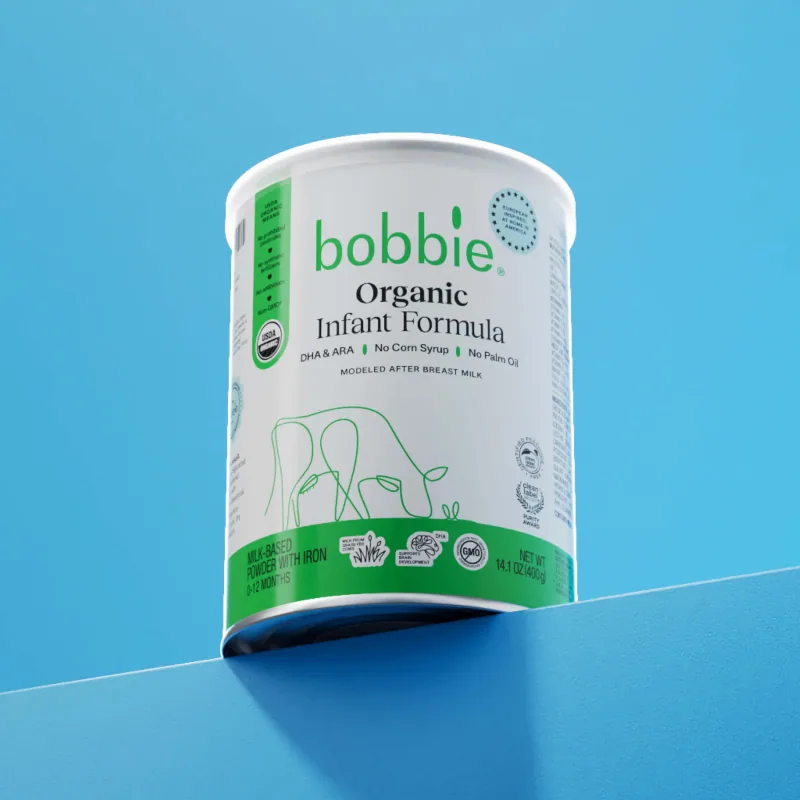
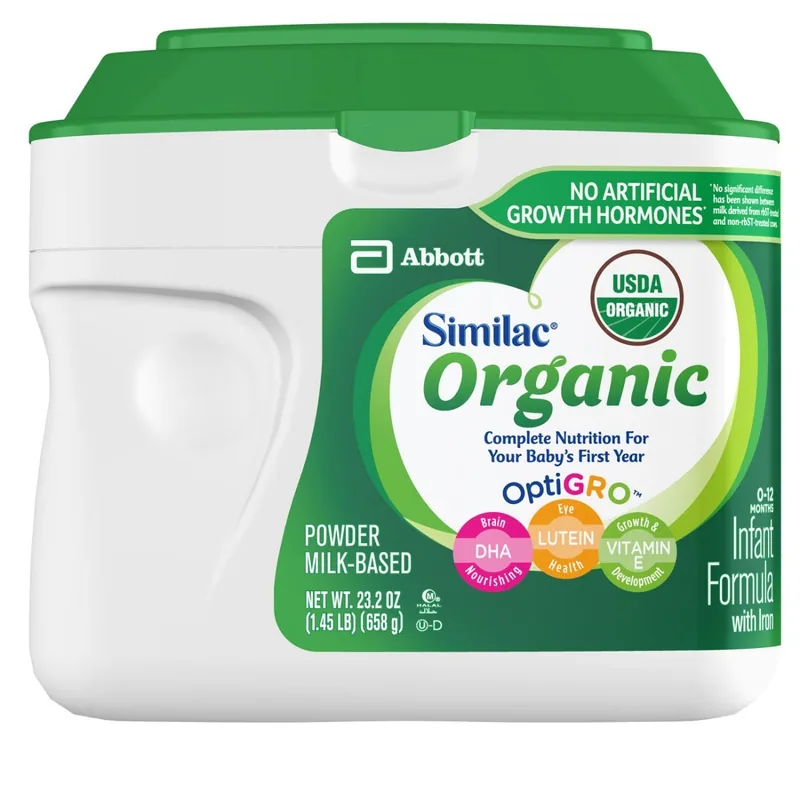
Both are USDA Organic, FDA-registered cow-milk Stage 1 formulas, and both are palm-free. Bobbie adds lactose and nothing else, uses no soy, and carries a Clean Label Project Purity Award at ~$2.94/oz. Similac Organic adds soybean oil, maltodextrin and sugar, and costs ~$1.64/oz, roughly 45% less. Neither carries a prebiotic.
Bobbie Original and Similac Organic are both USDA Organic certified, both FDA-registered, both US-domestic manufacturing, but they come from fundamentally different origins. Bobbie is the independent premium challenger brand: lactose-only, no soy, Clean Label Project-tested, positioned as "Big Formula done right." Similac Organic is Abbott's organic line, a big-brand variant within one of the two largest US formula manufacturers, with standard Abbott formulation practices applied to organic-certified inputs.
At a glance
| Dimension | Bobbie Original | Similac Organic |
|---|---|---|
| Manufacturer | Bobbie (US-contract Perrigo and Dutch Heerlen) | Abbott Nutrition (US) |
| Origin | USA | USA |
| Age range | 0-12 months | 0-12 months |
| Regulation | FDA 21 CFR 107 | FDA 21 CFR 107 |
| Organic certification | USDA Organic and Non-GMO Project and Clean Label Project Purity Award | USDA Organic |
| Protein | Skimmed cow milk and whey | Skimmed cow milk and whey |
| Whey:casein | 60:40 | 60:40 |
| Primary carbohydrate | Lactose (only added) | Lactose, then maltodextrin and sugar |
| Prebiotic | None | None |
| Probiotic | None | None |
| HMO | None | None |
| Folate form | Folic acid | Folic acid |
| DHA source | Algal oil, ~13.4 mg/100 ml | Algal oil, ~11 mg/100 ml |
| Fat blend | Coconut, sunflower, rapeseed (no palm, no soy) | Sunflower, soybean oil, coconut (no palm) |
| Fat-blend notes | None | Soy |
| Recall history | None | None for Similac Organic specifically (parent Abbott had 2022 Cronobacter recall) |
| Format | 14 oz tin | 22.5 oz (~640 g) can |
| Typical price | ||
| US availability | Target, Amazon, Bobbie direct, Whole Foods | Broad US retail (CVS, Walgreens, Target, Walmart, Amazon, grocery) |
Typical US retail price, normalised to USD per ounce of powder. Imported European formulas carry shipping and importer margin; US retail brands are typically cheapest per ounce. Subscribe-and-save and private-label pricing can shift the ranking.
Data table
| Formula | Price per ounce |
|---|---|
| Bobbie Original | $2.94 |
| Similac Organic | $1.64 |
Why this comparison matters
Parents who land on Similac Organic are often defaulting from "big US formula brand I recognize" and "I want organic." It's a fine choice, USDA Organic certification is rigorous regardless of which manufacturer implements it. But parents comparing Similac Organic against Bobbie are often asking whether the premium price difference really gets you cleaner composition or meaningful differences in manufacturing oversight. Short answer: yes on composition (no soy, no added sugars) and mixed on manufacturing (both FDA-compliant; Abbott has 2022 recall history in its Similac line though not specifically Similac Organic).
Compositional differences that actually matter
1. Soy, and the sugars behind the lactose
Both of these formulas are palm-free, which is worth stating plainly because it is the thing parents most often assume separates a challenger brand from a mainstream one. It does not separate these two. Similac Organic's blend is organic high oleic sunflower, soy and coconut oil, and the only palm-derived entry on its label is vitamin A palmitate, a vitamin ester rather than a fat. Every Similac formula in this Atlas is palm-free. See the palm oil explainer.
What does separate them on the fat is soy. Bobbie Original uses coconut, sunflower and rapeseed with no soy oil and no soy lecithin, a narrow combination among US organic formulas. Similac Organic uses organic soybean oil.
The larger difference is not in the fat at all. Similac Organic lists organic maltodextrin and organic sugar — plain sucrose — after the lactose. Bobbie adds lactose and nothing else. Both are lactose-first and both are USDA Organic, so neither label is doing anything irregular, but a parent reading for added sugars will find them on one tin and not the other. See maltodextrin.
2. Bioactive depth: both minimal
Neither has HMO, lactoferrin, probiotic, or MFGM. Neither has FOS or GOS prebiotic. Both are minimal-additive.
This is a meaningful design choice: Similac's bioactive-rich line is Similac 360 Total Care (5 HMOs) or Similac Pro-Advance (2'-FL HMO). Similac Organic deliberately does NOT carry those HMO additions. Similac reserves bioactive upgrades for its non-organic premium lines where the higher price point supports the added ingredients.
Among USDA Organic formulas, HMO inclusion is essentially unavailable in the US market. The nearest thing was ByHeart Whole Nutrition, which carried 2'-FL and lactoferrin before its recall — but ByHeart is not USDA Organic, so it never closed that gap either.
3. Clean Label Project: Bobbie has it, Similac doesn't
Bobbie Original carries Clean Label Project Purity Award, third- party testing for 400 chemical and environmental contaminants (heavy metals, pesticides, industrial chemicals). This is a distinct certification beyond USDA Organic's feed and farming-practice requirements.
Similac Organic does not carry Clean Label Project Purity Award or equivalent contaminant-testing certification. Abbott's manufacturing protocols are FDA 21 CFR 107 compliant but don't subscribe to the specific Clean Label Project testing regime.
For parents specifically valuing contaminant-testing assurance, Bobbie has the formal certification. Similac's omission isn't a red flag, it's simply not a certification Abbott has pursued for the Similac Organic line.
4. Recall history
Bobbie: no recall history. Clean track record since commercial launch.
Similac Organic: no recall history specific to this SKU. However, Abbott Nutrition (parent company) had the landmark 2022 Cronobacter recall affecting Similac, Alimentum, and EleCare non-organic lines produced at the Sturgis, Michigan facility. Similac Organic was not part of that 2022 recall (produced at a different Abbott facility), but some parents consider the parent-company recall history as a corporate-level signal. See our US formula recall history.
5. DHA level
Bobbie ~13.4 mg DHA / 100 ml. Similac Organic ~11 mg DHA / 100 ml. Both algal source. Bobbie ~22% higher DHA. Both FDA-compliant; Bobbie's level sits closer to upper-range breast-milk DHA.
6. Scale and brand positioning
Similac Organic is part of Similac's product family, a top-2 US infant formula brand with decades of pediatrician familiarity, broad retail distribution (CVS, Walgreens, grocery chains, Amazon, Walmart, Target), Similac StrongMoms rewards program, and the deep corporate resources of Abbott Nutrition. Some families value big-brand pediatrician- recommended continuity.
Bobbie is the independent challenger brand, direct-to-consumer subscription focus, Target, Whole Foods, and Amazon retail, newer (founded 2018, launched 2021), positioned explicitly as a Big-Formula alternative. Some families value independent challenger positioning; others prefer established scale.
7. Price per ounce
Similac Organic ~$1.64/oz at US retail. Bobbie $2.94/oz at retail
($2.50/oz with subscribe-and-save). ~45-80% price difference
depending on Bobbie price path. On 100 oz/week feeding, that's ~$55-
$130/month difference.
Regulatory framework
Both comply with FDA 21 CFR Part 107 and USDA National Organic Program. Both are US-domestic manufacturing. Both benefit from FSMA recall authority.
USDA Organic certification covers organic feed, no synthetic pesticides, no GMO, but does not regulate specific formulation choices like soy inclusion, added sugars or prebiotic addition. These are product- level decisions within USDA Organic rules. See USDA Organic vs EU Organic.
Real-world parent experience
Following site methodology, the observations below come from my personal use across both kids plus a stable pool of parent-feedback notes from families on both formulas. They carry the parent-experience label rather than being claimed as regulatory or clinical facts, because individual infant variation on stool consistency, smell preference, and mixability is large enough that any specific point can reverse for a specific baby. Read these as context, not prediction.
Smell and taste. Similac Organic has the slightly sweeter, richer profile typical of Similac lines. Bobbie has a cleaner, more neutral profile. Both are well-accepted by infants; sensory differences are modest.
Mixability. Both dissolve cleanly with typical shake preparation at 70°C. Similac Organic's 22.5 oz can is larger than Bobbie's 14 oz tin, fewer repurchases.
Stool consistency. Bobbie families commonly report moderate-to- soft stools. Similac Organic families report broadly similar stools; both blends are palm-free, so the firming effect palm is known for is absent from each. Neither is concerning.
Pediatrician familiarity. Similac has decades of pediatrician brand recognition, many US pediatricians' first reflex is to recommend Similac or Enfamil. Bobbie has growing pediatrician familiarity but remains a newer brand with less default-recommendation presence. This matters for families who value "what my pediatrician recommends by name."
Switching between them. Use a 4-6 day gradual transition. Both USDA Organic and lactose-primary and 60:40 whey:casein, smooth macro transition. Main observable change: the added maltodextrin and sugar fat blend shift (can affect stool character for 7-10 days).
Verdict: when to pick each
Pick Bobbie Original if:
- No soy and no added sugars are must-haves
- Clean Label Project contaminant-testing certification matters
- Independent challenger brand positioning resonates
- Higher DHA (~13.4 mg vs 11 mg) matters
- Clean recall history matters (no parent-company recall history)
Pick Similac Organic if:
- USDA Organic and big-brand retail scale matters
- Lower per-ounce price matters (~45% cheaper than Bobbie retail)
- Pediatrician-familiar Similac brand continuity matters
- Soy oil, maltodextrin and added sugar are acceptable
- Larger 22.5 oz format (fewer repurchases) appeals
Pick neither if:
- You want USDA Organic and HMO/bioactive depth, no widely-available SKU currently exists in this niche (ByHeart had 2'-FL but is non-organic and under active recall)
- You want EU Organic, whole-milk fat, and palm-free, consider Kendamil Organic Stage 1
What you can't infer from this comparison
Both are USDA Organic, FDA-registered, compliant. Neither is indicated for diagnosed cow milk protein allergy. Abbott's 2022 Cronobacter recall affected non-organic Similac lines; Similac Organic was not part of that recall. Independent challenger brand vs big-brand is a positioning signal, not a quality-tier signal, both are compliant, regulated, safe USDA Organic products.
Frequently asked questions
Is Similac Organic the same quality as Bobbie?
Was Similac Organic affected by the 2022 Abbott recall?
Does Similac Organic have HMO?
Is Similac Organic cheaper than Bobbie?
Does Bobbie have palm oil?
Does Bobbie have whole-milk fat?
Can I switch from Similac Organic to Bobbie?
Related reading
- Bobbie brand hub
- Similac brand hub
- Bobbie Original vs Earth's Best Dairy. USDA Organic premium vs budget
- Best European baby formulas. EU Combiotik vs Similac non-organic 2'-FL HMO line
- Best baby formulas
- US formula recall history: Abbott 2022 context
- Palm oil explainer
- Organic certifications compared
- Happy Baby Organic Infant vs Similac Organic - Danone US vs Abbott USDA Organic
- Does Bobbie have DHA?
Primary sources
- Bobbie, official US-market product information. hibobbie.com
- Similac / Abbott Nutrition, manufacturer product information. similac.com
- USDA National Organic Program. ams.usda.gov
- FDA 21 CFR Part 107. US infant formula regulation. ecfr.gov
- FDA Abbott 2022 recall records. fda.gov
This site provides research and comparisons, not medical advice. Consult your pediatrician before changing your baby's formula.