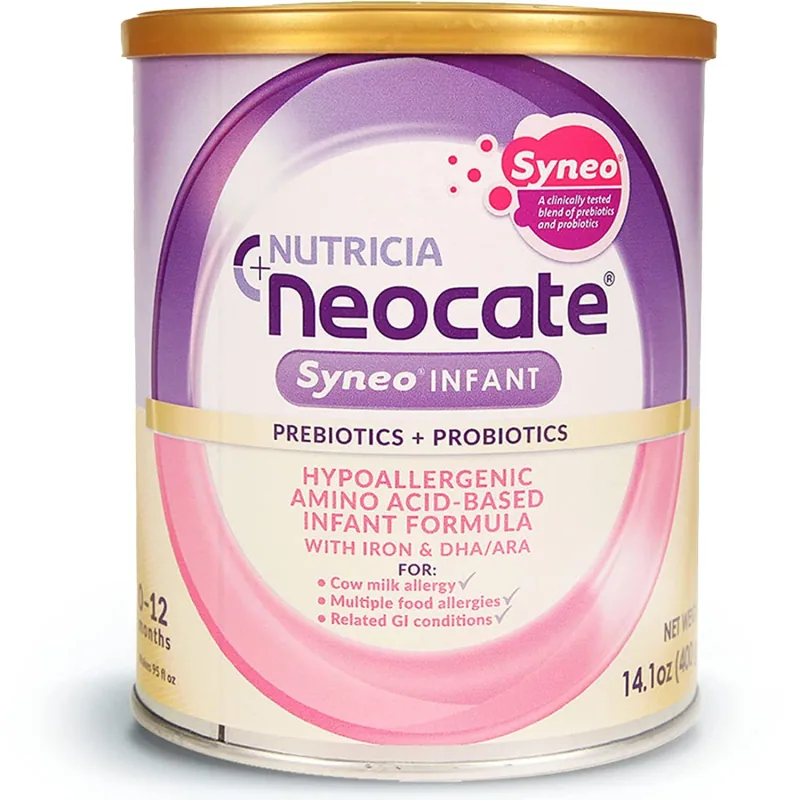
Neocate is not a consumer infant formula. It is a medical-specialty product used for infants with diagnosed conditions that make every other formula category, standard cow-milk, partially hydrolyzed, extensively hydrolyzed, soy, goat, clinically unsuitable. The amino-acid category (AAF) sits at the top of the CMPA hierarchy: when extensively hydrolyzed formulas (eHF) like Nutramigen, Alimentum, and Gerber Extensive HA fail to resolve symptoms, AAFs are the next step. Neocate, EleCare, and Puramino are the three products in this category; Neocate is the oldest (launched 1984) and most widely referenced in pediatric allergy literature.
Neocate is Nutricia's amino-acid-based formula for severe cow milk protein allergy, multiple food protein allergies, eosinophilic esophagitis and malabsorption. Unlike hydrolysed formulas it uses free amino acids rather than milk protein fragments at any size. FDA-registered under 21 CFR 107 and covered by most US insurance with medical necessity documentation. It needs specialist oversight.
Company snapshot
| Attribute | Value |
|---|---|
| Parent company | Nutricia (Danone subsidiary since 2007) |
| Founded | 1984 (original Neocate launch) |
| Corporate HQ | Amsterdam (Danone); Gaithersburg, MD (US operations) |
| Manufacturing | US, UK, Netherlands |
| Product category | Amino-acid-based infant formula (AAF) |
| FDA registered as infant formula | Yes (21 CFR 107) |
| Sold by Organic's Best Shop | No |
| Insurance coverage | Typically yes with medical necessity docs |
| Cost without insurance | Very high, $60-100+/can; multiple cans/week |
The CMPA hierarchy: where Neocate fits
Cow milk protein allergy affects approximately 2-3% of infants. The clinical response hierarchy under NASPGHAN/ESPGHAN guidelines progresses from least to most intervention:
- Partially hydrolyzed formula (pHF): HiPP HA, Gerber GentlePro, Enfamil Gentlease, Nestlé NAN HA. Not indicated for diagnosed CMPA.
- Extensively hydrolyzed formula (eHF): Nutramigen, Similac Alimentum, Gerber Extensive HA. First-line for diagnosed CMPA.
- Amino-acid-based formula (AAF), Neocate, EleCare, Puramino. Second-line; required when eHF fails to resolve symptoms (~10% of CMPA cases) or when multiple severe allergies are present.
For the full CMPA diagnostic and treatment framework, see cow milk protein allergy explained.
Clinically, the transition from eHF to AAF happens when:
- Symptoms persist after 2-4 weeks of eHF trial
- Infant has multiple food protein allergies
- Eosinophilic esophagitis is diagnosed (histologically confirmed)
- Severe anaphylactic risk requires zero protein fragment exposure
- Short gut syndrome or other severe malabsorption
What makes Neocate chemically different
Standard formulas and even extensively hydrolyzed formulas contain some residual protein fragments (peptides). In eHF, these are broken down to small sizes (typically below 1,500 Daltons), which the majority of CMPA-reactive infants tolerate. But for the most severe cases, even these small peptides can trigger reactions.
Neocate contains 100% free amino acids, no peptides, no protein fragments. This is the most hypoallergenic protein source commercially available. The trade-offs:
- Very poor taste, bitter, distinctive aminoacid flavor that many infants resist initially
- Expensive, manufacturing free amino acid-based formula costs significantly more than hydrolysate-based
- Still not sterile: AAF is a powder like other infant formulas; Cronobacter preparation rules still apply (see how to prepare baby formula safely)
Neocate product line
Neocate Syneo Infant (current US flagship)
Launched in the mid-2010s, Syneo adds a prebiotic synbiotic system, scGOS/lcFOS prebiotics plus Bifidobacterium breve M-16V probiotic. This mimics the prebiotic/probiotic environment of standard formulas that AAFs historically lacked. The clinical premise: AAF-fed infants may develop altered gut microbiota; the synbiotic system helps restore balance.
See the SKU record: Neocate Syneo Infant.
Neocate Infant DHA/ARA
Original Neocate formulation with DHA/ARA added. Still available in parallel with Syneo for families whose infants tolerated the original better or have specific reasons to avoid the prebiotic synbiotic additions.
Neocate Junior (12+ months)
Amino-acid formula for toddlers 12 and months with continued CMPA or related indications. Not regulated under 21 CFR 107 (toddler age range).
Neocate LCP (EU)
UK/EU market variant with long-chain polyunsaturates. Not directly comparable to US formulations.
Regulatory and insurance context
FDA 21 CFR 107 registration
Neocate Syneo Infant and Neocate Infant DHA/ARA are FDA-registered under 21 CFR 107 as infant formula. This means full nutritional compliance for the 0-12 month age range when used as sole nutrition. For the full regulatory framework, see FDA infant formula regulation.
Insurance coverage
Neocate is typically covered by US private insurance and Medicaid/CHIP with:
- Diagnosis of CMPA or qualifying medical condition from a pediatrician, allergist, or pediatric gastroenterologist
- Letter of medical necessity submitted to insurer
- Documented failure of eHF trial (for CMPA indication)
Coverage is generally under pharmacy benefit or DME (durable medical equipment) rather than food. WIC coverage for AAFs varies by state and is typically contingent on medical prescription.
Out-of-pocket cost
Without insurance, Neocate is very expensive:
- $60-100+ per 400g can
- A young infant may consume 2-3 cans per week
- Annual out-of-pocket cost without coverage: $8,000-15,000+
This cost is a significant barrier and is a frequent reason families struggle to access appropriate care for severe CMPA even after diagnosis.
How Neocate compares to other AAFs
The three amino-acid-based infant formulas in the US market:
| Feature | Neocate Syneo | EleCare (Abbott) | Puramino (Reckitt) |
|---|---|---|---|
| Parent company | Nutricia/Danone | Abbott | Reckitt (Mead Johnson) |
| Launch year | 1984 | 2003 | 2014 |
| Prebiotic synbiotic | Yes (scGOS/lcFOS and B. breve M-16V) | No | Yes (PDX and GOS) |
| Distinctive feature | Longest market presence, most clinical literature | Manufactured at Sturgis, MI (affected by 2022 recall) | Newer entrant; parent company owns Nutramigen |
| FDA 21 CFR 107 | Yes | Yes | Yes |
| Typical insurance coverage | Yes with letter | Yes with letter | Yes with letter |
See the EleCare brand hub for the full EleCare profile including its specific history during and after the Abbott 2022 recall.
Practical notes for parents
Introducing Neocate
Pediatric gastroenterologists typically supervise the transition. Key practical points:
- Taste adaptation, free amino acids taste quite different from standard or hydrolyzed formulas. Many infants resist the first feeds; persistence over 3-7 days typically leads to acceptance.
- Preparation, standard Cronobacter-prevention practices apply. 70°C water reconstitution per WHO/CDC/FDA guidance; see how to prepare baby formula safely.
- Stool changes, formula-fed infant stool patterns apply; amino-acid formulas can produce slightly different stool color and consistency than eHF.
- Growth monitoring, infants on AAF should be monitored closely for weight, length, and developmental milestones; pediatrician follow-up every 2-4 weeks initially is typical.
How long on Neocate
CMPA resolution timelines vary:
- Approximately 75-80% of infants outgrow CMPA by age 3
- Approximately 90% by age 5
- Some CMPA persists into older childhood and adulthood
Pediatric allergist guidance on when to attempt stepping down from AAF to eHF, and eventually to standard formula, is individualized based on milk challenge testing outcomes.
Editorial notes from María
Neocate is not something parents typically choose, it is prescribed in response to a specific medical situation. The brand's role in the US infant formula landscape is to exist for the subset of families with the most severe CMPA or other allergic conditions. The cost, the taste challenges, and the supervision required mean this is not a product parents casually evaluate.
The Atlas includes Neocate as a reference hub because:
- Parents navigating CMPA diagnosis need to understand the hierarchy from pHF → eHF → AAF
- Many families encounter Neocate through pediatric specialists without prior context
- The amino-acid formula category has meaningful differences between the three available products (Neocate, EleCare, Puramino) that parents and prescribing clinicians should be aware of
For the full CMPA navigation guide, see our cow milk protein allergy explained pillar. For related specialty brand profiles, see Nutramigen, Alimentum, and EleCare.
Neocate is not sold by Organic's Best Shop. This hub exists for Atlas completeness and to serve parents navigating severe allergy diagnoses who need a reference resource that is neither the manufacturer site nor a generic allergy blog.
Frequently asked questions
The questions below come up most often when families navigate Neocate after a CMPA, FPIES, EoE, or other clinical indication. Answers reference the FDA 21 CFR 107.30 framework for exempt infant formula and the AAP/NASPGHAN clinical guidance on amino-acid formulas.
What's the difference between Neocate and Neocate Syneo?
Is Neocate available without a prescription?
When does pediatric care escalate from Nutramigen to Neocate?
Will my insurance cover Neocate?
How does Neocate compare to EleCare and PurAmino?
Does Neocate taste different from regular formula?
Can I prepare Neocate the same way as standard formula?
Primary sources
- Neocate / Nutricia (Danone): Product information, clinical use guidance. neocate.com
- FDA: Infant Formula Guidance Documents and Regulatory Information. 21 CFR 107. fda.gov
- NASPGHAN: Clinical guidelines on diagnosis and management of cow's milk protein allergy in infants. naspghan.org
- AAP: Clinical Report on prevention and management of food allergy. Pediatrics. aap.org
- EAACI: European Academy of Allergy and Clinical Immunology guidelines on food allergy and anaphylaxis. eaaci.org
Related reading
This site provides research and comparisons, not medical advice. Consult your pediatrician before changing your baby's formula.