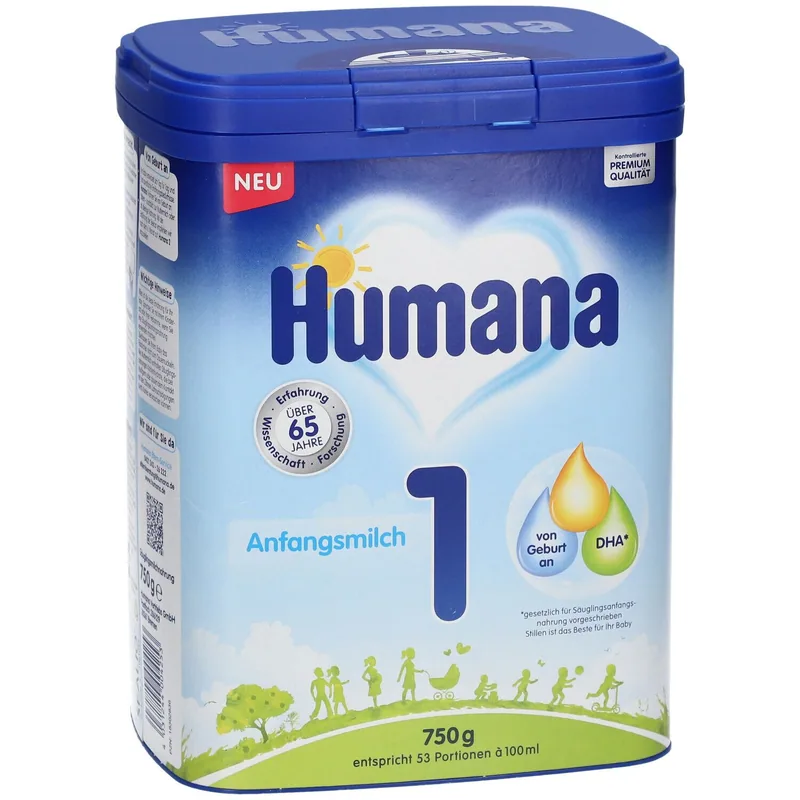
Humana is one of the few major German infant formula brands that remains independently German-owned, operating as a dairy cooperative headquartered in North Rhine-Westphalia. Founded in 1958, the brand has a meaningful share of the German infant formula retail market alongside the Danone-owned Milupa (Aptamil German variants) and the Nestlé-owned SMA. Humana is not FDA-registered and has minimal US presence. This reference guide documents the brand for German expat families in the US and for reference completeness of the German market.
Humana is an independent German infant formula brand founded in 1958 and run as a dairy cooperative in Herford, North Rhine-Westphalia. The line covers Humana 1 and 2, an HA partially hydrolysed variant and an anti-reflux one. It is EU 2016/127 compliant, not FDA-registered, and sold through German pharmacy and retail channels.
Company snapshot
| Attribute | Value |
|---|---|
| Parent company | Humana GmbH (independent dairy cooperative) |
| Founded | 1958 |
| Corporate HQ | Herford, North Rhine-Westphalia, Germany |
| Manufacturing | Germany |
| Product category | Full range (standard, HA, AR) |
| Organic status | No (non-organic positioning) |
| FDA registered | No |
| Sold by Organic's Best Shop | No |
| US retail presence | None |
The German market context
Germany has one of the most competitive infant formula markets in Europe with multiple distinct brand families:
| Brand | Parent | Positioning |
|---|---|---|
| HiPP | HiPP GmbH | Organic leader, Combiotik |
| Holle | Holle baby food AG | Demeter organic leader |
| Milupa | Danone | Mass-market brand and Aptamil mfg |
| Aptamil Germany (via Milupa) | Danone | Premium mass-market |
| SMA (Germany via EU) | Nestlé | Alternative mass-market |
| Humana | Independent German | Non-organic mass-market alternative |
| Lebenswert | Holle-owned | Bioland organic value |
| Löwenzahn | Löwenzahn GmbH | EU Organic, fish-oil-free |
| Töpfer | Topfer GmbH | Demeter organic value |
| Bebivita | Hipp Group | Non-organic value |
Humana's distinctive market position: non-organic, independent German-owned (not part of Danone/Nestlé multinational networks), pharmacy-channel-prominent.
Why Humana matters
For parents, Humana is a reference point rather than a practical choice. The Atlas documents it because:
1. German expat family continuity
German families who formula-fed on Humana in Germany may seek information about the brand after US relocation. Humana is not US-imported via mainstream channels, so transition to US alternatives is the typical path.
2. Independent German market representation
Most documented German brands in the Atlas are either organic (HiPP, Holle, Lebenswert, Löwenzahn, Töpfer) or multinational-owned (Milupa- Danone, SMA-Nestlé). Humana represents the independent non-organic German tier that has minimal international presence but real domestic market share.
3. Reference framework
Understanding Humana helps contextualize German infant formula market structure, the complete landscape includes organic and non-organic, multinational and independent, all operating under the same EU Regulation 2016/127 framework.
Humana product line
Humana 1 Anfangsmilch (Stage 1)
Standard 0-6 month German infant formula. Cow-milk-based, lactose- primary per EU 2016/127, vegetable oil blend.
See the SKU record: Humana Stage 1.
Humana 2 Folgemilch (Stage 2)
6+ month follow-on formula.
Humana HA (Hypoallergenic)
Partially hydrolyzed whey variant. Positioned for atopic-risk families. Like other HA formulas, NOT indicated for diagnosed CMPA, that requires extensively hydrolyzed or amino-acid formulas. See our CMPA explained pillar.
Humana Anti-Reflux (AR)
Thickened variant for regurgitation management. Framework: reflux and GERD in formula-fed babies.
Regulatory status
EU compliance
Humana complies with EU Regulation 2016/127. See our EU infant formula regulation pillar.
US status
Not FDA-registered. Not imported via Organic's Best Shop or similar mainstream channels. German expat families may self-import via German online retailers; this is operationally complex and costly.
How Humana compares
Against German organic brands
Humana is non-organic while HiPP, Holle, Lebenswert, Löwenzahn, and Töpfer are organic-certified. For parents valuing organic certification, the organic brands are preferred; for parents prioritizing price and conventional dairy, Humana may be a more affordable domestic German option.
Against German mass-market competitors
- Milupa Milumil: Danone mass-market, similar non-organic positioning but multinational ownership
- SMA (Germany): Nestlé mass-market, similar non-organic positioning
- Humana, independent German, comparable quality, similar regulatory compliance, smaller market share than the two multinational competitors
Structural profile
Humana's formulations follow standard German/EU mass-market conventions, lactose primary, vegetable oil blend with palm oil, fish-oil DHA, GOS prebiotic in some variants. No distinctive formulation features vs other German mass-market brands.
Editorial notes from María
Humana is a brand most parents will never directly interact with. The Atlas documents it primarily for:
- German expat family reference
- Completing the German market brand landscape documentation
- Supporting cross-jurisdictional context for parents researching international brand ownership
For practical US-family actionability, Humana offers nothing that the US-accessible German organic imports (HiPP, Holle, Lebenswert, Löwenzahn) or US-made alternatives don't already provide. The independent German dairy cooperative heritage is cultural context; it doesn't translate to meaningful US purchasing advantage.
Humana is not sold by Organic's Best Shop. This hub exists for Atlas completeness to document the independent German mass-market tier.
For related profiles:
- HiPP: German organic leader (US-accessible)
- Holle: German Demeter organic (US-accessible)
- Milupa: German Danone mass-market parallel
- Bebivita: German value brand (HiPP group)
- Töpfer: German organic independent
Frequently asked questions
Can I buy Humana in the US?
Is Humana related to the US health insurer Humana Inc?
What is Humana HA?
Is Humana organic?
How does Humana compare to Milupa or HiPP?
Why are German cooperatives prominent in infant formula?
Primary sources
- Humana GmbH: Official German corporate and product information. humana.de
- EU Regulation 2016/127: Infant formula compositional requirements. eur-lex.europa.eu
- FDA: Infant formula regulation (US import framework). fda.gov
- WHO: International Code of Marketing of Breast-milk Substitutes (EU implementation). who.int
- AAP / PubMed, peer-reviewed literature on German/EU vs US infant formula comparative research. pubmed.ncbi.nlm.nih.gov
This site provides research and comparisons, not medical advice. Consult your pediatrician before changing your baby's formula.